
In modern industrial, construction, and maintenance operations, lifting platforms have become essential equipment for safe and efficient work at height, where stability, reliability, and operational safety directly determine productivity and risk control. As working environments become more demanding and safety standards continue to rise, the performance of supporting components has gained increasing attention, and among them, lifting platform tires play a foundational role in ensuring smooth mobility, secure positioning, and consistent load support.
Solid tires for lifting platforms have emerged as the preferred solution because they provide superior stability, enhanced safety performance, and long-term durability in both indoor and outdoor aerial work applications.
The Critical Role of Tires in Lifting Platform Operations
Lifting platforms are widely used in construction sites, warehouses, manufacturing facilities, and equipment maintenance projects, where they are required not only to move across working areas but also to remain stable during vertical lifting operations. Unlike standard vehicles, these machines operate under unique conditions where even minor instability can lead to significant safety risks.
Tires in lifting platforms are responsible for supporting both dynamic movement and static load conditions, which means they must perform consistently during travel, positioning, and lifting phases. In environments where uneven surfaces, heavy equipment loads, and continuous usage are common, tire reliability becomes a key factor in ensuring operational safety and efficiency.
What Are Solid Tires for Lifting Platforms and How They Function
Solid tires for lifting platforms are non-pneumatic rubber tires manufactured through high-pressure molding and vulcanization processes, which eliminate the need for internal air pressure and instead rely entirely on dense rubber structure for load support and stability. Unlike pneumatic tires, which depend on air inflation to maintain shape and performance, solid tires maintain consistent geometry and load-bearing capacity throughout their entire service life.
These tires are typically engineered with multi-layer structures where each layer serves a specific function, including outer-layer wear resistance, middle-layer shock absorption, and inner-core load support, which together create a balanced performance profile suitable for aerial work equipment operating under variable and demanding conditions.
Why Solid Tires Improve Stability in Aerial Work Applications
Stability is one of the most critical performance requirements for lifting platforms because any movement instability during elevation can directly impact operator safety and work precision, and solid tires provide a structural advantage that significantly enhances stability in both static and dynamic conditions.
● They maintain consistent shape under heavy load conditions, ensuring that the lifting platform remains level during operation
● They provide a stable and uniform ground contact surface, reducing the risk of tilting or uneven lifting behavior
● They minimize deformation during prolonged static load support, which is essential during extended elevated work sessions
● They ensure predictable handling performance during movement, improving positioning accuracy in confined workspaces
These characteristics make solid tires particularly suitable for applications where precision and stability are more important than speed or cushioning.
Enhancing Safety in High-Altitude Working Environments
Safety is the highest priority in aerial work operations, especially in construction and industrial maintenance environments where workers are frequently exposed to elevated positions, and tire performance plays a direct role in reducing operational risks associated with instability or sudden equipment failure.
● They eliminate the risk of sudden blowouts or air leakage, which can cause unexpected platform instability
● They provide continuous load support without pressure fluctuation, ensuring stable lifting conditions at all times
● They reduce lateral movement during elevation, improving operator safety and reducing accident risk
● They enhance machine predictability, allowing operators to maintain better control in complex working environments
By removing air-dependent failure risks, solid tires significantly improve the safety reliability of lifting platforms.
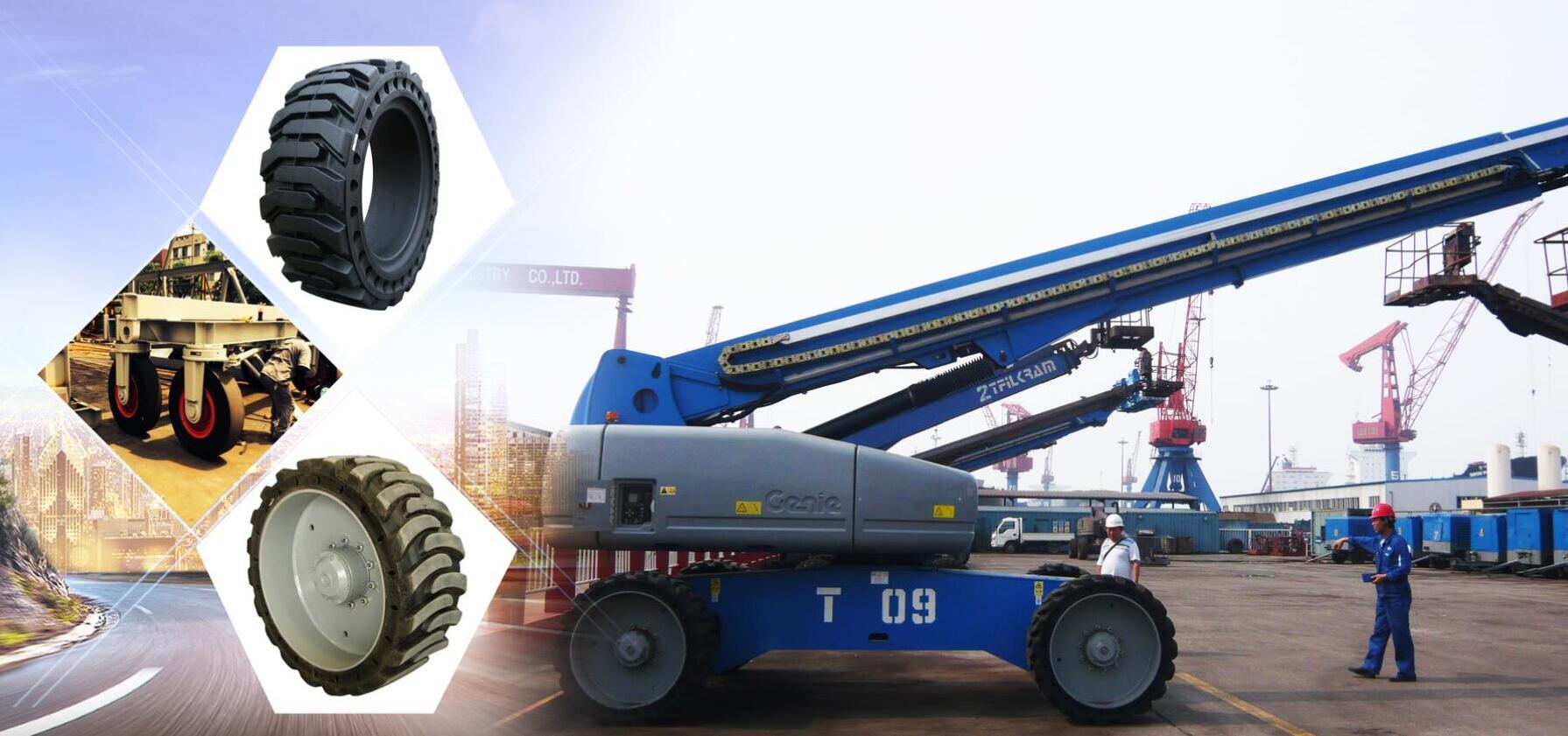
Improving Operational Efficiency in Industrial and Construction Use
Efficiency in aerial work operations depends not only on lifting speed but also on setup time, positioning accuracy, and equipment reliability, and solid tires contribute directly to operational efficiency by reducing maintenance interruptions and improving machine availability.
● They reduce downtime caused by tire punctures or air pressure maintenance requirements
● They enable continuous multi-shift operation without frequent service interruptions
● They improve positioning efficiency by maintaining stable rolling behavior during movement
● They reduce inspection frequency related to tire condition monitoring
This improved efficiency allows construction and industrial teams to complete tasks faster while maintaining consistent safety standards.
Long-Term Cost Advantages of Solid Tires
Although solid tires typically involve a higher initial investment compared to pneumatic alternatives, their long-term economic value becomes significantly more favorable when evaluated across full equipment lifecycle costs, particularly in high-intensity usage environments.
● They reduce maintenance costs by eliminating inflation, repair, and pressure monitoring requirements
● They extend operational lifespan due to high wear resistance in industrial flooring and construction surfaces
● They reduce downtime-related financial losses by minimizing unexpected tire failures
● They simplify fleet maintenance management, reducing administrative and labor costs
Over time, these benefits contribute to lower total cost of ownership and improved return on equipment investment.
Adaptability Across Industrial and Construction Environments
Lifting platforms are used in a wide range of working environments, each presenting different challenges in terms of surface conditions, load requirements, and operational intensity, and solid tires demonstrate strong adaptability across these diverse applications.
● In indoor industrial facilities, they provide clean and stable performance on smooth flooring surfaces
● In warehouse environments, they support frequent movement and repetitive lifting operations with high reliability
● In construction sites, they withstand rough terrain, debris, and uneven ground conditions
● In maintenance and installation projects, they ensure stable positioning during precision work at height
This versatility makes them suitable for both controlled indoor environments and harsh outdoor conditions.
Key Considerations When Selecting Solid Tires for Lifting Platforms
Choosing the correct solid tire requires careful evaluation of operational conditions and equipment specifications, as improper selection can affect both performance and safety outcomes in aerial work applications.
● Load capacity matching ensures that the tire can safely support maximum platform weight under all working conditions
● Surface condition compatibility determines required levels of wear resistance and traction performance
● Usage intensity influences selection between standard-duty and heavy-duty tire designs
● Environmental factors such as temperature variation, chemical exposure, and debris presence affect material selection
A proper selection process ensures optimal performance, longer service life, and improved operational safety.
Future Trends in Solid Tire Technology for Aerial Work Equipment
As aerial work platforms continue to evolve toward higher efficiency, automation, and improved safety standards, solid tire technology is also advancing to meet emerging industry demands, with ongoing innovation focused on performance optimization and operational efficiency.
● Advanced rubber compounds are being developed to improve wear resistance and reduce energy consumption
● Structural improvements are enhancing shock absorption to improve operator comfort during movement
● Low rolling resistance designs are being introduced to support energy-efficient electric lifting platforms
● Application-specific customization is becoming more common for different industrial and construction use cases
These developments are expected to further strengthen the role of solid tires in modern aerial work equipment systems.
Conclusion
Solid tires for lifting platforms have become a critical component in ensuring stability, safety, and long-term operational performance in industrial and construction applications, as they eliminate the risks associated with pneumatic systems while delivering consistent load support and reliable handling characteristics under demanding conditions. By improving safety margins, reducing downtime, and lowering long-term maintenance costs, solid tires provide a comprehensive solution for businesses seeking dependable aerial work equipment performance in both indoor and outdoor environments.
FAQ
1. Why are solid tires preferred for lifting platforms?
Because they provide stable load support, eliminate air-related failures, and improve overall operational safety in aerial work conditions.
2. Can solid tires be used in both indoor and outdoor environments?
Yes, they are suitable for both environments, with specific designs available for smooth indoor floors and rough outdoor surfaces.
3. Do solid tires improve safety in aerial work operations?
Yes, they significantly reduce risks such as blowouts, instability, and sudden loss of control during lifting operations.
4. Are solid tires cost-effective in the long term?
Yes, despite higher initial cost, they reduce maintenance, downtime, and replacement frequency, leading to lower total cost of ownership.
Post time: 13-04-2026