
Mold-on solid tires are designed for industrial equipment that requires strong tire-rim integration, stable load support, and dependable performance in demanding environments. For machines working in underground mining, conveyor systems, passenger boarding bridges, construction support, and special industrial applications, tire reliability can directly affect equipment uptime and operating safety.
WonRay mold-on solid tires provide a durable solution for B2B users who need puncture-free performance, reduced maintenance, and long service life under low-speed and heavy-load working conditions.
What Are Mold-On Solid Tire?
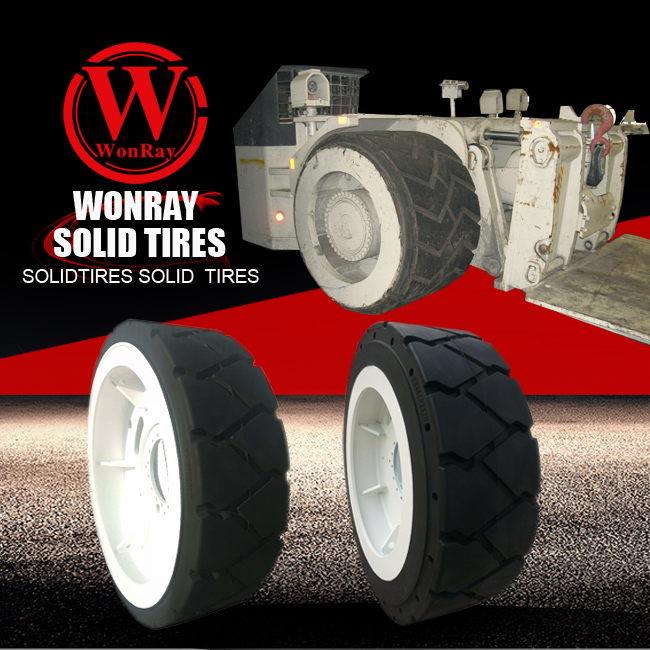
Mold-on solid tires, also known as cured-on solid tires, are produced by bonding rubber directly onto the wheel rim during the manufacturing process. Unlike tires that can be separated from the rim after installation, mold-on tires form an integrated tire and wheel structure.
This integrated design is useful for equipment that needs strong rim adherence and stable tire performance during repeated movement, loading, braking, and turning. Since the tire and rim are firmly combined, mold-on solid tires can help reduce issues related to tire slippage, loose fitting, or unstable mounting under demanding work conditions.
For industrial users, this structure brings a practical advantage: the tire is ready for reliable service as a complete wheel assembly. It can be especially valuable for equipment where tire replacement complexity, downtime, and safety requirements are important concerns.
Why Mold-On Solid Tires Are Used in Industrial Applications
Many industrial machines do not work like ordinary road vehicles. They may travel slowly, carry heavy loads, move in confined areas, or operate on surfaces where puncture risk is high. In these situations, pneumatic tires may create problems because they depend on air pressure and are more vulnerable to punctures, leaks, and sudden flats.
Mold-on solid tires solve these issues by using a solid rubber structure. There is no air chamber, so the tire cannot lose air due to punctures. This makes the product suitable for environments with sharp debris, rough surfaces, metal scraps, stones, or industrial waste.
WonRay mold-on solid tires are designed for B2B customers who need tire products that can support continuous industrial work without frequent maintenance interruptions. Their solid construction helps equipment remain productive in environments where tire damage would otherwise be common.
Key Advantages of WonRay Mold-On Solid Tires
WonRay mold-on solid tires focus on durability, stability, and reduced maintenance. Their design supports special industrial equipment that requires dependable tire performance in difficult operating conditions.
● Integrated tire and rim structure helps improve mounting stability during heavy-duty work.
● Puncture-free solid rubber construction reduces flats caused by sharp objects and harsh ground conditions.
● Heavy-load support helps equipment carry operators, materials, components, or machinery weight more steadily.
● Durable rubber compound improves resistance to wear, cutting, tearing, and surface damage.
● Low maintenance performance reduces the need for air pressure checks, puncture repairs, and emergency service.
● Stable operation supports equipment working in confined, underground, or high-frequency industrial areas.
● Lower downtime helps industrial users maintain production, transport, and maintenance schedules.
● Custom sizes and wheel assembly options can support different equipment and project requirements.
These advantages make mold-on solid tires a practical product category for machines that need more than ordinary tire performance.
Common Applications for Mold-On Solid Tires
Mold-on solid tires are widely used in special industrial equipment where tire-rim stability is important. One common application is underground mining equipment. In underground sites, machines may operate in narrow tunnels, rough surfaces, wet conditions, and areas where tire service is difficult. A puncture-free tire helps reduce maintenance pressure and keeps equipment available for critical tasks.
Passenger boarding bridges are another important application. These systems require stable and controlled movement at airports. Tire reliability matters because equipment must operate safely around aircraft and passenger areas. Mold-on solid tires can provide smooth, stable, and low-maintenance performance for this type of controlled movement.
Conveyor systems and industrial transport equipment may also use mold-on tires where repeated movement and stable wheel performance are needed. In construction vehicles and special-purpose machines, these tires can support heavy-duty use under low-speed conditions.
Supporting Underground and Confined-Space Operations
Underground and confined-space operations create special challenges for tires. There may be limited access for repair teams, difficult ventilation, narrow movement areas, and rough ground. If a tire fails, equipment may be difficult to move or service quickly.
WonRay mold-on solid tires help reduce this risk by eliminating air-related failure. Since they are solid, they do not require inflation and cannot become flat from punctures. Their integrated tire-rim structure also supports stable performance in areas where wheel reliability is critical.
For mining, tunneling, underground construction, and industrial maintenance applications, this reliability can be highly valuable. Reduced tire maintenance allows operators and service teams to focus on core work rather than emergency tire problems.
Why Tire-Rim Integration Matters
In heavy-duty applications, tire fitting stability is not a small detail. Machines may carry heavy loads, stop frequently, turn under pressure, or operate with repeated directional changes. If the tire does not remain securely attached to the rim, performance and safety can be affected.
Mold-on tires are designed to solve this by integrating rubber and rim into one structure. This helps improve wheel stability and reduces the risk of separation under suitable working conditions. For equipment owners, this means a more reliable wheel assembly with fewer fitting-related concerns.
WonRay mold-on solid tires are especially useful where equipment design requires compact, stable, and durable tire assemblies. This makes them suitable for both OEM equipment and replacement needs in industrial sectors.
Reducing Maintenance and Downtime
For B2B users, tire downtime is not just a maintenance inconvenience. It can delay operations, reduce equipment utilization, and create additional labor costs. In applications such as mining, airport ground systems, and industrial transport, downtime may affect a wider workflow.
WonRay mold-on solid tires help reduce this problem through puncture-free construction and low maintenance performance. Operators do not need to check air pressure, repair punctures, or manage sudden flats. Regular visual inspection is still necessary, but the overall tire service burden is lower than pneumatic alternatives in harsh environments.
This makes mold-on solid tires a strong option for businesses that prioritize stable operation and predictable equipment availability.
Summary
WonRay mold-on solid tires are built for industrial equipment that requires strong tire-rim integration, puncture-free reliability, heavy-load stability, and reduced maintenance. Their integrated wheel structure makes them suitable for underground mining equipment, passenger boarding bridges, conveyor systems, construction support machines, and other special industrial vehicles.
For B2B customers, the key value is dependable operation in demanding environments. By reducing tire-related downtime and improving wheel stability, WonRay mold-on solid tires help industrial equipment work longer, safer, and more efficiently.
FAQ
1、What are mold-on solid tires?
Mold-on solid tires are solid rubber tires bonded directly to the wheel rim during production, forming an integrated tire and rim assembly.
2、Are mold-on solid tires puncture-free?
Yes. They do not contain air, so they cannot go flat because of punctures or air leakage.
3、Where are WonRay mold-on solid tires used?
They are used in underground mining equipment, passenger boarding bridges, conveyor systems, construction vehicles, and special industrial machines.
4、Why choose mold-on tires instead of pneumatic tires?
Mold-on tires provide puncture-free performance, strong tire-rim stability, low maintenance, and reliable operation in low-speed heavy-duty environments.
Post time: 14-05-2026