
Forklift performance depends on far more than lifting capacity and battery efficiency. In warehouses, factories, logistics centers, and industrial production facilities, tire reliability plays a major role in determining equipment uptime, maintenance costs, operator safety, and overall operational efficiency. For businesses operating forklifts continuously across multiple shifts, tire failures can quickly become an expensive operational problem. This is one of the main reasons why more companies are switching to press on solid tires.
Unlike pneumatic forklift tires that rely on internal air pressure, press on solid tires use a dense rubber structure bonded to a steel ring. This design provides exceptional durability, stable load handling, and reduced maintenance requirements, making them highly suitable for indoor industrial operations.
As global supply chains become faster and warehouse automation continues to grow, reliable forklift tire systems are becoming increasingly important. Press on solid tires are now widely recognized as one of the most practical long-term solutions for modern material handling equipment.
The challenges facing forklift tires in industrial environments
Industrial forklifts often operate under conditions that place enormous stress on tire systems.
Common operational challenges include:
● Continuous heavy-load transportation
● Sharp turning in narrow warehouse aisles
● Long daily operating hours
● Rough concrete floor surfaces
● Frequent start-stop movement cycles
Traditional tire systems may struggle to maintain stable performance under these conditions, especially when equipment is used intensively.
For forklift fleets operating around the clock, even a single tire failure can disrupt workflow and reduce productivity.
How press on solid tires solve common forklift problems
Press on solid tires are specifically designed to address the weaknesses of pneumatic tire systems in indoor industrial environments.
No air means no punctures
One of the biggest advantages of press on solid tires is their puncture-proof structure.
Because they contain no air:
● There is no risk of flats
● Tire pressure checks are unnecessary
● Blowouts are eliminated
● Unexpected tire-related downtime is reduced
This is especially valuable in warehouses and manufacturing plants where damaged pallets, metal fragments, or debris may be present.
Better stability for heavy lifting operations
Forklifts regularly transport heavy pallets, industrial materials, and stacked products.
Press on solid tires maintain consistent structural support under these loads, helping improve:
● Forklift balance
● Steering stability
● Load positioning accuracy
● Operator confidence during lifting
Stable tire performance becomes increasingly important in high-density warehouse environments.
Lower long-term maintenance costs
Maintaining large forklift fleets can become expensive when pneumatic tires require constant inspection and repair.
Press on solid tires help reduce:
● Tire maintenance labor
● Emergency service interruptions
● Tire replacement frequency
● Equipment downtime costs
For many businesses, these savings become significant over long operating periods.
Why warehouses prefer press on solid tires
Modern warehouses demand fast, continuous, and highly organized operations.
Forklifts inside warehouses must navigate:
● Narrow aisles
● Smooth indoor flooring
● High shelving systems
● Continuous loading and unloading cycles
Press on solid tires perform particularly well in these environments because they provide:
● Stable turning performance
● Low rolling resistance on smooth surfaces
● Reliable maneuverability
● Reduced tire movement under load
Their stable structure supports safer and more efficient indoor material handling.
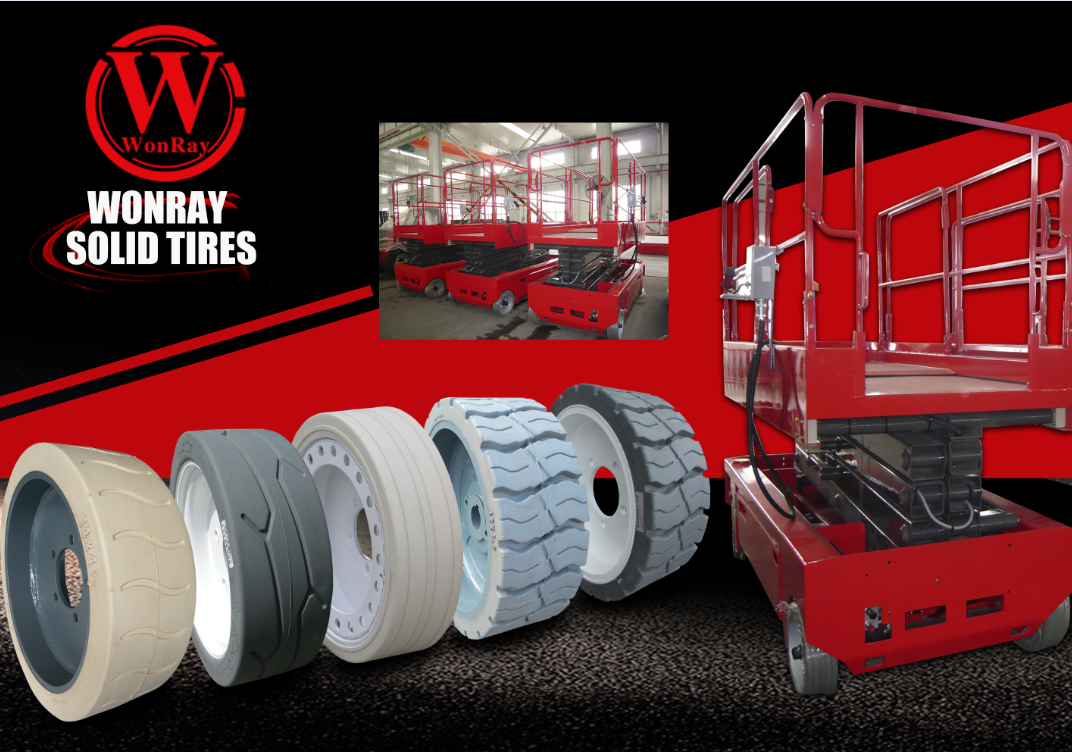
Press on solid tires and electric forklifts
Electric forklifts are increasingly replacing internal combustion forklifts in warehouses and indoor industrial facilities.
Press on solid tires are highly compatible with electric forklift systems because they help improve:
● Energy efficiency
● Stable indoor operation
● Equipment handling precision
● Reduced maintenance downtime
Low rolling resistance tire designs can also help extend battery operating time in certain applications.
The importance of tire durability in multi-shift operations
Many industrial facilities now operate continuously across two or three shifts.
In these high-usage environments, tire durability becomes critical.
Frequent tire replacements can create:
● Production delays
● Higher labor costs
● Maintenance scheduling difficulties
● Reduced equipment availability
Press on solid tires are engineered to handle long-duty-cycle operations while maintaining consistent performance over extended periods.
Non-marking press on solid tires for sensitive industries
Certain industries require tires that will not leave black residue or floor marks.
Non-marking press on solid tires are commonly used in:
● Food processing plants
● Pharmaceutical facilities
● Electronics manufacturing
● Beverage production
● Clean warehouse environments
These specialized tire compounds help maintain cleaner floors while reducing contamination risks.
Comparing press on solid tires with pneumatic forklift tires
Both tire types have advantages, but for many indoor industrial applications, press on solid tires offer greater operational reliability.
Pneumatic forklift tires
Advantages:
● Softer ride quality
● Better performance on uneven outdoor terrain
Limitations:
● Vulnerable to punctures
● Require pressure monitoring
● Higher maintenance demands
Press on solid tires
Advantages:
● Puncture-proof operation
● Longer service life
● Lower maintenance costs
● Stable indoor handling performance
Limitations:
● Less cushioning on rough outdoor terrain
Because of these advantages, many businesses use press on solid tires for indoor fleets while reserving pneumatic tires for outdoor applications.
Key factors when choosing press on solid tires
Selecting the correct tire specification is important for maximizing performance and lifespan.
Load capacity
The tire must support the forklift’s operating weight and lifting requirements.
Floor conditions
Smooth warehouse floors may require different tread compounds than mixed industrial environments.
Operating hours
High-intensity operations often require premium wear-resistant compounds.
Non-marking requirements
Certain facilities require clean, non-marking tire systems.
Equipment compatibility
Proper steel band sizing and wheel fitment are essential for safe installation.
How modern technology is improving press on solid tires
Industrial tire technology continues evolving to meet changing logistics demands.
Manufacturers are developing:
● Heat-resistant rubber materials
● Reduced vibration designs
● Longer-life tread compounds
● Lower rolling resistance structures
● Environmentally friendly production methods
These innovations help improve both operational performance and sustainability.
Why more companies are standardizing solid tire systems
Large warehouse operators and logistics companies increasingly prefer standardized tire systems because they simplify fleet management.
Benefits include:
● Easier maintenance scheduling
● Reduced spare parts complexity
● More predictable operating costs
● Improved fleet reliability
For businesses managing large forklift fleets, standardizing press on solid tires can significantly improve operational efficiency.
Conclusion
Press on solid tires are becoming an increasingly important solution for modern forklift operations. Their puncture-proof structure, stable load support, and low maintenance requirements make them ideal for warehouses, manufacturing facilities, logistics centers, and indoor industrial environments.
As businesses continue prioritizing uptime, safety, and operational efficiency, demand for high-quality press on solid tires will continue to grow. For forklift fleets operating in demanding indoor environments, upgrading to durable press on solid tires is a practical investment that supports long-term productivity and cost control.
FAQ
1. What are press on solid tires mainly used for?
They are mainly used on forklifts and indoor material handling equipment operating on smooth industrial floors.
2. Why do warehouses prefer press on solid tires?
Because they offer stable handling, lower maintenance, and puncture-proof performance.
3. Are non-marking press on solid tires available?
Yes, non-marking versions are widely used in food, pharmaceutical, and clean warehouse environments.
4. Do press on solid tires last longer than pneumatic tires?
In many indoor industrial applications, they typically provide a longer service life and lower maintenance requirements.
Post time: 09-05-2026