
In modern industrial material handling and heavy-duty logistics environments, forklifts are essential equipment for maintaining efficient workflows, ensuring fast goods movement, and supporting continuous production operations. As industries become more demanding in terms of productivity and safety standards, the importance of reliable forklift components has significantly increased. Among all key components, forklift tires play a critical role in determining operational stability, safety performance, and long-term cost efficiency.
Forklift solid tires have become the preferred solution for heavy-duty applications because they provide superior durability, consistent performance, and excellent reliability under extreme working conditions.
The Importance of Tire Performance in Industrial Forklift Operations
Forklifts are widely used in manufacturing plants, warehouses, ports, construction supply chains, and distribution centers, where they are required to handle heavy loads and operate continuously for long hours. In these environments, tire performance directly affects load stability, traction control, and operational efficiency, making it a fundamental factor in equipment reliability.
Industrial operations often involve uneven surfaces, frequent directional changes, and high load stress, which place continuous pressure on forklift tires. Any instability or failure in tire performance can lead to productivity loss, increased downtime, and higher maintenance costs, which is why tire selection is a strategic decision in heavy-duty applications.
What Are Forklift Solid Tires and How Do They Work
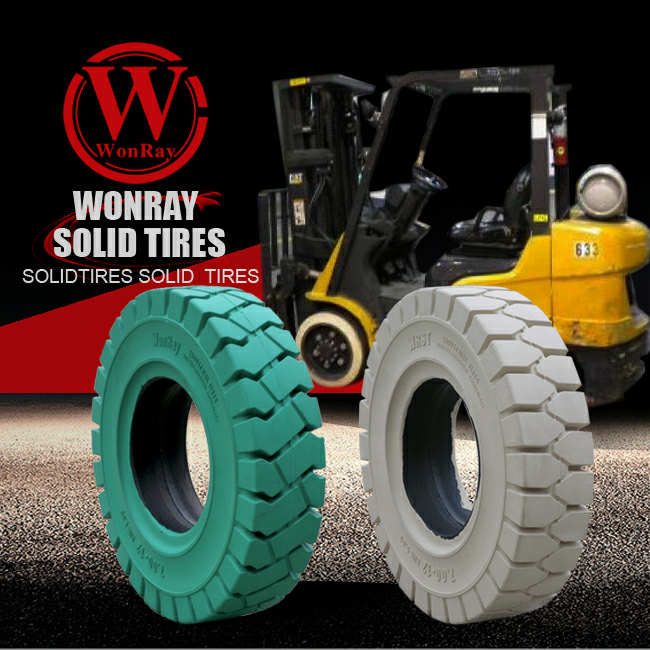
Forklift solid tires are non-pneumatic tires manufactured using high-density rubber compounds and engineered structural layers that eliminate the need for internal air pressure. Unlike pneumatic tires, which depend on inflation to maintain shape and load capacity, solid tires rely entirely on their molded rubber structure to provide support and stability.
These tires are typically designed with multi-layer construction, where each layer serves a specific function such as wear resistance, shock absorption, and load-bearing support. This engineering approach allows solid tires to maintain consistent performance even under extreme pressure, heavy loads, and continuous usage conditions.
Why Forklift Solid Tires Are Ideal for Heavy-Duty Applications
Forklift solid tires are widely recognized as the most reliable option for heavy-duty industrial applications due to their structural strength and operational stability. Their advantages become especially significant in environments where downtime and equipment failure are not acceptable.
● They eliminate the risk of punctures and air leakage, ensuring uninterrupted forklift operation in environments with sharp debris, metal fragments, and rough surfaces
● They maintain consistent structural integrity under heavy loads, preventing deformation during lifting, transport, and stacking operations
● They provide stable ground contact in all working conditions, improving traction control and reducing operational risks
● They are designed for continuous operation across multiple shifts, making them suitable for high-intensity industrial workflows
These advantages make solid tires particularly valuable in industries where reliability and uptime are critical performance indicators.
Enhancing Operational Efficiency in Material Handling Systems
Operational efficiency in industrial logistics depends heavily on equipment availability and consistency of performance. Forklift solid tires contribute directly to efficiency improvement by reducing unplanned interruptions and minimizing maintenance-related downtime.
● They reduce unexpected equipment stoppages caused by tire damage or failure, allowing smoother workflow continuity
● They maintain consistent rolling performance under varying load conditions, improving forklift handling predictability
● They reduce the frequency of maintenance inspections related to tire pressure and air system integrity
● They support long-duration operational cycles, enabling forklifts to perform efficiently across multiple work shifts
By improving operational continuity, solid tires help businesses achieve higher productivity levels and more stable logistics performance.
Improving Safety in Industrial and Heavy-Duty Environments
Safety is a top priority in material handling operations, especially in environments where heavy loads are transported in confined spaces with human-machine interaction. Forklift solid tires significantly improve safety performance by eliminating common risks associated with pneumatic tires.
● They remove the possibility of sudden blowouts, reducing the risk of loss of control during operation
● They maintain stable load support during lifting and transport, ensuring balanced vehicle behavior
● They provide consistent traction on concrete, asphalt, and industrial flooring surfaces, reducing slip hazards
● They improve operator confidence, which contributes to safer driving behavior and reduced human error
These safety improvements are especially important in high-density industrial environments where operational risks must be carefully managed.
Long-Term Cost Efficiency and Lifecycle Value
Although forklift solid tires typically require a higher initial investment compared to pneumatic tires, their long-term cost efficiency is significantly higher when evaluated over the full lifecycle of equipment usage. Many industrial operators adopt solid tires as part of a long-term cost optimization strategy rather than a short-term purchasing decision.
● They reduce maintenance costs by eliminating the need for inflation, puncture repair, and pressure monitoring
● They extend service life due to high resistance to wear in industrial environments
● They reduce downtime-related losses by minimizing unexpected tire failures
● They simplify spare parts management and reduce inventory complexity
When total cost of ownership is considered, solid tires often deliver better financial performance in heavy-duty applications.
Performance Stability in Continuous Industrial Operations
Heavy-duty industrial environments often require forklifts to operate continuously under high load conditions for extended periods of time. Tire stability becomes a key factor in maintaining consistent operational performance.
● They maintain uniform performance without pressure fluctuations
● They ensure stable handling characteristics across different load conditions
● They reduce vibration inconsistencies during movement and lifting operations
● They support stable performance across long working cycles and multi-shift operations
This level of consistency helps industrial facilities maintain predictable workflow efficiency and reduce operational variability.
Applications Across Heavy-Duty Industrial Sectors
Forklift solid tires are widely used across multiple heavy-duty industries due to their durability and adaptability in harsh working environments.
● In manufacturing plants, they support raw material handling and production line logistics
● In ports and freight terminals, they withstand heavy loads and continuous cargo movement
● In construction supply chains, they operate reliably in rough and debris-filled environments
● In large distribution centers, they enable fast and continuous goods processing operations
Their versatility makes them suitable for both standard industrial operations and extreme heavy-duty applications.
Key Considerations When Selecting Forklift Solid Tires
Selecting the right forklift solid tire requires careful evaluation of operational conditions, equipment specifications, and performance requirements.
● Load capacity compatibility ensures safe operation under maximum working conditions
● Surface conditions influence wear resistance and traction performance requirements
● Operational intensity determines the required durability level of the tire
● Environmental factors such as temperature, debris, and chemical exposure affect material selection
Proper selection ensures maximum performance, safety, and return on investment.
Future Development Trends in Forklift Solid Tire Technology
As industrial automation and smart logistics continue to evolve, forklift solid tire technology is also advancing to meet new performance demands.
● Advanced rubber compounds are improving wear resistance and energy efficiency
● Structural innovations are enhancing shock absorption and operator comfort
● Low rolling resistance designs are improving energy savings for electric forklifts
● Customized tire solutions are being developed for specific industrial applications
These advancements are expected to further strengthen the role of solid tires in modern industrial material handling systems.
Conclusion
Forklift solid tires have become the preferred choice for industrial material handling and heavy-duty applications due to their durability, safety performance, and long-term cost efficiency. By eliminating the risks associated with pneumatic tires and providing consistent performance under extreme working conditions, they offer a reliable foundation for continuous industrial operations. For businesses aiming to improve productivity, reduce downtime, and enhance operational safety, forklift solid tires represent a strategic and high-value investment.
FAQ
1. Why are forklift solid tires better for heavy-duty applications?
Because they provide superior load stability, puncture resistance, and consistent performance under extreme working conditions.
2. Do solid tires improve forklift safety?
Yes, they eliminate blowout risks, improve traction stability, and reduce operational hazards.
3. Are solid tires suitable for continuous industrial operations?
Yes, they are specifically designed for long-duration and multi-shift heavy-duty use.
4. What industries commonly use forklift solid tires?
They are widely used in manufacturing, logistics, ports, construction supply chains, and distribution centers.
Post time: 13-04-2026