
Industrial trucking is no longer limited to smooth highways and predictable routes. Today, many trucks operate inside mines, steel plants, ports, recycling centers, and construction zones where surfaces are unpredictable, debris is constant, and downtime is extremely costly. In these environments, traditional pneumatic tires often become the weakest point in the entire operation system.
Solid wheels for trucks offer a fundamentally different approach to load support and mobility. Instead of relying on air pressure, they use a fully engineered solid structure that prioritizes durability, impact resistance, and uninterrupted operation. This makes them particularly valuable in industries where equipment must keep moving no matter how harsh the ground conditions become.
How Solid Wheels Change the Way Industrial Trucks Operate
Unlike conventional tires that gradually lose performance as air pressure fluctuates or punctures occur, solid wheels are built to maintain consistent physical integrity throughout their entire service life. This structural stability directly changes how trucks behave under real working conditions.
In practical applications, solid wheels influence operations in several ways:
● Trucks maintain consistent load support without variation caused by air pressure changes
● Vehicle downtime caused by tire repair or replacement is significantly reduced
● Operators experience more predictable handling in uneven or debris-filled environments
● Fleet scheduling becomes more stable due to fewer unexpected tire failures
Instead of being a consumable component that frequently interrupts operations, the wheel becomes a long-term structural asset.
Engineering Logic Behind Solid Wheel Construction
Solid truck wheels are not simply “airless tires.” They are engineered load-bearing systems designed to survive extreme mechanical stress over long periods.
Their structure typically focuses on three engineering priorities:
● Internal density control to balance rigidity and controlled flexibility under load
● Multi-layer energy absorption zones that help manage impact from uneven surfaces
● Reinforced outer compounds designed specifically to resist cutting, tearing, and surface abrasion
This design philosophy ensures that performance degradation is gradual and predictable, rather than sudden and catastrophic.
Why Pneumatic Tires Fail Faster in Industrial Truck Applications
In controlled road environments, pneumatic tires perform well because shock absorption is important and surface hazards are limited. However, industrial truck environments create a completely different stress profile.
Common failure reasons for pneumatic tires in these environments include:
● Continuous exposure to sharp debris such as metal fragments, broken concrete, and rock edges
● Repeated heavy loading cycles that accelerate internal fatigue
● Sidewall damage caused by tight turning in confined spaces
● Pressure instability under temperature fluctuations and long operating hours
Solid wheels eliminate these failure modes by removing the air-based system entirely and replacing it with structural load-bearing design.
Performance Behavior Under Continuous Heavy Load Conditions
Industrial trucks rarely operate under light conditions. Most tasks involve repeated transport of heavy materials, often at low speeds but high torque demand. This creates constant stress on wheel structures.
Solid wheels respond to this environment through:
● Stable deformation resistance that prevents flattening under heavy payloads
● Even stress distribution that reduces localized wear zones
● Improved vertical load consistency during lifting and transport cycles
● Reduced rolling instability when operating at maximum rated capacity
This stability is especially important in logistics hubs where trucks operate continuously across multiple shifts.
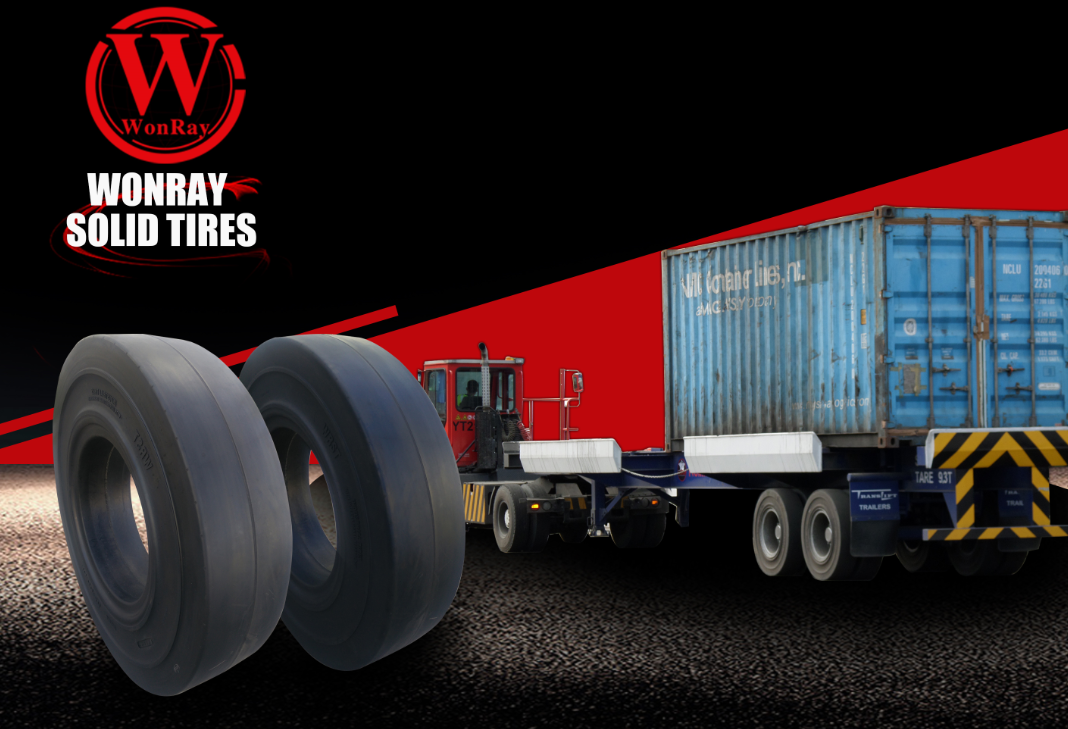
How Solid Wheels Perform in Real Industrial Surfaces
Industrial surfaces are rarely uniform. A single facility may include polished concrete, rough loading zones, steel plates, and gravel transition areas. Each surface creates different wear patterns and impact forces.
Solid wheels are particularly effective in such mixed environments because:
● They maintain consistent traction across multiple surface types without pressure adjustment
● They resist surface abrasion caused by concrete friction and metallic contact
● They handle debris-heavy zones without risk of puncture or sudden failure
● They maintain structural integrity even when transitioning between smooth and rough terrain
This adaptability makes them suitable for multi-zone industrial operations where trucks cannot be limited to a single surface type.
Load Stability as a Core Advantage in Heavy Transport
In industrial trucking, load stability is not just about comfort—it directly impacts safety and cargo integrity. When transporting heavy or uneven loads, even small tire deformation can affect vehicle balance.
Solid wheels improve stability through structural rigidity:
● Reduced lateral flex during turning reduces cargo shift risk
● Consistent contact patch ensures balanced weight distribution
● Higher resistance to compression maintains vehicle height stability
● Predictable handling improves driver control in tight operating spaces
This is particularly valuable in port terminals and industrial yards where precision movement is required.
Maintenance Behavior and Lifecycle Predictability
One of the most overlooked advantages of solid wheels is not just durability, but predictability. Unlike pneumatic tires that fail unpredictably, solid wheels degrade in a gradual and measurable way.
This creates operational benefits such as:
● Easier maintenance planning based on wear patterns rather than sudden failures
● Reduced emergency repair interventions in remote or busy industrial zones
● More stable fleet cost forecasting over long operational cycles
● Lower dependency on tire pressure monitoring systems
For fleet operators, this predictability often matters more than raw performance alone.
Are Solid Wheels Suitable for Every Truck Application?
Solid wheels are highly specialized and are not designed to replace pneumatic tires in every situation. Their advantages become most visible in low-speed, high-load industrial environments.
They are most effective in:
● Port handling trucks and container movement vehicles
● Mining support and heavy material transport trucks
● Steel and recycling yard transport systems
● Construction logistics and site supply vehicles
● Industrial intra-facility cargo transport systems
They are less suitable for long-distance highway trucking where comfort, speed, and shock absorption are more important than structural rigidity.
Safety Improvements in Industrial Transport Systems
Safety is a major concern in heavy industrial logistics, especially where trucks operate near workers, machinery, and valuable cargo.
Solid wheels improve safety performance by:
● Eliminating sudden air loss that can destabilize vehicles
● Providing consistent traction during acceleration and braking
● Maintaining predictable steering response under load
● Reducing vibration that affects operator control precision
These factors reduce accident risk in fast-paced industrial environments.
Conclusion
Solid wheels for trucks represent a shift from traditional tire design toward structural load-bearing engineering. Instead of focusing on cushioning through air pressure, they prioritize durability, predictability, and uninterrupted performance in extreme environments.
Their value becomes most apparent in industrial systems where downtime is expensive and operating conditions are severe. While they are not a universal replacement for pneumatic tires, they provide a highly efficient solution for heavy-duty, low-speed transport operations that demand maximum reliability and minimal interruption.
For industries operating in mining, ports, steel processing, and heavy logistics, solid wheels are not just an alternative—they are a strategic upgrade in operational stability and long-term efficiency.
Post time: 09-06-2026