
Solid tires for aerial work vehicles are increasingly used in construction sites, maintenance operations, warehouse facilities, and industrial installations where elevated work platforms must operate safely and reliably under demanding conditions. These vehicles, including scissor lifts, boom lifts, and aerial work platforms, depend heavily on tire stability to ensure operator safety while working at height.
Unlike standard pneumatic tires, solid tires eliminate air pressure systems entirely, providing a more stable and puncture-resistant foundation for lifting operations. This structural advantage becomes critical when vehicles are extended to high elevations, where even minor instability at ground level can translate into significant safety risks at height.
Ground Stability as the Foundation of Aerial Work Safety
Aerial work vehicles are unique because their operational safety does not depend only on the lifting mechanism but also on the stability of the base. The tires act as the first point of contact with the ground and therefore directly influence balance, vibration control, and load distribution.
Solid tires provide a consistent contact surface that does not deform under pressure fluctuations, ensuring that the platform remains stable even when fully extended. This stability is especially important during lateral movement, rotation, or positioning of aerial platforms.
In environments such as uneven construction sites or industrial floors with debris, maintaining a predictable ground interface is essential for preventing tipping or instability.
● Provides stable base support for elevated platforms
● Maintains consistent ground contact under load
● Reduces platform vibration during vertical extension
● Improves balance during lateral movement operations
● Enhances safety in high-altitude working conditions
● Minimizes instability caused by ground irregularities
Structural Design Focused on Load Distribution and Rigidity
Solid tires used in aerial work vehicles are engineered with a high-strength rubber composition designed to support heavy vertical loads while maintaining rigidity. Since these vehicles often carry operators, tools, and hydraulic systems at height, the base must support both static and dynamic forces.
The internal structure of solid tires ensures even load distribution across the contact surface, reducing stress concentration points that could lead to uneven wear or instability. This is particularly important when aerial platforms are extended to maximum height, where weight distribution changes dynamically.
Modern designs also incorporate vibration-dampening layers that help reduce shock transmission from uneven ground surfaces to the lifting platform.
● Reinforced rubber structure supports vertical load stress
● Even load distribution improves operational stability
● High rigidity reduces deformation under pressure
● Designed for dynamic weight shifts during lifting
● Vibration-dampening layers improve ride stability
● Enhances structural integrity during elevation operations
Performance Behavior in Construction and Industrial Environments
Aerial work vehicles are commonly used in environments where ground conditions are unpredictable, including construction sites, factory floors, warehouses, and outdoor maintenance zones. These surfaces may include gravel, metal debris, oil patches, or uneven concrete.
Solid tires perform consistently in these conditions because they are not affected by punctures or pressure loss. This ensures that aerial platforms remain operational even in harsh environments where traditional tires might fail.
The durability of solid tires allows operators to focus on task execution rather than equipment limitations.
● Resistant to punctures from debris and sharp objects
● Stable performance on uneven construction surfaces
● Suitable for indoor and outdoor aerial operations
● Maintains reliability in industrial maintenance zones
● Reduces downtime caused by tire damage
● Supports continuous high-intensity operations
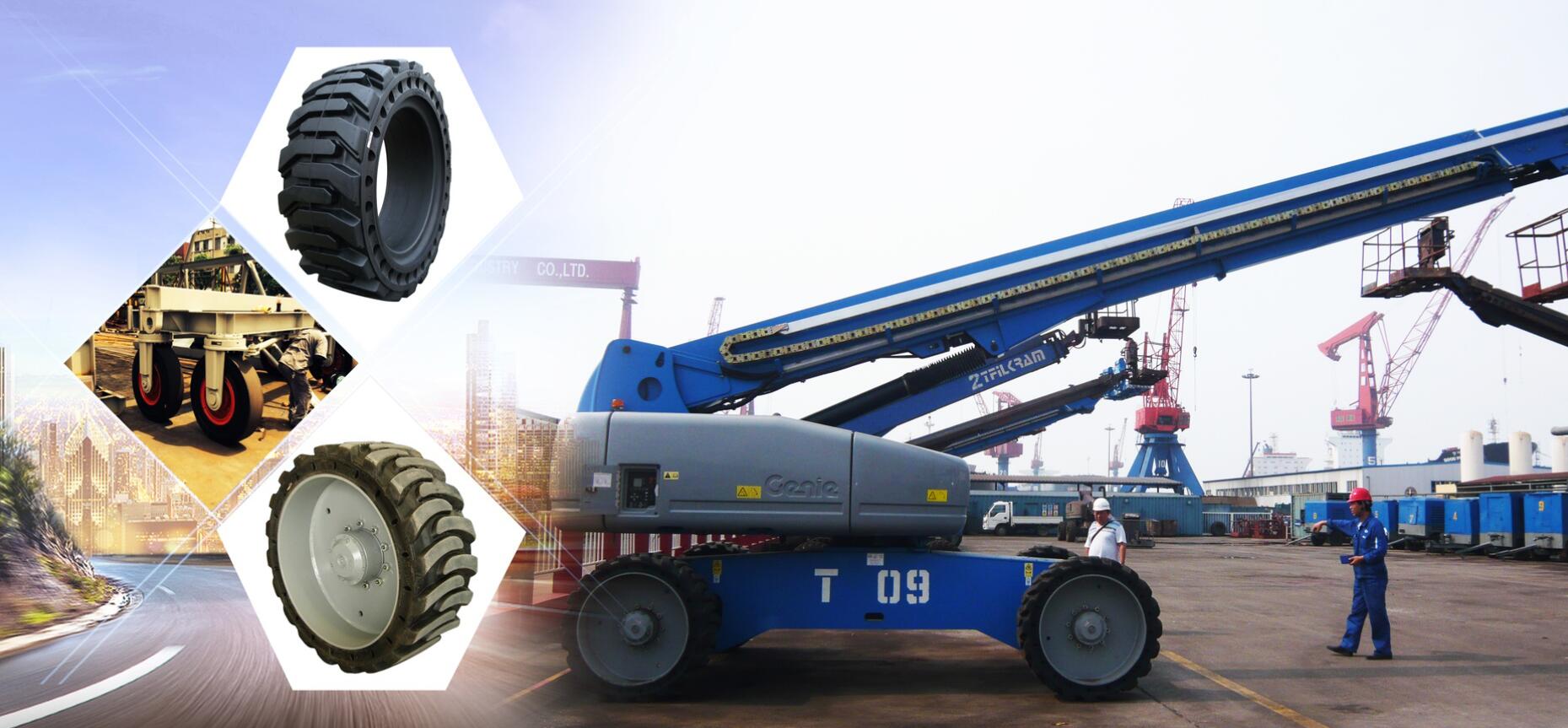
Safety Enhancement in Elevated Work Applications
Safety is the most critical factor in aerial work operations, as any instability at ground level can be amplified when the platform is raised. Solid tires significantly reduce risk by eliminating sudden air loss scenarios such as blowouts or slow leaks, which could destabilize the vehicle.
Additionally, the consistent stiffness of solid tires improves braking response and directional control, particularly when repositioning the vehicle with an elevated platform.
These characteristics help create a safer working environment for operators working at height.
● Eliminates risk of sudden tire deflation
● Improves braking stability during platform elevation
● Enhances directional control on uneven surfaces
● Reduces risk of tipping during movement
● Supports safer high-altitude maintenance work
● Increases operator confidence and control
Application Scenarios Across Multiple Industries
Solid tires for aerial work vehicles are used in a wide range of industries where elevated access is required for maintenance, installation, and construction tasks. Their reliability makes them suitable for both indoor and outdoor applications.
In construction, they support scaffold replacement, structural installation, and exterior finishing work. In warehousing, they are used for high-level inventory access and facility maintenance. In industrial plants, they assist in equipment inspection and repair at elevated positions.
They are also widely used in airport maintenance, event setup, and large facility management.
● Construction site elevation work platforms
● Warehouse high-level storage and maintenance
● Industrial equipment inspection operations
● Airport maintenance and repair systems
● Event installation and stage setup work
● Large facility infrastructure maintenance
Maintenance Efficiency and Operational Longevity
One of the major advantages of solid tires in aerial work vehicles is reduced maintenance demand. Since they do not rely on air pressure systems, operators do not need to perform regular inflation checks or worry about pressure loss during operation.
Their wear pattern is also more predictable, allowing maintenance teams to schedule replacements in advance rather than responding to sudden failures. This improves fleet management efficiency and reduces unexpected downtime in critical operations.
In high-utilization environments, this predictability is a major operational advantage.
● No air pressure maintenance required
● Predictable and uniform wear pattern
● Reduced risk of sudden operational failure
● Simplified maintenance scheduling
● Improved fleet management efficiency
● Lower long-term service interruptions
FAQ:
1. What are solid tires for aerial work vehicles used for?
They are used on scissor lifts, boom lifts, and aerial platforms to ensure stable and safe operation during elevated work activities.
2. Why are solid tires important for aerial platforms?
Because they provide a stable base, eliminate air-related failures, and improve safety during high-altitude operations.
3. Can solid tires be used on outdoor construction sites?
Yes, they are designed to perform reliably on rough, uneven, and debris-filled surfaces commonly found in construction environments.
4. Do aerial work vehicle solid tires require regular maintenance?
They require minimal maintenance since they do not rely on air pressure and have fewer failure risks compared to pneumatic tires.
Solid tires for aerial work vehicles play a vital role in ensuring safety, stability, and efficiency in elevated operations. As industries continue to demand safer and more reliable access equipment, their importance in modern construction and industrial maintenance will continue to grow.
Post time: 04-06-2026