
Wheel loader solid tires are designed for demanding earthmoving and material handling environments where equipment must operate under heavy load, frequent impact, and rough ground conditions. In industries such as construction, mining support, quarry operations, and bulk material handling, tire performance directly affects machine productivity and operational stability.
Why Wheel Loaders Need Reinforced Tire Performance
Wheel loaders are built to move large volumes of material quickly and efficiently. They often operate in environments filled with rocks, gravel, debris, uneven surfaces, and high-impact loading cycles. Unlike light industrial vehicles, wheel loaders frequently face sudden force changes when digging, lifting, carrying, and dumping heavy materials.
In these conditions, conventional pneumatic tires may suffer from punctures, sidewall damage, or pressure instability. A single tire failure can stop the machine and interrupt the entire workflow, especially in mining or quarry operations where continuous material movement is required.
Solid tires provide a more stable alternative by removing air dependency. This means no risk of sudden deflation caused by sharp rock edges or metal debris. For B2B operators managing heavy equipment fleets, this reliability helps reduce downtime, improve scheduling predictability, and stabilize long-term maintenance planning.
Performance Requirements in Heavy Earthmoving Environments
Wheel loader tires must handle more than static load. They are constantly exposed to dynamic stress, including acceleration under load, braking on uneven surfaces, and impact during bucket operations. The tire must maintain structural integrity even when the machine is fully loaded or working on rough terrain.
A suitable solid tire for wheel loaders should balance strength, durability, and stability. It must resist cracking, chunking, and abrasion while maintaining predictable handling performance during repeated heavy-duty cycles.
Key performance expectations include:
● Strong load-bearing capability for high-capacity bucket operations
● Resistance to cutting and tearing from rocks, gravel, and debris
● Stable structure for safe operation during loading and dumping cycles
● Reduced risk of sudden failure in harsh outdoor environments
● Consistent performance under repetitive impact and vibration
● Lower maintenance demand compared with pneumatic tire systems
For equipment operators, these characteristics directly influence machine uptime and operational cost control. A tire that performs consistently reduces emergency repair situations and improves overall fleet efficiency.
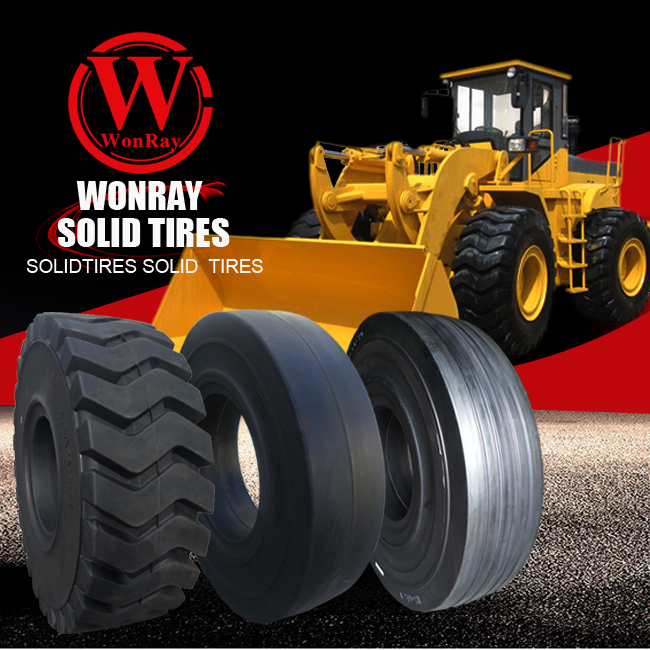
Structural Design Behind Solid Tire Durability
Wheel loader solid tires typically use a multi-layer rubber structure designed to absorb impact while maintaining rigidity under heavy load. The outer tread layer is responsible for resisting wear from abrasive surfaces. The middle structure helps absorb shock from uneven ground and heavy loading cycles. The inner layer supports stability and ensures strong rim adhesion.
This layered design is important because wheel loaders do not operate on uniform surfaces. They frequently move between loose soil, compacted gravel, rocky ground, and industrial stockpile areas. Each surface creates different stress patterns on the tire.
Heat management is another important factor. Continuous heavy-duty operation can generate internal heat within the tire body. A well-designed solid tire helps manage heat buildup, which supports longer service life and more stable performance over extended working hours.
Advantages of Wheel Loader Solid Tires in Industrial Use
Solid tires are widely used in wheel loader applications where durability and uptime are more important than ride comfort. Their benefits are especially visible in high-impact environments such as quarries and mining support operations.
● Puncture-free structure eliminates downtime caused by sharp rocks, metal fragments, and construction debris
● Heavy-load stability supports large-scale earthmoving and bulk material handling tasks
● High abrasion resistance improves service life in rough terrain conditions
● Strong structural integrity helps maintain safe handling during lifting and dumping operations
● Reduced maintenance needs lower overall fleet servicing pressure
● Improved operational continuity supports long working shifts in demanding environments
● Stable rim fit reduces risk of tire movement under heavy impact cycles
These advantages make solid tires a practical solution for wheel loaders operating in environments where tire damage is frequent and repair access may be limited.
Application Scenarios for Wheel Loader Solid Tires
Wheel loaders equipped with solid tires are commonly used in industries where material volume, ground conditions, and operating intensity are high. These environments require equipment that can continue working even under difficult conditions.
Typical application areas include mining support sites, quarry operations, construction earthmoving projects, industrial bulk material yards, waste handling facilities, and heavy logistics storage zones.
In mining and quarry operations, tires are exposed to sharp rock edges, uneven ground, and continuous heavy loading cycles. In construction sites, machines may work in partially developed areas where ground conditions change frequently. In industrial yards, loaders may handle scrap, aggregates, and heavy raw materials.
Solid tires help ensure these machines continue operating reliably in all of these conditions.
Operational Value for Equipment Fleets
For fleet operators, tire reliability is closely tied to production efficiency. A wheel loader that stops due to tire damage can affect multiple stages of material handling. This includes loading, transport, stockpiling, and downstream processing operations.
Solid tires reduce this risk by eliminating air-related failures. This allows maintenance teams to focus on scheduled inspections rather than emergency tire repairs. Over time, this improves fleet predictability and reduces unplanned downtime costs.
In addition, consistent tire performance helps operators maintain better control over machine behavior during loading and movement. This is especially important in environments where safety and precision are critical.
Summary
Wheel loader solid tires are engineered for heavy earthmoving and high-impact industrial applications where reliability and durability are essential. Their puncture-free structure, strong load capacity, abrasion resistance, and stable performance make them suitable for mining, construction, quarry, and bulk material handling operations. For B2B users, they provide a practical way to reduce downtime, improve machine availability, and support stable long-term fleet performance.
FAQ
1、What are wheel loader solid tires used for?
Wheel loader solid tires are used on heavy equipment operating in mining, quarrying, construction, and industrial material handling environments where high load and rough ground conditions are common.
2、Why are solid tires suitable for wheel loaders?
They are suitable because they eliminate puncture risk, provide strong load support, and maintain stable performance in abrasive and high-impact environments.
3、Can wheel loader solid tires handle extreme terrain?
Yes. They are designed for rough surfaces such as rock, gravel, uneven ground, and industrial stockpile areas.
4、Do solid tires reduce maintenance for wheel loaders?
Yes. They reduce emergency tire repairs and puncture-related downtime, allowing maintenance teams to focus on planned servicing.
Post time: 18-05-2026