
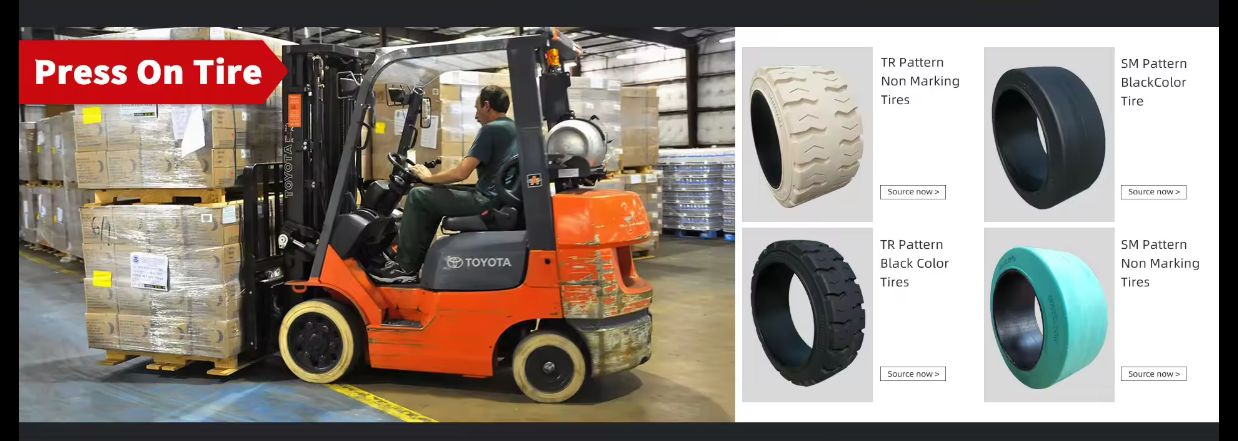
Warehouse forklift solid tires have become a core component in modern logistics infrastructure, especially in high-throughput distribution centers, e-commerce fulfillment hubs, and industrial storage facilities where forklifts operate continuously under demanding conditions. In these environments, efficiency is measured not only by speed but also by equipment reliability, operational consistency, and downtime control.
As warehouse operations become increasingly automated and time-sensitive, any disruption caused by tire failure can directly affect order processing speed, inventory flow, and delivery schedules. Solid tires address these challenges by offering a maintenance-light, puncture-proof solution designed specifically for intensive indoor material handling.
Operational Demands in Modern Warehousing Environments
Unlike traditional industrial environments, modern warehouses are highly structured systems built around constant movement and tight operational cycles. Forklifts are required to perform thousands of repetitive tasks daily, including pallet lifting, aisle navigation, and precise stacking operations.
These repeated cycles create continuous stress on tire surfaces, especially during sharp turns, braking, and directional changes in narrow aisles. Under such conditions, tire consistency becomes a critical factor for maintaining workflow efficiency.
Warehouse forklift solid tires are engineered to handle these stress patterns by maintaining uniform contact pressure and minimizing deformation during operation.
● Designed for high-frequency forklift movement cycles
● Supports precision handling in narrow warehouse aisles
● Maintains stability during repeated start-stop operations
● Reduces performance variation under continuous use
● Improves operational consistency across shifts
● Enhances material handling efficiency in dense storage systems
Material Composition and Structural Engineering
The performance of warehouse forklift solid tires is primarily determined by their material composition and internal structure. These tires are typically manufactured using high-grade synthetic rubber compounds combined with reinforcement layers that enhance load-bearing capacity and resistance to wear.
The absence of internal air cavities eliminates pressure-related instability, while the dense rubber structure ensures that the tire maintains its shape even under maximum load conditions.
Some advanced models also incorporate multi-layer cushioning zones that help absorb micro-vibrations generated during indoor operations, improving overall driving smoothness.
● High-density rubber compound improves durability
● Reinforced internal structure supports heavy loads
● No air chamber eliminates pressure failure risk
● Multi-layer design improves shock absorption
● Stable deformation resistance under continuous load
● Enhanced structural integrity for industrial use
Performance Advantages in Continuous Warehouse Operations
In high-volume logistics centers, forklifts often operate across multiple shifts with minimal downtime. This continuous usage pattern requires tires that can maintain consistent performance without frequent replacement or maintenance interruptions.
Solid tires are particularly well-suited for these conditions because they do not suffer from gradual air leakage or pressure imbalance. Instead, their wear pattern is predictable and uniform, allowing warehouse managers to plan maintenance more effectively.
This predictability contributes to improved fleet management and reduced operational uncertainty.
● Stable performance across multi-shift operations
● No air leakage or pressure loss issues
● Predictable and uniform wear behavior
● Reduced maintenance interruptions
● Improved fleet scheduling efficiency
● Supports 24/7 warehouse operations
Role in Automation and Smart Logistics Systems
Modern warehouses increasingly rely on automated systems, including AGVs (automated guided vehicles), smart forklifts, and robotic handling equipment. These systems require highly stable and consistent ground interaction to ensure navigation accuracy and operational precision.
Warehouse forklift solid tires contribute to this requirement by providing a uniform and predictable contact surface that supports sensor-based navigation and automated control systems.
Their stability reduces vibration interference, which is especially important for precision lifting and placement tasks in automated environments.
● Compatible with automated warehouse systems
● Supports AGV and smart forklift integration
● Improves navigation accuracy in logistics systems
● Reduces vibration impact on sensors and controls
● Enhances precision in automated lifting operations
● Supports digital warehouse transformation
Safety and Risk Reduction in Indoor Operations
Safety is a major concern in warehouse environments where forklifts operate in close proximity to workers, shelving systems, and other equipment. Tire-related failures can lead to sudden loss of control, load instability, or operational delays.
Solid tires significantly reduce these risks by eliminating air-based failure modes such as blowouts or sudden deflation. Their stable structure also improves braking response and directional control, especially when carrying heavy loads in confined spaces.
This contributes to a safer and more controlled working environment.
● Eliminates sudden tire failure risks
● Improves braking stability under load
● Enhances directional control in tight spaces
● Reduces workplace accident risks
● Supports safer warehouse traffic flow
● Improves operational safety standards
Economic Efficiency and Lifecycle Value
From a long-term operational perspective, warehouse forklift solid tires provide strong cost advantages despite higher initial purchase costs. Their extended service life and reduced maintenance requirements lead to lower total cost of ownership over time.
In high-utilization logistics centers, reducing even small amounts of downtime can result in significant productivity gains. This makes solid tires a strategic investment for warehouse operators focused on long-term efficiency and operational stability.
● Reduces long-term replacement frequency
● Minimizes unplanned downtime costs
● Lowers maintenance workload for fleets
● Improves warehouse productivity output
● Enhances equipment utilization rates
● Optimizes total operational cost structure
FAQ:
1. Where are warehouse forklift solid tires commonly used?
They are mainly used in distribution centers, e-commerce warehouses, manufacturing storage facilities, and logistics hubs where forklifts operate continuously.
2. Why are solid tires preferred in indoor warehouse environments?
Because they eliminate puncture risks, maintain stable performance, and support high-frequency forklift operations without downtime.
3. Can solid tires improve forklift handling in narrow aisles?
Yes, their stable footprint and consistent structure improve control and maneuverability in tight warehouse spaces.
4. Do warehouse solid tires require regular maintenance?
They require minimal maintenance since they do not rely on air pressure and have fewer failure points compared to pneumatic tires.
Warehouse forklift solid tires continue to play a crucial role in modern logistics systems by ensuring stable, efficient, and uninterrupted material handling operations. As warehouses evolve toward higher automation and faster fulfillment cycles, their importance in maintaining operational continuity and productivity will continue to increase.
Post time: 03-06-2026