
Selecting the right tyres for forklifts is a critical decision for businesses that rely on material handling equipment. Types of forklift tyres directly impact operational efficiency, safety, and maintenance costs. Choosing suitable tyres ensures that forklifts can navigate different surfaces, handle various loads, and maintain longevity under demanding industrial conditions.
For B2B buyers and industrial operators, understanding tyre types is essential for optimizing performance and reducing operational downtime.
Key Types of Forklift Tyres
Forklift tyres are broadly categorized based on their construction, application, and performance characteristics. Choosing the right type depends on the operating environment and load requirements.
1. Pneumatic Tyres
Pneumatic tyres are air-filled and provide cushioning, making them ideal for uneven surfaces or outdoor operations.
● Offer smooth ride quality and shock absorption
● Suitable for rough terrain, construction sites, and outdoor yards
● Available in solid pneumatic (reinforced for durability) or standard pneumatic versions
● Require regular maintenance to check air pressure and prevent punctures
2. Solid Tyres
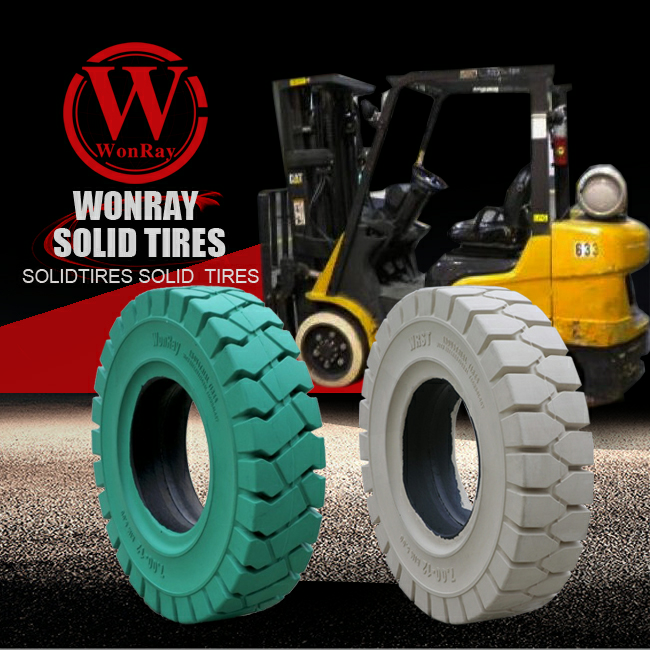
Solid tyres are made from solid rubber or polyurethane, eliminating the risk of punctures. They are highly durable and suitable for indoor operations.
● Non-pneumatic and virtually maintenance-free
● Ideal for warehouses, factories, and smooth floor surfaces
● Provide high load-bearing capacity for heavy equipment
● Reduce downtime caused by flats or air leaks
3. Cushion Tyres
Cushion tyres feature a rubber layer bonded to a steel rim. They are compact and ideal for indoor, smooth floor operations.
● Offer excellent traction on concrete and asphalt
● Lower initial cost compared to pneumatic tyres
● Best suited for high-density warehouse operations
● Limited performance on uneven or outdoor terrain
4. Polyurethane Tyres
Polyurethane tyres are commonly used for electric forklifts and offer both durability and reduced floor marking.
● Resistant to chemicals, abrasion, and wear
● Ideal for indoor applications where floor protection is critical
● Provide quiet operation and smooth handling
● Can be customized for specific load capacities and tread designs
Choosing the Right Forklift Tyre
Selecting the correct tyre type requires evaluating several factors:
● Operational Environment: Indoor vs. outdoor, smooth vs. rough terrain
● Load Requirements: Heavy or light-duty applications
● Maintenance Considerations: Pneumatic vs. solid tyres
● Safety: Grip, stability, and performance under load
● Cost Efficiency: Total cost of ownership, including replacement and downtime
Proper tyre selection improves safety, reduces operational costs, and enhances overall forklift performance.
Advantages for B2B Operators
Choosing the right type of forklift tyres delivers significant business benefits:
● Minimizes downtime caused by tyre failure or maintenance
● Enhances safety for operators and cargo
● Extends equipment lifespan by providing optimal support
● Reduces long-term maintenance and replacement costs
For OEM manufacturers, offering forklifts with appropriate tyre options can increase product value and customer satisfaction.
Conclusion
Understanding the types of forklift tyres is crucial for B2B businesses and industrial operators. Each tyre type—pneumatic, solid, cushion, or polyurethane—offers unique advantages tailored to specific environments and load requirements. Selecting the correct tyres enhances efficiency, reduces maintenance costs, and improves operational safety, making it an essential factor in industrial equipment management.
Investing in the right forklift tyres ensures reliable performance, longevity, and optimal productivity across diverse industrial applications.
FAQ
Q1: What is the main difference between pneumatic and solid forklift tyres?
● Pneumatic tyres are air-filled and provide cushioning for uneven surfaces, while solid tyres are puncture-proof and more durable for indoor operations.
Q2: Which forklift tyre type is best for outdoor rough terrain?
● Pneumatic tyres, especially solid pneumatic, are ideal for rough or uneven outdoor surfaces.
Q3: Can polyurethane tyres prevent floor damage in warehouses?
● Yes. Polyurethane tyres are non-marking and resistant to abrasion, making them perfect for indoor floor protection.
Q4: How do tyre types affect forklift maintenance costs?
● Solid and polyurethane tyres reduce maintenance costs by eliminating punctures and air pressure checks, while pneumatic tyres may require more regular servicing.
Q5: Are forklift tyres customizable for specific industrial needs?
● Yes. Many manufacturers offer custom sizes, tread patterns, and load capacities to match operational requirements.
Post time: 02-03-2026