
Telehandlers perform several jobs with one machine, including lifting materials, placing loads at height, and traveling across construction sites, farms, and industrial yards. Operating conditions change as the boom extends, attachments are exchanged, and loads are moved. They affect stability and tire loading. Choosing Telehandler Tires therefore involves more than matching a tire to the machine’s nominal size. The tires must meet the equipment manufacturer’s requirements, support the loads associated with approved operating conditions, and suit the surfaces and travel patterns found on site. Understanding these demands helps prevent unsuitable replacements.
How Load Conditions Change During Operation
A telehandler’s load distribution depends on its design and configuration. The chassis, boom, counterweight, attachment, and material all affect axle forces. When the boom is raised or extended, the load moves farther from the machine, changing the overturning moment and stability conditions.
A telehandler may lift a load safely when it is close to the chassis but have a much lower permitted capacity when the boom is extended. The load-chart capacity depends on boom angle, extension, attachment, and operating position. A tire with a high load rating does not increase the machine’s lifting capacity or make an unsafe configuration acceptable.
For tire selection, consider normal working loads and positions, including whether the machine travels with a load. These details are more useful than the maximum lifting capacity alone.
Why Boom Extension Matters
Boom extension changes the distance between the load and the machine. As the load moves outward, the overturning moment increases, and the machine must remain within the stability limits specified by its manufacturer. Tires form part of the machine’s support system, but their capacity cannot be calculated from boom reach alone.
Actual tire loading depends on machine design, axle arrangement, attachment, load position, boom angle, and whether the machine is stationary or moving. Use the manufacturer’s load chart and fitment specifications rather than estimating axle loads from boom extension.
This matters during replacement: a tire may fit the wheel but remain unsuitable for the required load, speed, or operating conditions. If the machine uses different tire sizes or specifications across axle positions, each position must be checked separately.
Lifting and Traveling Create Different Tire Demands
During lifting, the machine may remain stationary while the boom and load change position. Tire deformation, ground contact, and stability matter because the equipment must remain within its permitted limits. Soft ground, uneven surfaces, or slopes can affect stability even when the tires are correctly specified.
Telehandler Tires must be evaluated according to the machine’s actual lifting configuration, because boom extension, load position, and attachment type can change the forces transferred through the tires.
Travel creates different demands: tires support the machine while responding to acceleration, braking, steering, and surface irregularities. Traveling with a load changes the forces acting on the tires, while repeated turns on hard surfaces can increase tread and shoulder wear. On rough sites, sharp debris and uneven ground raise the risk of cuts, impact damage, and irregular wear.
A tire selected only for lifting capacity may not suit the site’s travel conditions. Likewise, a tread designed for loose ground should also be assessed for wear and handling on compacted surfaces. Selection should reflect the full duty cycle: lifting, carrying, turning, and traveling.
Match Tread Design to the Working Surface
Telehandlers may operate on compacted soil, gravel, broken ground, concrete, asphalt, or a mixture of surfaces. Tread design affects how a tire engages with the ground, releases loose material, and maintains traction during movement.
On loose or uneven ground, a directional tread with suitable void spaces can improve surface engagement and clear trapped dirt. However, an aggressive pattern is not automatically best for every application. Machines that spend much of their time on hard floors may experience unnecessary vibration or faster tread wear if the pattern is poorly matched to the surface.
Consider both the site’s most demanding sections and its most common surfaces. Mud, loose gravel, sharp stones, and smooth concrete create different requirements. No tread pattern can compensate for unsafe speed, unsuitable ground conditions, or operation beyond the machine’s load chart.
Solid Tires: Look Beyond Puncture Resistance
Solid tires may be considered for telehandlers working in areas where sharp debris causes frequent punctures. Because they do not rely on air pressure, they eliminate conventional air-loss punctures and routine inflation checks. This can be useful in recycling areas, construction sites, and other demanding environments.
However, solid tires are not automatically suitable for every telehandler. Their construction and deflection characteristics differ from pneumatic tires, affecting ride comfort, shock transmission, ground contact, and load support. The equipment manufacturer must permit the tire type, and the replacement must meet the required dimensions, load capacity, speed conditions, and wheel specifications.
Some solid tire designs use sidewall openings to improve flexibility and shock absorption, but their rated application and operating limits must still be checked. Solid tires can also generate heat during prolonged operation, particularly when load, speed, and continuous running time are not properly matched.
Check Size, Load Rating, and Wheel Compatibility
Correct dimensions are essential, but size alone is not enough. Before ordering Telehandler Tires, compare the replacement with the equipment manufacturer’s approved specifications. Confirm tire size, rim dimensions, overall diameter, section width, load rating, speed conditions, and mounting arrangement.
The load rating must be appropriate for the relevant tire position and operating speed. A higher rating does not automatically make a tire a better choice. Different constructions may have different deflection characteristics or intended applications, affecting compatibility even when nominal dimensions appear similar.
Before confirming a replacement, review:
- Telehandler make and model, axle configuration, and approved tire size.
- Attachment type, typical load, and operating positions shown on the load chart.
- Maximum travel speed, working hours, and the balance between lifting and traveling.
- Main ground surfaces, exposure to sharp debris, gradients, and turning frequency.
- Rim dimensions, mounting requirements, and any restrictions on solid tire use.
If existing tires show unusual wear, investigate possible causes such as incorrect inflation pressure on pneumatic tires, misalignment, overloading, unsuitable speed, or frequent tight turns. Replacing the tires without correcting the operating cause may allow the same problem to return.
When to Review the Tire Specification
Review the tire specification when a telehandler moves to a different work environment, receives a new attachment, handles different materials, or changes its daily operating pattern. A machine transferred from a smooth warehouse yard to a rough construction site may need a different balance of tread and damage resistance, provided the alternative remains approved for that equipment.
Replacement is an opportunity to confirm that the specification remains suitable. Check tire identification and dimensions, review the equipment manual and load chart, and compare the work cycle with the tire manufacturer’s guidance. If the operating configuration has changed, consult the equipment manufacturer before assuming the previous tire specification is still appropriate.
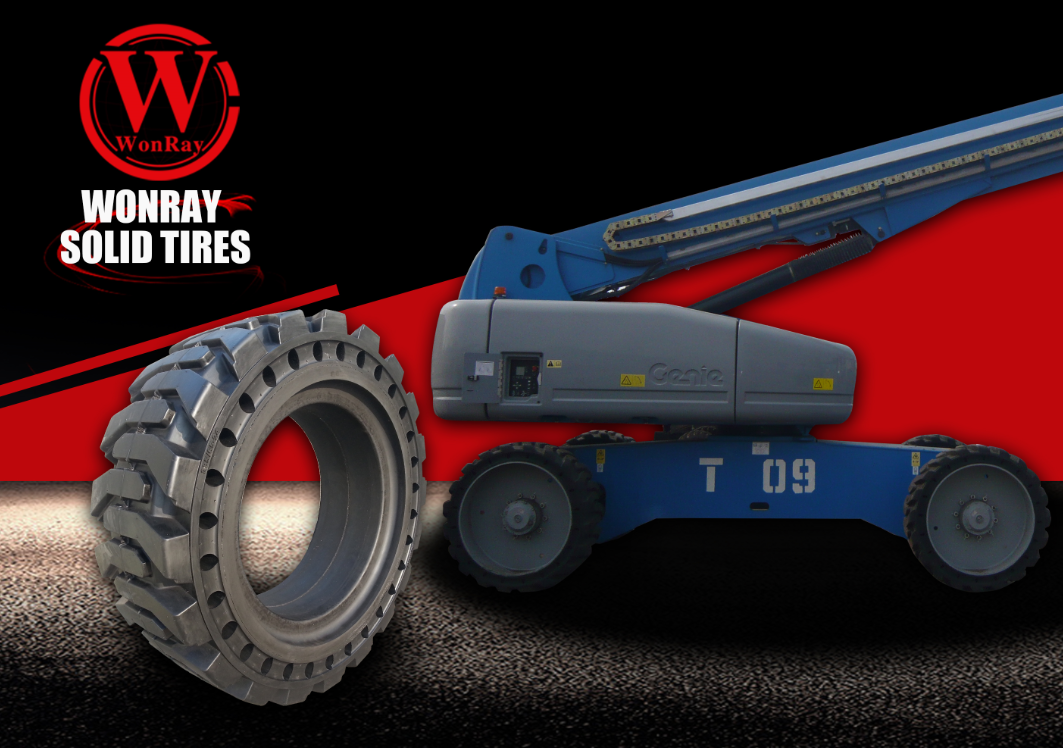
For telehandler applications, WonRay offers solid tire options featuring a directional tread pattern intended to support traction and self-cleaning, as well as an oval sidewall-hole design intended to improve shock absorption. These features may suit demanding off-road environments, but suitability depends on the model, approved fitment, wheel dimensions, load, speed, and site conditions. Providing these details helps assess the tire against the actual application rather than selecting by size alone.
Conclusion
Choosing Telehandler Tires means matching the tire to both the machine and its working cycle. Boom extension changes the load position and stability conditions, while lifting, traveling, turning, and different ground surfaces create distinct tire demands. The load chart, equipment specifications, tire rating, tread design, and wheel compatibility should all be checked before replacement. A choice based on verified operating conditions is more reliable than selecting by size or maximum load figures alone.
FAQs
Does extending a telehandler boom affect tire loading?
It changes the load position and the machine’s stability conditions. The actual forces at each tire depend on machine design and operating configuration, so consult the load chart and manufacturer data.
Can a telehandler use solid tires instead of pneumatic tires?
Only when the tire type is approved for the specific machine and meets its size, load, speed, and wheel requirements. Solid tires are not universal replacements for pneumatic tires.
Is a higher tire load rating always better for a telehandler?
No. The tire must also match approved dimensions, speed conditions, construction, and intended application. A higher rating does not increase the machine’s lifting capacity.
What should be checked before replacing telehandler tires?
Confirm the machine model, approved tire size, wheel and rim details, load chart, attachment, operating speed, ground conditions, and whether solid tires are permitted.
Post time: 25-11-2026