
Solid trailer tires have become an essential component for industrial trailers operating in high-load, high-frequency, and high-risk environments. For manufacturers, fleet operators, and equipment distributors, choosing the right tire solution directly impacts uptime, safety, and total operating cost. Unlike pneumatic alternatives, solid trailer tires are engineered for consistency, durability, and predictable performance across demanding applications.
This article provides a professional B2B overview of solid trailer tires, focusing on their technical advantages, application value, and long-term operational benefits for industrial and commercial trailer systems.
What Are Solid Trailer Tires and How Do They Work
Solid trailer tires are manufactured from high-density rubber or elastomer compounds and do not rely on air pressure to support loads. Their structure eliminates the risk of punctures, air leakage, and blowouts, which are common causes of downtime in trailer operations.
Unlike pneumatic tires that depend on inflation for load-bearing and shock absorption, solid trailer tires rely on material composition and internal design to deliver structural strength and controlled deformation. This makes them particularly suitable for trailers used in closed facilities, harsh outdoor conditions, or continuous-duty cycles.
From a supplier perspective, solid trailer tires are typically produced to meet standardized or custom dimensional requirements, allowing compatibility with a wide range of industrial trailer axles and hubs.
Key Advantages of Solid Trailer Tires in Industrial Use
For B2B buyers, the value of solid trailer tires lies not only in durability but also in operational predictability and lifecycle efficiency.
● Puncture-free performance eliminates unexpected stoppages caused by sharp debris, scrap materials, or uneven ground
● Stable load-bearing capacity ensures consistent trailer handling under static or dynamic heavy loads
● Minimal maintenance requirements reduce labor costs and simplify fleet management
● Long service life lowers replacement frequency and total cost of ownership
● Reliable performance in indoor and outdoor environments, including warehouses, ports, factories, and yards
These advantages make solid trailer tires a preferred solution for industrial trailers where reliability outweighs ride comfort.
Typical Applications for Solid Trailer Tires
Solid trailer tires are widely used across multiple industrial sectors where trailers operate under controlled speeds and heavy loads. From a supplier standpoint, these tires are often specified during equipment manufacturing or fleet standardization.
Common application areas include:
● Logistics and material handling trailers used in distribution centers
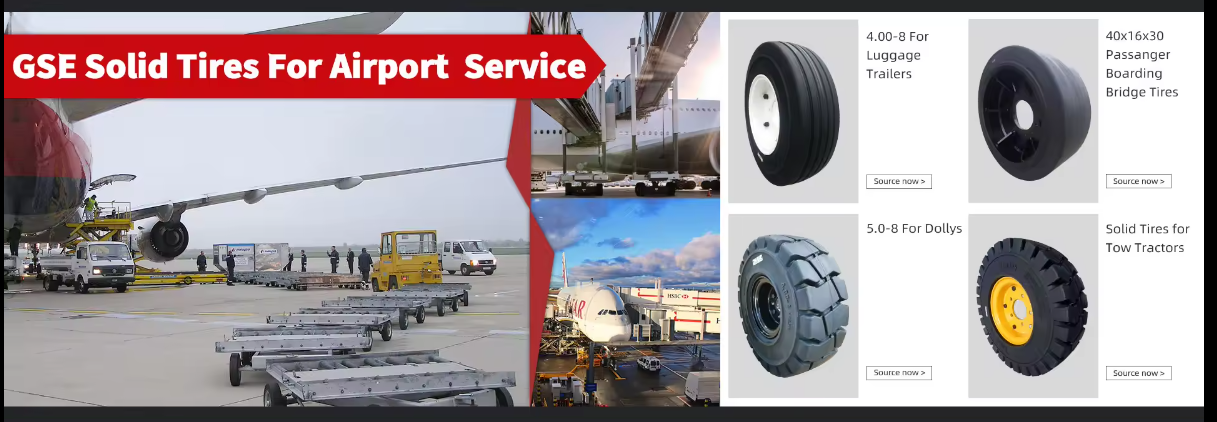
● Airport ground support trailers such as baggage and cargo dollies
● Industrial plant trailers for steel, aluminum, or heavy component transport
● Waste handling and recycling trailers exposed to sharp debris
● Port, yard, and inter-facility transport trailers operating on rough surfaces
In these applications, solid trailer tires help reduce unplanned downtime and support continuous operations.
Solid Trailer Tires vs Pneumatic Trailer Tires
Understanding the differences between solid and pneumatic trailer tires is critical for proper application matching in B2B procurement.
Solid trailer tires prioritize durability and uptime. They perform best in environments where puncture risk is high and travel speeds are moderate. Pneumatic trailer tires, by contrast, offer better shock absorption and ride comfort but require regular pressure monitoring and are vulnerable to damage.
For industrial buyers managing fleets or OEMs designing trailers for long-term use, solid trailer tires often represent a more stable and predictable solution, especially where maintenance access is limited.
Manufacturing Considerations and Customization Options
From a supplier perspective, solid trailer tires can be produced in a wide range of sizes, tread profiles, and rubber compounds to meet specific operational requirements.
Key manufacturing considerations include:
● Load rating and static load capacity
● Tire diameter and width for axle compatibility
● Tread design optimized for smooth floors or rough ground
● Rubber compound selection for wear resistance, heat resistance, or chemical exposure
● Bonding quality between tire and wheel if supplied as an assembly
For OEM customers and bulk buyers, customization ensures the tire integrates seamlessly with the trailer design while meeting performance expectations.
Long-Term Cost Efficiency for B2B Buyers
While solid trailer tires may have a higher upfront unit cost compared to pneumatic alternatives, their long-term economic advantages are significant. Reduced maintenance, fewer replacements, and minimized downtime translate into measurable savings over the service life of the trailer.
For fleet operators and distributors, solid trailer tires also simplify inventory planning, as fewer spare units are required and performance consistency is easier to maintain across multiple trailers.
Conclusion:
Solid trailer tires are a proven solution for industrial trailers that demand reliability, durability, and low maintenance. From manufacturing plants to logistics hubs and airport operations, these tires support stable performance under heavy loads and challenging conditions.
For B2B buyers, OEMs, and distributors, solid trailer tires offer long-term value through reduced downtime, predictable service life, and compatibility with a wide range of trailer systems. As a supplier-focused solution, they are well-suited for projects and fleets where operational efficiency is a priority.
FAQ:
What are solid trailer tires best used for
Solid trailer tires are best suited for industrial and commercial trailers operating in environments with high puncture risk, heavy loads, and continuous use.
Do solid trailer tires require maintenance
Solid trailer tires do not require air pressure checks and have minimal maintenance needs, aside from routine visual inspection for wear.
Are solid trailer tires suitable for outdoor use
Yes, solid trailer tires perform well both indoors and outdoors, including yards, ports, and industrial sites with uneven surfaces.
Can solid trailer tires be customized for OEM projects
Solid trailer tires can be manufactured in custom sizes, compounds, and tread designs to meet specific OEM or bulk procurement requirements.
Post time: 02-02-2026