
Port environments are among the most demanding industrial workplaces in the world. Heavy loads, constant movement, abrasive surfaces, and unpredictable operating conditions all place extreme stress on equipment. Port vehicles such as terminal tractors, reach stackers, container handlers, forklifts, and yard trailers operate around the clock to keep global trade moving efficiently.
In this context, tire performance becomes a critical factor in operational continuity. Solid tires for port vehicles are designed to solve common problems such as punctures, downtime, and excessive maintenance costs, making them an increasingly preferred choice for port operators and logistics companies.
For B2B users in shipping terminals, container yards, and logistics hubs, upgrading to solid tire systems can significantly improve fleet uptime and reduce long-term operating risk.
Challenges Faced by Port Vehicles in Daily Operation
Port operations are very different from typical industrial environments. Vehicles are required to transport extremely heavy loads, often in excess of tens of tons, across large paved yards and container storage areas.
One of the biggest challenges is surface condition. Port floors are typically made of reinforced concrete or asphalt, but they are constantly exposed to saltwater, oil spills, metal debris, and abrasive sand. These conditions accelerate tire wear and increase the likelihood of damage.
Another major issue is continuous operation. Many port vehicles run 24/7 with minimal downtime, which puts constant pressure on tire performance. Any tire failure can cause serious delays in cargo handling and disrupt entire supply chain schedules.
In addition, port vehicles frequently operate under heavy load conditions. Whether lifting containers or towing cargo trailers, tires must support extreme weight while maintaining stability and control.
Why Traditional Pneumatic Tires Struggle in Port Environments
Conventional air-filled tires are commonly used in many industrial applications, but they face significant limitations in port operations.
Punctures caused by metal debris, broken pallets, or sharp container edges are common. Even minor damage can lead to air leakage, requiring immediate repair or replacement.
Pressure instability is another issue. Heavy loads and long operating hours can cause uneven pressure distribution, affecting vehicle stability and increasing safety risks.
Frequent maintenance requirements also reduce operational efficiency. In high-intensity port environments, stopping a vehicle for tire repair directly impacts cargo handling schedules and productivity.
These limitations make pneumatic tires less suitable for high-demand port applications where reliability is critical.
How Solid Tires Solve Port Operation Problems
Solid tires eliminate the need for air entirely, replacing it with a dense, engineered rubber structure capable of supporting heavy loads without inflation.
This structural difference provides a major advantage in port environments. Without air, there is no risk of puncture or sudden deflation, which greatly reduces unexpected downtime.
Solid tires are also highly resistant to impact and abrasion. This makes them suitable for rough port surfaces, where debris and heavy equipment traffic are constant.
For port operators, this means fewer interruptions, more predictable maintenance schedules, and improved fleet availability.
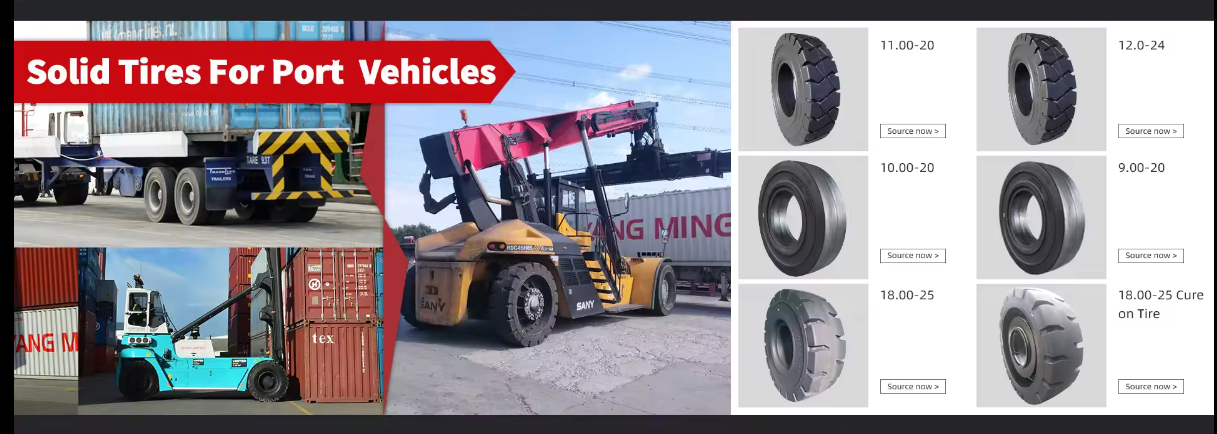
Key Advantages of Solid Tires for Port Vehicles
Solid tires provide multiple performance benefits that directly address the challenges of port operations.
● Zero puncture risk for continuous operation
Solid tires eliminate downtime caused by sharp debris, metal fragments, or container-related damage. This is especially important in high-traffic container yards.
● High load-bearing stability under extreme weight
Port vehicles often carry or move extremely heavy cargo. Solid tires maintain structural integrity under sustained load conditions, improving operational safety.
● Reduced maintenance requirements
Without air pressure systems, maintenance needs are significantly reduced. This helps port operators minimize service interruptions and improve fleet efficiency.
● Improved safety in heavy-duty transport operations
Stable tire structure reduces the risk of sudden failure during container lifting or towing operations, enhancing workplace safety.
● Better performance in corrosive environments
Port environments often involve exposure to saltwater and chemicals. Solid tire materials are designed to resist environmental degradation.
Application Areas in Port and Terminal Operations
Solid tires are widely used across various types of port equipment.
Container handling equipment such as reach stackers and empty container handlers require strong load stability and durability for repetitive lifting cycles.
Terminal tractors rely on solid tires for towing heavy container trailers over long shifts with minimal downtime.
Forklifts operating in port warehouses benefit from improved puncture resistance and stability when handling mixed cargo loads.
Yard trailers and transport platforms use solid tires to ensure continuous movement of containers between storage and loading zones.
In addition, specialized port service vehicles such as maintenance trucks and inspection carts also rely on solid tire systems for reliability.
Operational Benefits for Port Logistics Efficiency
In port logistics, time efficiency is directly linked to financial performance. Even short delays can impact vessel schedules, cargo transfers, and supply chain coordination.
Solid tires contribute to improved efficiency by reducing unexpected equipment failures. Vehicles can operate longer without interruption, which increases overall terminal throughput.
They also simplify maintenance planning. Instead of frequent emergency repairs, port operators can follow scheduled replacement cycles, improving resource allocation.
For large-scale port fleets, this translates into higher equipment availability and smoother operational flow.
Performance Considerations in Port Conditions
While solid tires offer strong durability, their performance depends on proper selection and usage conditions.
Load distribution is critical in port operations, where vehicles often carry uneven or shifting container weights. Tire selection must match maximum load requirements to ensure stability.
Surface friction also plays an important role. Port surfaces may include smooth concrete zones as well as rough outdoor storage areas, requiring balanced traction performance.
Heat generation during long-distance towing operations is another factor to consider, especially in high-temperature environments.
Proper tire design and compound selection help ensure consistent performance under these demanding conditions.
Conclusion
Solid tires for port vehicles provide a reliable and efficient solution for one of the most demanding industrial environments. By eliminating puncture risks, improving load stability, and reducing maintenance requirements, they help ensure continuous operation in container terminals, shipping yards, and logistics hubs.
For port operators and industrial logistics providers, solid tires are not just a replacement option—they are a strategic upgrade that enhances operational reliability, safety, and overall efficiency in global trade systems.
FAQ
Where are solid tires for port vehicles used?
They are used in container terminals, shipping ports, logistics yards, and heavy cargo handling areas.
Why are solid tires preferred in ports?
Because they eliminate puncture risk and support continuous heavy-duty operation.
Can solid tires handle heavy loads?
Yes, they are designed for high-load industrial and port equipment.
Do they reduce maintenance costs?
Yes, they significantly reduce repair frequency and downtime compared to pneumatic tires.
Post time: 19-05-2026