
Solid tires for industrial equipment are widely recognized as one of the most reliable mobility solutions in modern heavy-duty operations. In industries such as logistics, warehousing, construction, mining, metallurgy, and port handling, equipment is expected to operate continuously under extreme load conditions, and any unexpected downtime can directly affect productivity, cost efficiency, and overall operational safety.
Unlike pneumatic tires, solid tires are manufactured from fully dense rubber compounds without internal air chambers, which eliminates the risk of punctures, blowouts, and air pressure loss. This structural advantage makes them especially suitable for forklifts, loaders, skid steer machines, and other industrial transport vehicles that must maintain stable performance in harsh working environments.
Why Solid Tires Are Essential for Industrial Equipment
Industrial environments are characterized by constant mechanical stress, uneven surfaces, sharp debris, and continuous multi-shift operations. In such conditions, tire reliability becomes a critical factor that determines whether equipment can operate efficiently without interruption.
Solid tires are designed specifically to eliminate the most common failure points associated with traditional tire systems while ensuring stable load-bearing performance over long operational cycles.
● They eliminate air pressure dependency and reduce unexpected tire failures
● They maintain consistent structural stability under heavy load conditions
● They provide continuous operation even on rough and abrasive surfaces
● They significantly reduce maintenance frequency and downtime risks
● They improve operational reliability in 24/7 industrial environments
These characteristics make solid tires an indispensable choice for industries where equipment availability directly impacts production output.
Structural Design Advantages of Solid Tires
The structural design of solid tires is fundamentally different from pneumatic systems because they rely on a fully solid rubber composition that distributes load evenly across the entire contact area. This design significantly reduces stress concentration points that typically cause deformation or premature wear.
In addition, modern solid tires often adopt multi-layer construction methods that combine durability, shock absorption, and wear resistance into a single integrated structure.
● Multi-layer rubber structure for improved load distribution
● High-density core design for maximum structural stability
● Reinforced sidewalls for impact resistance in rough environments
● Wear-resistant tread compounds for extended service life
● Integrated vibration absorption layers to protect equipment systems
This engineering approach ensures that solid tires maintain consistent performance even under extreme industrial stress conditions.
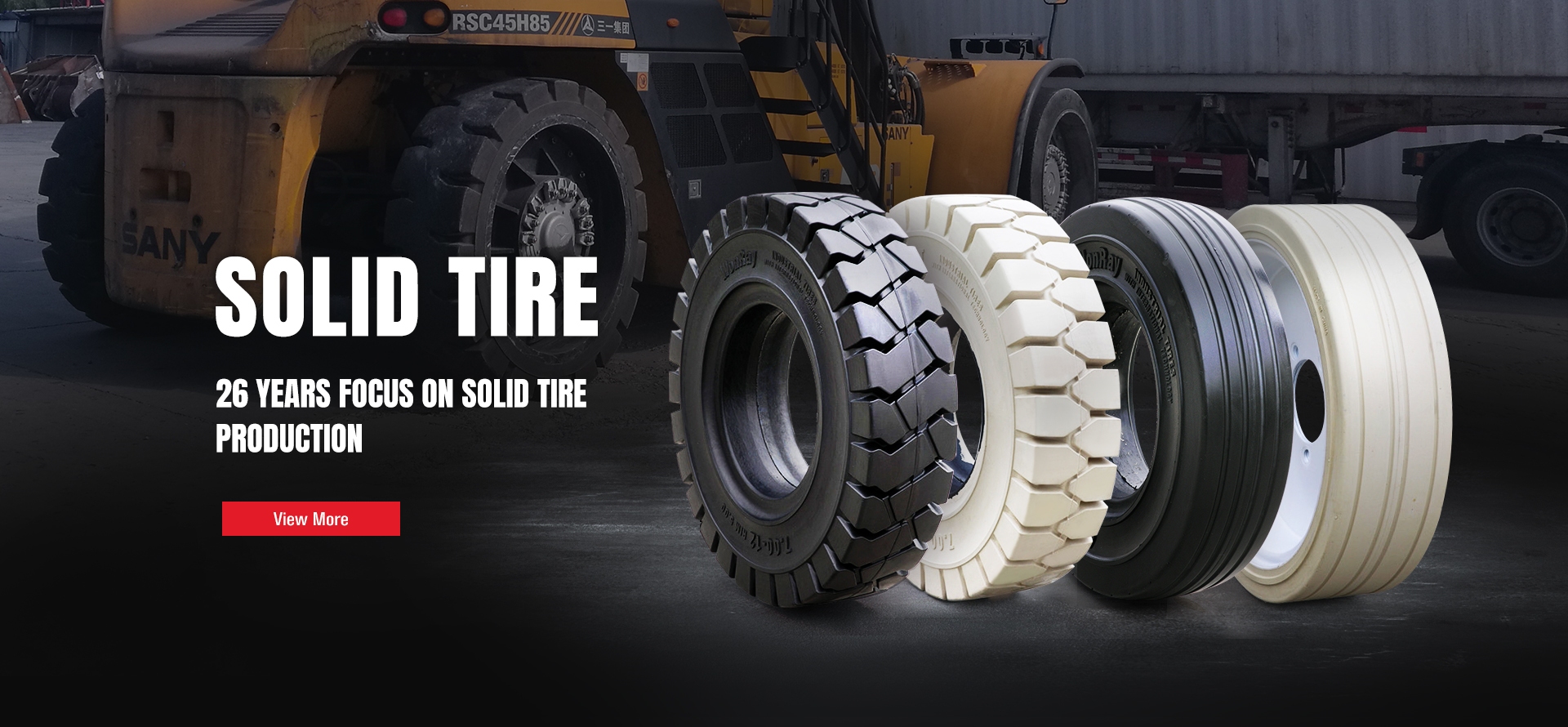
Application Across Multiple Industrial Sectors
Solid tires are used in a wide range of industrial applications where equipment reliability and continuous operation are essential. These environments often involve heavy materials, frequent directional changes, and unpredictable surface conditions.
● Forklift operations in warehouses and logistics distribution centers
● Container handling equipment in port terminals and shipping yards
● Construction machinery used in infrastructure and earth-moving projects
● Mining vehicles operating in rocky and high-impact environments
● Steel and metallurgical production facilities with heavy material flow
● Recycling plants handling scrap metal and abrasive waste materials
Each application demands a tire solution capable of maintaining consistent performance under different combinations of load weight, surface condition, and operating intensity.
Operational Benefits in Industrial Environments
The use of solid tires brings significant operational improvements that extend beyond simple durability. Their reliability directly contributes to smoother workflow, higher productivity, and improved workplace safety.
One of the most important advantages is the reduction of unexpected equipment downtime, which is a major cost factor in industrial operations.
● Increased equipment uptime through reduced failure rates
● Improved safety during heavy load transportation and lifting operations
● More stable vehicle control in narrow or congested work areas
● Reduced maintenance complexity in fleet management systems
● Enhanced precision in steering and load handling operations
These benefits make solid tires particularly valuable in industries where operational continuity is a key performance indicator.
Material Engineering and Performance Optimization
Modern industrial solid tires are produced using advanced rubber formulation technologies designed to withstand extreme industrial conditions. These materials are optimized for heat resistance, abrasion resistance, and long-term structural integrity.
The performance design also focuses on balancing hardness and flexibility to ensure both durability and operational comfort for equipment systems.
● Heat-resistant rubber compounds for high-temperature working environments
● Anti-abrasion formulations to resist wear from rough surfaces and debris
● Reinforced internal bonding layers to prevent structural separation
● Optimized tread designs for improved traction on industrial floors
● Shock-absorbing structures to reduce mechanical stress on equipment
These engineering improvements ensure stable performance even in the most demanding industrial conditions.
Economic Efficiency and Lifecycle Value
Although solid tires generally require a higher initial investment compared to pneumatic alternatives, their long-term economic advantages are significantly greater in industrial applications.
Their extended service life and reduced maintenance requirements make them a cost-effective solution for companies operating large fleets of industrial equipment.
● Lower replacement frequency reduces overall procurement costs
● Reduced maintenance labor and service interruptions
● Minimized downtime-related production losses
● Extended lifespan of both tires and equipment components
● Higher return on investment over long-term usage cycles
For large-scale industrial operations, these advantages translate into substantial cost savings over time.
Integration with Modern Industrial Automation Systems
As industrial operations continue to evolve toward automation and digital logistics systems, equipment consistency and predictable movement behavior have become increasingly important. Solid tires contribute to this transformation by providing stable and uniform performance across different operating conditions.
This makes them suitable for automated material handling systems, smart warehouses, and digitally controlled logistics environments where precision and reliability are critical.
● Stable traction performance for automated guided vehicles
● Predictable load response for robotic transport systems
● Consistent movement behavior across industrial zones
● Improved compatibility with smart logistics and warehouse systems
Their reliability supports the development of highly efficient and automated industrial ecosystems.
Conclusion
Solid tires for industrial equipment play a vital role in ensuring safe, stable, and efficient operations across multiple heavy-duty industries. Their ability to withstand extreme loads, harsh surfaces, and continuous operation makes them an essential component in modern industrial logistics and material handling systems.
As industries continue to move toward automation, efficiency optimization, and uninterrupted production models, solid tire technology will remain a key foundation supporting reliable industrial mobility.
FAQ
1. What are solid tires used for in industrial equipment?
They are used in forklifts, loaders, and transport vehicles that operate in heavy-duty industrial environments.
2. Why are solid tires better than pneumatic tires in industrial use?
Because they eliminate air pressure failures such as punctures and blowouts, ensuring continuous operation.
3. Can solid tires handle very heavy industrial loads?
Yes, they are designed specifically for high-load applications in construction, mining, and logistics industries.
4. Do solid tires help reduce downtime?
Yes, they significantly reduce downtime by minimizing tire-related failures and maintenance needs.
5. Are solid tires suitable for automated industrial systems?
Yes, their stable and predictable performance makes them ideal for automated logistics and smart warehouse systems.
Post time: 25-05-2026