
Port tires are a critical component in maritime logistics and cargo handling operations. Their performance directly affects efficiency, safety, and operational continuity in port terminals. In environments where extremely heavy loads and harsh working conditions are common, specialized port tires are essential.
This article provides a detailed overview of the features, applications, and advantages of port tires, helping to better understand their importance in modern logistics systems.
Importance of Tires in Port Operations
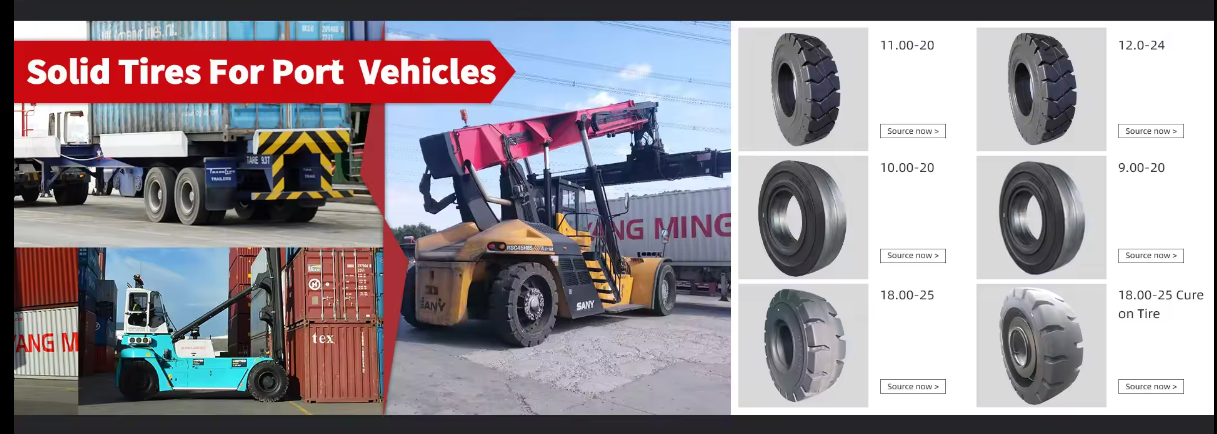
Port operations involve a wide range of heavy-duty equipment such as reach stackers, mobile cranes, container handlers, and internal transport vehicles. These machines rely heavily on high-performance tires to ensure stability, mobility, and safety.
Conventional tires are not designed to withstand the extreme loads and continuous friction found in port environments. Therefore, port tires must offer higher load capacity and wear resistance to support intensive continuous operations.
Key Features of Port Tires
Port tires must meet very high technical standards. Their main characteristics include:
● Ultra-high load capacity: capable of supporting the massive weight of containers and heavy machinery
● Reinforced structure: made with special rubber compounds and multi-layer reinforcement
● Excellent wear resistance: suitable for high-abrasion surfaces such as concrete and industrial asphalt
● Strong stability: ensures safe and precise maneuvering operations
● Long service life: reduces downtime and replacement frequency
● Heat resistance: withstands high temperatures generated by long-term friction
● Compatibility with heavy equipment: specifically designed for port machinery
These features ensure stable performance even under extreme and continuous working conditions.
Main Applications of Port Tires
Port tires are widely used in various heavy machinery and logistics operations, including:
● Reach stackers
● Mobile harbor cranes
● Terminal tractors
● Container transport vehicles
● Heavy cargo handling equipment
● Intermodal logistics systems
Different equipment requires different tire specifications depending on load, frequency of use, and working conditions.
Key Factors Affecting Port Tire Performance
The performance of port tires is influenced by several factors that directly affect efficiency and operational cost:
● Type of surface: concrete, asphalt, or mixed surfaces
● Daily usage intensity: continuous or intermittent operation
● Load weight level: light containers or ultra-heavy loads
● Environmental conditions: humidity, salinity, and temperature variations
● Equipment maintenance: tire pressure and alignment
● Operating speed requirements
Proper evaluation of these factors helps extend tire lifespan and reduce operational failures.
Advantages of Using Specialized Port Tires
Using dedicated port tires offers significant operational and economic benefits:
● Improved efficiency due to lower rolling resistance
● Reduced downtime from mechanical failures
● Lower replacement frequency and long-term cost savings
● Enhanced safety during heavy-load operations
● Better stability in precision handling tasks
● Optimized energy consumption
● Consistent performance in extreme environments
These advantages make port tires a strategic investment for large-scale logistics operations.
Types of Port Tires
Common types of port tires include solid tires, industrial radial tires, and reinforced tubeless tires.
Solid tires are widely used in container handling equipment due to their puncture resistance and long service life. Radial tires offer better shock absorption and are suitable for continuous transport operations. The choice depends on operational intensity and equipment type.
Maintenance and Care of Port Tires
Proper maintenance is essential to ensure optimal performance and extend tire lifespan, even though port tires are designed for extreme conditions.
Regular inspection for uneven wear, maintaining correct tire pressure, and ensuring proper alignment of equipment are crucial. Overloading should also be avoided to prevent structural damage.
A preventive maintenance program helps reduce operational costs and improves overall safety in port operations.
Technological Development of Port Tires
The tire industry has evolved significantly, with modern port tires incorporating advanced materials and structural designs. New rubber compounds improve durability, reduce rolling resistance, and extend service life.
At the same time, sustainable materials are increasingly used to reduce environmental impact and improve energy efficiency in port logistics systems.
Conclusion
Port tires play a vital role in the efficiency and safety of maritime logistics operations. Their high load capacity, durability, and stability enable continuous operation under extreme working conditions.
Choosing the right port tires not only improves productivity but also reduces maintenance costs and extends equipment lifespan. In today’s highly competitive global logistics environment, high-performance tires have become an essential infrastructure component for port operations.
FAQ
What are port tires?
They are specialized tires designed for heavy port machinery, capable of handling extreme loads and harsh working conditions.
What equipment uses port tires?
Reach stackers, cranes, terminal tractors, and container transport vehicles.
What is the difference between port tires and industrial tires?
Port tires are designed for higher loads and more extreme working environments than standard industrial tires.
How long do port tires last?
Their lifespan varies depending on usage intensity but is generally longer than standard tires due to reinforced construction.
Which type of port tire is best for heavy-duty operations?
Solid tires are often preferred for high-frequency, high-load port operations.
Post time: 15-04-2026