
In indoor access applications, scissor lifts are expected to deliver safe elevation, smooth movement, and zero disruption to the working environment. However, one often overlooked factor that directly affects performance and facility standards is the type of tire used. Non marking solid tires for scissor lift equipment are specifically engineered to meet the dual demands of cleanliness and durability, making them a preferred choice for modern indoor operations such as warehouses, maintenance facilities, and commercial buildings.
Why Tire Choice Matters in Scissor Lift Applications
Scissor lifts are widely used in environments where floors are finished, polished, or coated, including epoxy surfaces, tiles, and sealed concrete. Traditional tires containing carbon black tend to leave visible marks during turning, braking, or prolonged use. These marks not only affect the visual appearance of the facility but also increase cleaning frequency and maintenance costs.
At the same time, scissor lifts often operate in confined spaces where precise control and stability are critical. Tires must provide consistent traction without compromising floor integrity. This combination of requirements makes non marking solid tires an ideal solution.
What Are Non Marking Solid Tires?
Non marking solid tires are manufactured using specialized rubber compounds that exclude carbon black, replacing it with materials such as silica or other non-staining fillers. This allows the tire to maintain structural strength while preventing black streaks or scuffs on floors.
In addition to being non marking, these tires feature a solid construction, meaning they do not rely on air pressure. This eliminates the risk of punctures, air leaks, or sudden deflation, which are common issues with pneumatic tires.
The result is a tire that offers both cleanliness and reliability, tailored for indoor lifting equipment.
Performance Advantages in Indoor Environments
Non marking solid tires provide a combination of features that directly enhance scissor lift operation in controlled environments.
● Clean floor operation: Prevents tire marks, maintaining a professional and compliant workspace
● Puncture-proof design: Ensures uninterrupted operation, even in debris-prone areas
● Stable load support: Maintains consistent contact with the ground for safe elevation
● Low maintenance: Eliminates the need for inflation or frequent repairs
● Smooth maneuverability: Supports precise movement in tight indoor spaces
These benefits contribute to both operational efficiency and improved workplace conditions.
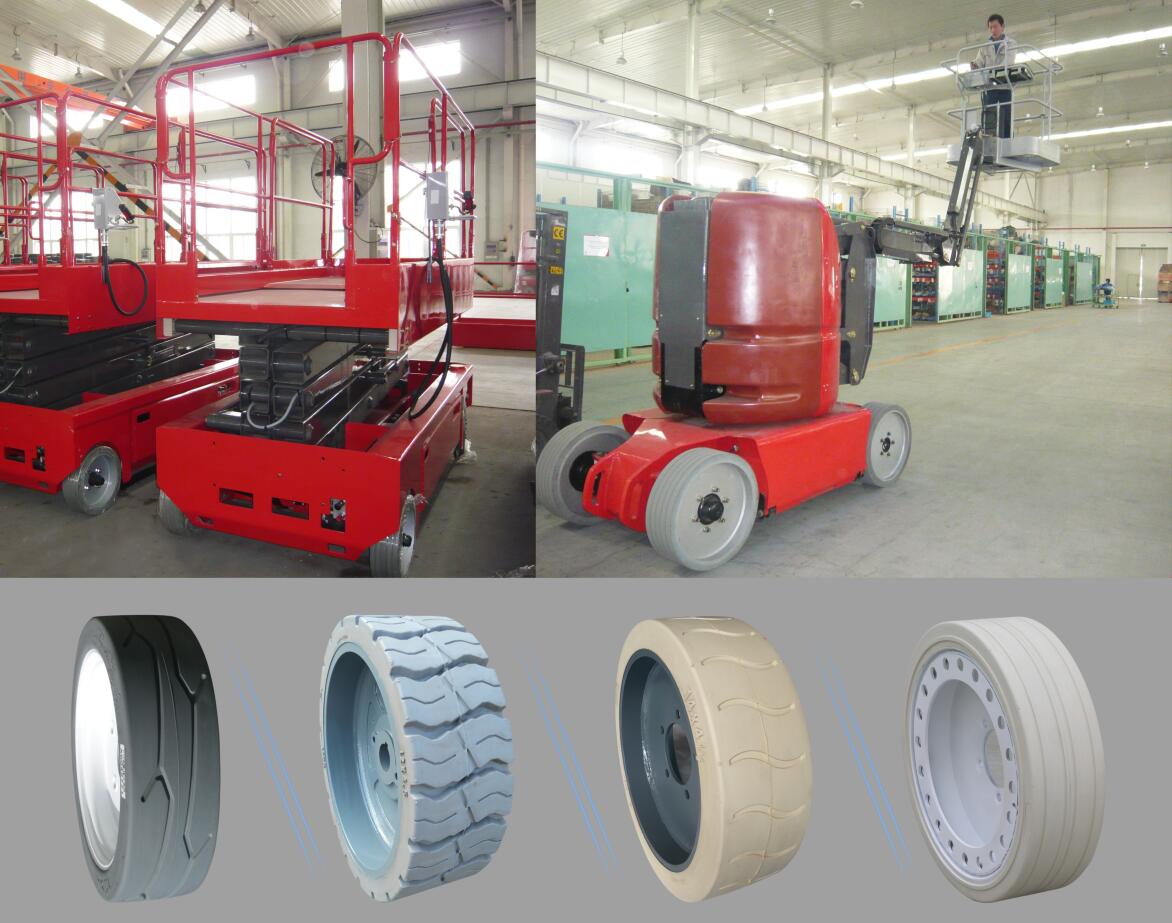
Ideal Use Cases Across Industries
The value of non marking solid tires becomes particularly clear in industries where cleanliness and floor protection are essential.
● Warehousing and logistics: Protects epoxy-coated floors and reduces cleaning requirements
● Retail and shopping centers: Maintains visual cleanliness in customer-facing areas
● Hospitals and healthcare facilities: Supports hygiene standards and reduces contamination risks
● Facility maintenance: Ideal for indoor repair and installation work
● Manufacturing plants: Ensures stable operation without damaging finished floors
In each of these environments, the ability to operate without leaving marks is not just a convenience but a necessity.
Comparing Non Marking Solid Tires with Other Options
When evaluating tire choices for scissor lifts, it is important to understand how non marking solid tires differ from other common types.
● Compared to pneumatic tires: Solid tires eliminate puncture risks and reduce maintenance
● Compared to standard solid tires: Non marking variants prevent floor staining
● Compared to polyurethane wheels: Offer better load capacity and durability in heavy-duty use
This makes non marking solid tires a balanced solution for applications that require both performance and cleanliness.
Design Features That Enhance Durability
Modern non marking solid tires are engineered with advanced design features to ensure long-term performance.
● Multi-layer construction: Combines wear resistance, cushioning, and structural strength
● Abrasion-resistant compounds: Extend service life in high-use environments
● Reinforced core: Provides secure mounting and load stability
● Optimized tread patterns: Improve traction and reduce slippage
These features ensure that the tires can withstand continuous use without compromising performance.
Operational Efficiency and Cost Benefits
Beyond performance, non marking solid tires offer clear economic advantages over time.
By preventing floor marks, they reduce the need for cleaning labor and equipment. This not only lowers operational costs but also minimizes interruptions to daily workflows.
The elimination of puncture-related downtime further improves equipment utilization. Operators can rely on consistent performance without unexpected tire failures.
Additionally, longer service life means fewer replacements, contributing to overall cost savings.
Choosing the Right Non Marking Solid Tires
Selecting the appropriate tire requires careful consideration of equipment specifications and working conditions.
● Match tire size with scissor lift model requirements
● Consider load capacity and operational weight
● Evaluate floor type and surface sensitivity
● Choose compound hardness based on usage intensity
Proper selection ensures optimal performance and maximizes return on investment.
Conclusion
Non marking solid tires for scissor lifts provide a practical solution for indoor operations that demand both cleanliness and reliability. By combining puncture-proof durability with non-staining materials, these tires address key challenges faced in modern facilities.
For businesses operating in warehouses, healthcare environments, retail spaces, and other controlled settings, upgrading to non marking solid tires is a strategic decision that enhances efficiency, reduces maintenance, and preserves floor quality.
FAQ
- Do non marking solid tires wear faster than standard tires?
Modern compounds offer competitive durability, though performance depends on usage conditions. - Are they suitable for outdoor use?
They are primarily designed for indoor environments and may not perform optimally on rough outdoor terrain. - Can they handle heavy loads?
Yes, they are engineered to support the load requirements of scissor lift platforms. - Do they require maintenance?
Maintenance is minimal, but regular inspection is recommended.
Post time: 21-04-2026