
Non-marking solid tires are developed for industrial vehicles that need strong tire performance without leaving black marks on clean floors. In modern factories, warehouses, food processing plants, electronics workshops, pharmaceutical facilities, and indoor logistics areas, floor cleanliness is part of both operational management and brand image.
For companies using forklifts, scissor lifts, warehouse vehicles, and other industrial equipment indoors, ordinary black rubber tires may leave visible marks during driving, braking, or turning. Non-marking solid tires provide a practical solution by combining clean-floor performance with the durability of solid tire construction.
The Clean-Floor Problem in Industrial Vehicle Operation
Many indoor industrial spaces are designed to look clean, organized, and professional. Smooth concrete floors, coated floors, epoxy floors, and polished warehouse surfaces are common in modern facilities. However, these floors can easily show black tire marks when equipment moves repeatedly through aisles, production lines, storage zones, and loading areas.
This problem is especially obvious when forklifts carry heavy loads, turn sharply, or brake frequently. Over time, tire marks can make a clean facility look poorly maintained. Cleaning these marks also requires extra labor, chemicals, and time.
For operations that serve strict industries, such as food, electronics, pharmaceuticals, or clean manufacturing, visible floor marks may also create a negative impression during customer visits, audits, and internal inspections.
What Are Non-Marking Solid Tires?
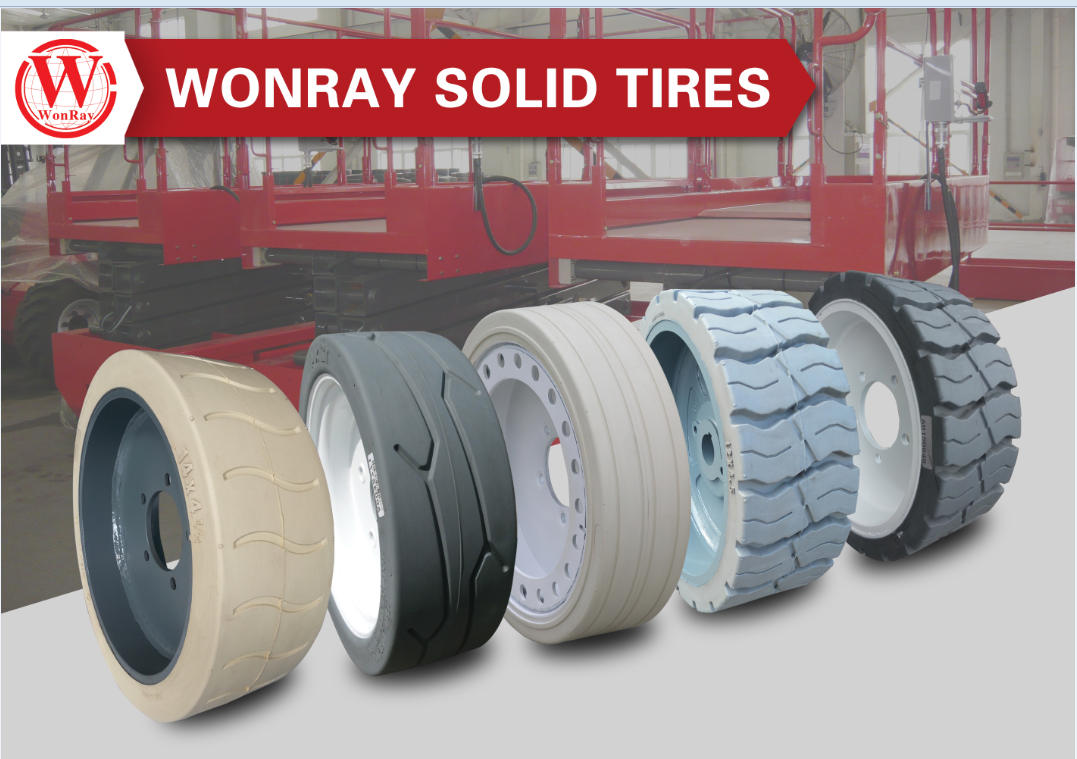
Non-marking solid tires are solid rubber tires made with special rubber compounds that reduce or avoid black marks on the floor. Instead of the traditional black appearance, they are commonly produced in grey or white colors.
The purpose of non-marking tires is not only visual cleanliness. They are also designed to provide the same practical advantages expected from industrial solid tires, including puncture resistance, stable load support, and reduced maintenance needs.
WonRay non-marking solid tires can be used for forklifts, electric forklifts, aerial work platforms, scissor lifts, boom lifts, trailers, and other indoor industrial vehicles where floor protection and equipment reliability are both important.
Where Non-Marking Solid Tires Are Commonly Used
Non-marking solid tires are especially useful in environments where floor appearance, hygiene, and indoor safety are important. They help companies operate industrial vehicles without constantly dealing with black rubber stains.
● Food processing plants where clean production areas need better floor appearance.
● Pharmaceutical workshops where controlled environments require stricter cleanliness.
● Electronics factories where clean floors support organized production management.
● Warehouses and logistics centers with epoxy or polished concrete floors.
● Supermarkets and retail storage areas where equipment may move near customer-facing spaces.
● Airports and ground support areas where equipment appearance and facility cleanliness matter.
● Indoor exhibition halls and event facilities using forklifts or lifting platforms.
● Ultra-clean factories where ordinary black tire marks are not acceptable.
In these settings, non-marking tires help industrial vehicles move smoothly while supporting a cleaner and more professional environment.
Solid Structure for Reliable Daily Use
Non-marking performance is important, but these tires still need to work like industrial tires. A clean tire that wears quickly or cannot handle load pressure would not be practical for B2B users. That is why solid structure remains a key advantage.
Non-marking solid tires do not rely on air pressure, so they help prevent unexpected flats. This is valuable for indoor operations where forklifts and lifting equipment must stay available during production or order fulfillment. The puncture-free structure reduces tire failure caused by nails, metal pieces, pallet damage, or small sharp objects on the floor.
The solid rubber body also supports stable load carrying. Forklifts and industrial vehicles often move goods repeatedly throughout the day, and tire stability affects turning, braking, and lifting confidence. With the right compound design, non-marking solid tires can provide a balance of floor protection, durability, and operating safety.
Why Non-Marking Tires Are Important for Electric Forklifts
Electric forklifts are widely used indoors because they are cleaner, quieter, and more suitable for warehouses and factories than combustion-powered equipment. Since electric forklifts often operate on clean floors, tire marks can become a major issue.
Non-marking solid tires match the needs of electric forklifts because they support indoor movement without leaving dark marks during frequent use. They can also help reduce maintenance concerns because operators do not need to manage tire pressure or repair punctures.
For companies using electric forklifts in production workshops, storage centers, or clean logistics spaces, non-marking solid tires help maintain both appearance and productivity.
Supporting Aerial Work Platforms and Lifting Equipment
Non-marking solid tires are also useful for aerial work platforms, including scissor lifts and boom lifts. These machines often operate inside buildings during installation, repair, lighting maintenance, warehouse construction, factory inspection, and facility management.
When lifting platforms move across finished floors, ordinary tires may damage the appearance of the site. Non-marking solid tires help reduce this problem while still providing strong support for the equipment.
For rental companies and equipment service providers, this can be especially valuable. A machine equipped with non-marking tires is easier to use in more indoor environments, including shopping malls, airports, workshops, hotels, and commercial facilities.
Practical Benefits for Facility Management
Non-marking solid tires provide value beyond the tire itself. They also support better facility management. When tire marks are reduced, cleaning teams spend less time removing stains. Floors can keep a more professional appearance for longer periods. Visitors, customers, auditors, and staff can see a cleaner working environment.
This is important because facility appearance often reflects company management. A clean workshop or warehouse suggests better organization, stronger quality awareness, and more attention to operational details.
For companies managing large indoor spaces, reducing tire marks can also protect floor coatings. Frequent cleaning with strong chemicals may damage surface coatings over time, while tire marks may require extra scrubbing. Non-marking tires help reduce this pressure.
Balancing Cleanliness and Durability
One of the main concerns about non-marking tires is whether they are durable enough for daily industrial use. A well-designed non-marking solid tire should not only avoid black marks but also provide stable wear resistance and load performance.
WonRay non-marking tires can be positioned as products for clean-floor applications that still require solid tire durability. They are suitable for customers who do not want to choose between floor protection and industrial performance.
This balance is important in B2B applications. Factories and warehouses need tires that support real work conditions, not only clean appearance. Non-marking solid tires meet this need by combining specialized rubber compounds with practical industrial tire structure.
Summary
Non-marking solid tires are an effective solution for industrial vehicles operating in clean indoor environments. They help reduce black floor marks while maintaining the key benefits of solid tires, including puncture-free operation, load stability, reduced maintenance, and reliable daily use.
For WonRay, non-marking solid tires are suitable for clean warehouses, electric forklift applications, food plants, electronics factories, pharmaceutical workshops, airports, lifting platforms, and other environments where floor cleanliness and equipment performance must work together.
FAQ
1、What are non-marking solid tires?
Non-marking solid tires are industrial solid tires made with special rubber compounds that help prevent black marks on clean floors. They are often produced in grey or white colors.
2、Where are non-marking solid tires used?
They are commonly used in clean warehouses, food factories, pharmaceutical workshops, electronics plants, airports, supermarkets, indoor logistics centers, and facilities using electric forklifts or aerial work platforms.
3、Are non-marking solid tires puncture-free?
Yes. Like other solid tires, non-marking solid tires do not rely on air pressure, so they are resistant to punctures and flats.
4、Can non-marking tires be used on electric forklifts?
Yes. Non-marking solid tires are very suitable for electric forklifts working indoors because they support clean-floor operation and reduce tire maintenance needs.
Post time: 12-05-2026