
Mold-on solid tires are widely used in modern industrial equipment systems where stability, durability, and uninterrupted operation are critical performance requirements. These tires are engineered for heavy-duty applications in warehouses, manufacturing plants, logistics hubs, airports, and port operations where material handling equipment must operate continuously under high load conditions.
Unlike conventional replaceable tire systems, mold-on solid tires are permanently formed by bonding rubber directly onto a metal wheel core during the vulcanization process. This creates a unified wheel structure that significantly improves mechanical strength, reduces maintenance complexity, and enhances long-term operational reliability in demanding industrial environments.
Integrated Wheel Design and Its Industrial Importance
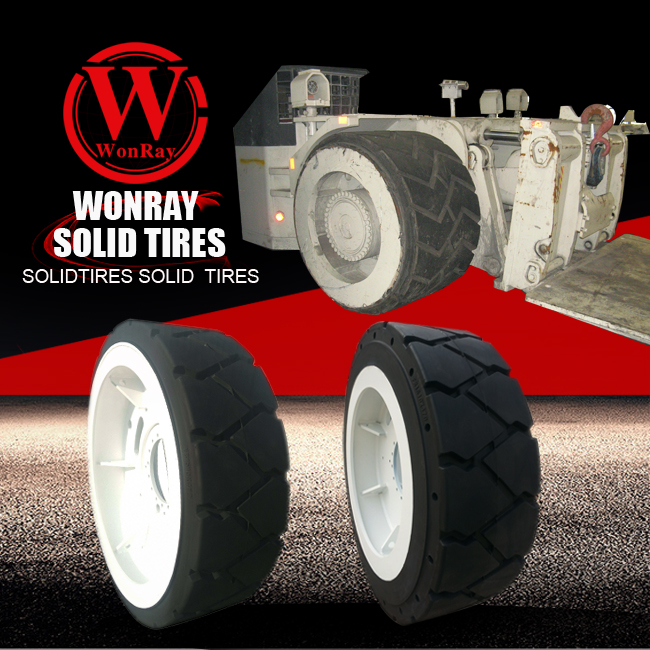
The defining feature of mold-on solid tires is their integrated construction, where the rubber and wheel core become a single inseparable unit. This eliminates the need for traditional tire mounting systems and removes common failure points associated with loosening, slippage, or improper installation.
In industrial environments where equipment operates continuously and downtime is costly, this integrated design offers a significant operational advantage.
● Creates a permanent bond between rubber and wheel core for maximum structural integrity
● Eliminates tire bead failure and installation-related risks
● Reduces maintenance operations associated with tire replacement systems
● Improves mechanical reliability in continuous operation environments
● Enhances overall wheel system rigidity under heavy load conditions
Why Mold-on Solid Tires Are Preferred in Material Handling Systems
Material handling operations require equipment that can perform repetitive movements under heavy load conditions without interruption. Mold-on solid tires are specifically designed for such environments where consistency and durability are more important than speed or flexibility.
They are commonly used in controlled indoor and semi-controlled industrial environments where equipment follows predictable operational paths.
● Provide stable performance in repetitive industrial workflows
● Reduce equipment downtime caused by tire maintenance interruptions
● Ensure consistent load-bearing performance under continuous use
● Improve operational safety in busy industrial zones
● Support long service life in high-frequency usage environments
Structural Engineering of Mold-on Solid Tires
The engineering design of mold-on solid tires focuses on maximizing load distribution efficiency while maintaining long-term structural stability. The rubber is permanently molded onto a steel core under controlled heat and pressure conditions, ensuring a strong molecular bond between materials.
This manufacturing method enhances resistance to deformation, vibration, and mechanical stress during operation.
● Permanent vulcanized bonding between rubber and steel core
● High-density rubber composition improves structural strength
● Uniform load distribution reduces stress concentration points
● Reinforced outer tread layer increases wear resistance
● Improved rigidity enhances equipment handling stability
Industrial Applications Across Multiple Sectors
Mold-on solid tires are widely used in various industrial sectors where equipment must operate under repetitive load cycles and controlled movement patterns. Their reliability makes them suitable for both light-heavy and heavy-duty material handling equipment.
● Forklifts operating in warehouses and distribution centers
● Tow tractors used in factory internal logistics systems
● Airport ground handling vehicles transporting cargo and baggage
● Port terminal equipment operating in container and cargo yards
● Manufacturing plants with continuous material transfer systems
● Industrial logistics hubs requiring stable and predictable operations
Each application benefits from reduced downtime and improved equipment reliability.
Operational Performance Advantages in Industrial Use
Mold-on solid tires provide significant improvements in operational performance by reducing variability in wheel behavior and ensuring stable movement under load. This consistency is especially important in automated or semi-automated logistics systems.
Their structure also helps minimize vibration transfer, improving both equipment lifespan and operator comfort.
● Stable performance under continuous heavy load cycles
● Reduced vibration improves equipment durability and precision
● Enhanced safety during lifting and transportation operations
● Consistent traction behavior across industrial surfaces
● Improved maneuverability in confined working environments
Advanced Material Technology and Production Process
The production of mold-on solid tires involves advanced vulcanization techniques combined with high-performance rubber compounds designed for industrial durability. The bonding process ensures that the rubber becomes permanently integrated with the wheel core structure.
This method significantly improves resistance to mechanical fatigue and long-term deformation.
● High-performance rubber compounds designed for industrial stress resistance
● Precision vulcanization process ensures permanent structural bonding
● Heat-resistant formulations support continuous operation conditions
● Anti-wear materials extend operational lifespan in harsh environments
● Structural reinforcement enhances long-term mechanical stability
Economic Efficiency and Lifecycle Value
Mold-on solid tires offer strong long-term economic advantages in industrial operations due to their extended lifespan and reduced maintenance requirements. While the initial investment is higher compared to conventional tire systems, the total cost of ownership is significantly lower over time.
Their durability reduces replacement cycles and minimizes operational interruptions.
● Extended service life reduces frequency of tire replacement
● Lower maintenance requirements decrease operational costs
● Reduced downtime improves overall productivity efficiency
● Increased equipment utilization rates in industrial fleets
● Long-term cost savings in high-intensity operations
Safety Performance in Industrial Environments
Safety is a critical factor in industrial material handling operations, especially in environments with heavy machinery and constant movement. Mold-on solid tires enhance safety by eliminating risks associated with tire failure or separation.
Their rigid bonded structure ensures predictable performance even under maximum load conditions.
● Stable load handling reduces risk of equipment instability
● Eliminates sudden tire failure caused by air loss or punctures
● Improves control during lifting and transport operations
● Enhances safety in high-traffic industrial environments
● Supports reliable operation in continuous workflow systems
Environmental Benefits and Sustainability Impact
Mold-on solid tires also contribute to sustainability goals by reducing material waste and improving resource efficiency. Their long service life reduces the frequency of tire disposal and replacement cycles.
In addition, improved operational efficiency reduces energy consumption in material handling systems.
● Reduced tire waste through extended product lifespan
● Lower material consumption due to fewer replacements
● Improved energy efficiency in industrial equipment operation
● Reduced environmental footprint from industrial logistics systems
Conclusion
Mold-on solid tires represent a highly durable and efficient wheel solution for industrial equipment operating in repetitive and heavy-load environments. Their integrated construction, advanced rubber technology, and permanent bonding structure provide exceptional stability, reduced maintenance needs, and long-term cost efficiency.
As industrial systems continue to move toward higher automation and efficiency standards, mold-on solid tires will remain an essential component in ensuring reliable and continuous material handling performance across global industries.
Post time: 26-05-2026