
In today’s industrial mobility systems, equipment reliability and uptime have become critical performance indicators for manufacturing plants, logistics centers, airports, and construction operations. Every component of material handling equipment contributes to productivity, but tires remain one of the most influential factors affecting stability, safety, and lifecycle cost. Among different solid tire technologies, mold-on solid tires stand out as a highly engineered solution designed for demanding, high-frequency, and heavy-load applications where failure is not an option.
As global industries continue to shift toward automation, continuous operation, and lean maintenance strategies, mold-on solid tires are increasingly adopted as a core component in modern fleet management strategies.
The Engineering Concept Behind Mold-on Solid Tires
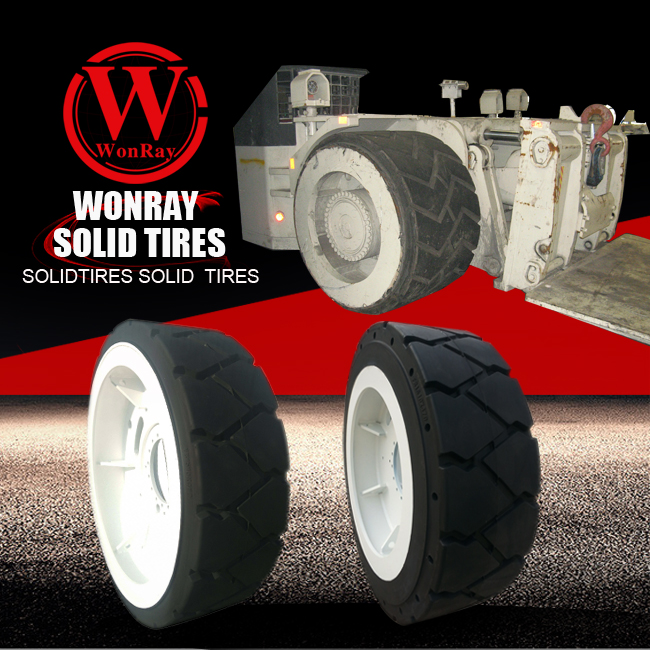
Mold-on solid tires are produced through a specialized vulcanization process in which high-performance rubber is permanently bonded to a metal wheel core under controlled high-pressure and high-temperature conditions. This process creates a unified structure where the tire and wheel function as a single integrated component.
Unlike conventional press-on or replaceable solid tires, mold-on solid tires are not designed for periodic removal, which significantly enhances structural integrity and operational consistency.
Core engineering features include:
● Permanent rubber-to-metal bonding achieved through vulcanization chemistry
● High-density rubber compounds optimized for abrasion and load resistance
● Precision mold forming to ensure uniform geometry and balanced rotation
● Reinforced interface design to eliminate micro-movement between tire and rim
This integrated design is particularly valuable in environments where equipment is exposed to continuous stress cycles.
Why Mold-on Solid Tires Are Essential for Industrial Operations
Industrial equipment operates under conditions that combine heavy loads, repetitive cycles, and unpredictable surface conditions. These factors create constant stress on tires, making durability and reliability essential.
Mold-on solid tires address these challenges by providing:
● A structurally unified system that eliminates tire-rim separation risks
● Stable performance under long-duration static and dynamic loads
● Consistent rolling behavior even under uneven weight distribution
● High resistance to deformation during continuous industrial cycles
These characteristics make them suitable for mission-critical applications where downtime can directly impact production output.
Performance Advantages in Heavy-Duty Environments
The real value of mold-on solid tires becomes most visible in heavy-duty applications such as forklifts, lifting platforms, industrial trailers, and ground support equipment.
1. Structural Integrity Under Extreme Load Conditions
One of the most important advantages is the ability to maintain structural integrity even under maximum load stress.
● Prevents tire slippage or separation from wheel core during operation
● Maintains stable load distribution across the entire tire surface
● Ensures consistent contact pressure with industrial flooring
● Supports safe lifting, transporting, and stacking operations
This makes them particularly effective in high-load warehouse and manufacturing environments.
2. Resistance to Harsh Industrial Surfaces
Industrial environments often include rough concrete floors, metal debris, oil contamination, and uneven surfaces, all of which accelerate tire wear.
● High abrasion resistance ensures long service life on concrete surfaces
● Strong rubber bonding prevents tread delamination
● Maintains performance in debris-heavy operational zones
● Suitable for both indoor and semi-outdoor environments
This durability significantly reduces replacement frequency.
3. Operational Stability for Continuous Use
Modern industrial fleets often operate across multiple shifts with minimal downtime, requiring consistent tire performance.
● Eliminates air pressure fluctuations found in pneumatic systems
● Provides stable rolling resistance under continuous operation
● Reduces vibration inconsistency during long work cycles
● Maintains predictable handling characteristics across shifts
This stability improves overall fleet efficiency.
Maintenance Optimization and Fleet Efficiency
One of the strongest advantages of mold-on solid tires is their ability to reduce maintenance complexity in industrial fleets.
In large-scale operations, maintenance efficiency directly impacts operational cost and equipment availability.
Key benefits include:
● No requirement for air inflation or pressure monitoring systems
● Reduced frequency of tire inspections and corrective maintenance
● Elimination of puncture-related emergency repairs
● Lower dependency on spare tire inventory and logistics
These factors allow maintenance teams to focus on higher-value equipment management tasks rather than routine tire servicing.
Safety Enhancements in Industrial Mobility Systems
Safety is a critical priority in industrial environments where forklifts, trailers, and lifting equipment operate in close proximity to personnel and infrastructure.
Mold-on solid tires contribute to safety in several important ways:
● Eliminates sudden blowout risk associated with pneumatic tires
● Provides stable load support during lifting and transport operations
● Reduces lateral instability during turning or braking maneuvers
● Enhances equipment predictability in congested operational zones
This improves operator confidence and reduces accident probability.
Industrial Applications Across Multiple Sectors
Mold-on solid tires are widely used across industries where equipment reliability and uptime are critical performance requirements.
Typical applications include:
● Forklifts in manufacturing and warehouse logistics systems
● Aerial work platforms used in construction and maintenance operations
● Industrial trailers for internal material transportation
● Airport ground support equipment and baggage handling systems
● Heavy-duty indoor logistics vehicles operating in continuous cycles
Their versatility makes them suitable for both high-intensity indoor environments and demanding outdoor conditions.
Cost Efficiency and Lifecycle Value
From a B2B perspective, cost efficiency is not measured only by purchase price but by total lifecycle cost, including maintenance, downtime, and replacement frequency.
Mold-on solid tires deliver strong long-term economic value:
● Extended service life reduces replacement cycles
● Lower downtime improves equipment utilization rates
● Reduced maintenance labor and repair costs
● Improved operational consistency reduces indirect productivity losses
Over time, these benefits contribute to significantly lower total cost of ownership.
Selection Criteria for Mold-on Solid Tires
Choosing the right mold-on solid tire requires careful analysis of operational requirements and equipment specifications.
Important factors include:
● Load capacity requirements based on equipment type and maximum working weight
● Surface conditions such as smooth concrete, rough industrial flooring, or mixed terrain
● Duty cycle intensity including shift frequency and operating hours
● Environmental exposure including temperature variation, chemicals, and debris conditions
Proper selection ensures maximum performance, durability, and safety.
Future Trends in Mold-on Solid Tire Technology
As industrial systems move toward electrification, automation, and smart logistics, tire technology is also evolving to support new operational demands.
Key development directions include:
● Low rolling resistance materials for energy-efficient electric equipment
● Advanced bonding technologies for enhanced structural reliability
● Improved rubber compounds for longer wear life and reduced heat buildup
● Application-specific tire designs tailored for different industrial vehicles
These innovations are expected to further strengthen the role of mold-on solid tires in modern industrial ecosystems.
Conclusion
Mold-on solid tires represent a highly engineered and performance-oriented solution for heavy-duty industrial mobility applications. Their permanent bonding structure, superior load stability, and low-maintenance characteristics make them an ideal choice for industries that prioritize uptime, safety, and lifecycle cost efficiency. By integrating wheel and tire into a single durable unit, they deliver consistent performance under the most demanding operating conditions, supporting the evolving needs of modern industrial fleets.
FAQ
1. What makes mold-on solid tires different from other solid tires?
They are permanently bonded to the wheel during vulcanization, creating a single integrated structure rather than a replaceable tire system.
2. Are mold-on solid tires suitable for high-intensity operations?
Yes, they are designed specifically for continuous heavy-duty industrial use.
3. Do mold-on solid tires require regular maintenance?
They require minimal maintenance since there is no air pressure system and no risk of tire-rim separation.
4. Which industries commonly use mold-on solid tires?
They are widely used in logistics, manufacturing, construction, airports, and industrial material handling systems.
Post time: 14-04-2026