
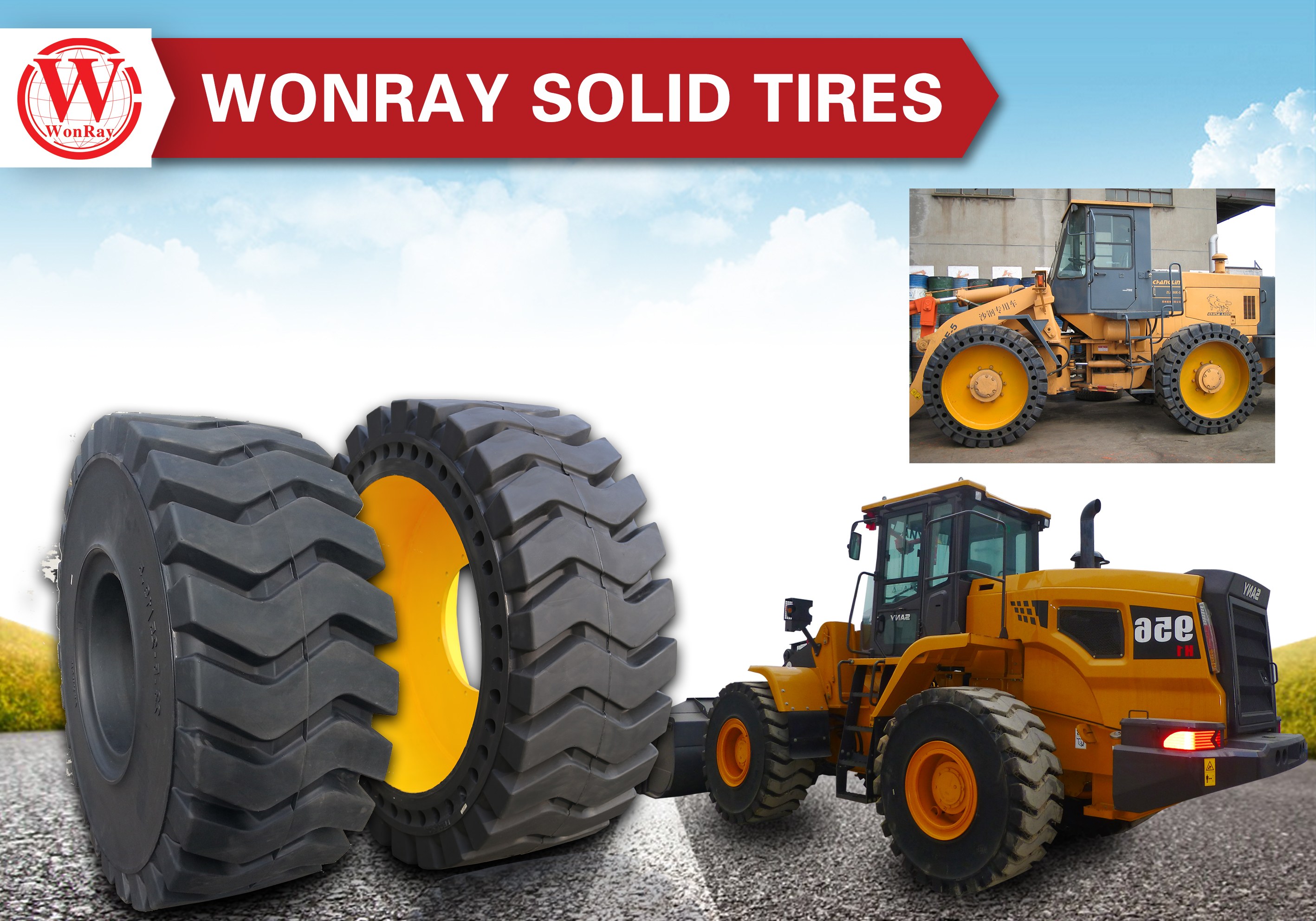
Loader solid tires play an essential role in modern industrial material handling systems where reliability, continuous operation, and load stability are critical performance requirements. These tires are widely used on wheel loaders operating in construction sites, mining zones, recycling facilities, ports, and large-scale industrial yards where equipment is exposed to constant impact stress and abrasive ground conditions.
Unlike pneumatic tires that rely on air pressure for load support, solid tires are built from fully dense rubber structures that eliminate internal air cavities. This design ensures that loaders can continue operating even in environments filled with sharp debris, uneven terrain, and heavy-duty cyclic loading conditions where conventional tires often fail.
Why Loader Solid Tires Are Critical for Continuous Industrial Operations
In heavy-duty industries, loader machines are expected to operate under high workload conditions for extended hours, often in multi-shift schedules. Any unexpected tire failure can result in costly downtime, production delays, and increased maintenance complexity.
Loader solid tires are specifically developed to ensure operational continuity by eliminating the most common causes of tire failure such as punctures, blowouts, and pressure loss.
● They ensure uninterrupted operation in continuous loading and transport cycles
● They eliminate downtime caused by air leakage or tire puncture risks
● They maintain consistent performance under fluctuating load conditions
● They support safe operation in high-impact industrial environments
● They improve equipment reliability in demanding multi-shift workflows
Engineering Structure of Loader Solid Tires
The structural composition of loader solid tires is designed to maximize strength while maintaining stability under extreme mechanical stress. Their fully solid rubber construction distributes load evenly across the entire tire body, reducing stress concentration points that often lead to deformation or premature failure.
Advanced manufacturing techniques integrate multiple functional layers into a single tire structure to enhance durability and operational performance.
● Fully solid rubber body eliminates internal air pressure dependency
● Reinforced core structure improves resistance to heavy compression loads
● Multi-layer design enhances shock absorption and structural durability
● High-strength sidewalls resist deformation during heavy lifting operations
● Wear-resistant tread surface extends service life in abrasive conditions
Application Scenarios in Heavy Industry
Loader solid tires are widely used across multiple industrial sectors where equipment must handle heavy materials and operate in harsh environmental conditions. These tires are essential for maintaining operational efficiency in both indoor and outdoor industrial systems.
● Construction sites involving excavation, loading, and aggregate transport
● Mining operations with continuous handling of ore, rocks, and minerals
● Waste management facilities processing scrap and industrial debris
● Recycling plants with high-impact material sorting and handling operations
● Port terminals handling bulk cargo and container yard operations
● Industrial logistics centers requiring continuous heavy material movement
Each environment places different stress demands on tires, including load weight variation, surface roughness, and operational frequency.
Operational Benefits in Real-World Working Conditions
The use of loader solid tires provides significant operational advantages in terms of machine uptime, safety performance, and long-term cost efficiency. Their ability to maintain structural integrity under continuous stress makes them highly suitable for industries where equipment downtime must be minimized.
One of the most important benefits is consistent operational stability, even in environments where ground conditions are unpredictable and heavily abrasive.
● Improved machine stability during heavy lifting and loading cycles
● Reduced risk of unexpected equipment downtime from tire failure
● Enhanced traction performance on gravel, mud, and uneven surfaces
● Better load distribution under extreme working conditions
● Increased precision control during confined space operations
These advantages directly contribute to higher productivity and safer working environments in industrial operations.
Advanced Material Technology and Manufacturing Process
Modern loader solid tires are produced using advanced rubber compounding technologies combined with structural reinforcement materials that enhance durability and performance. These materials are engineered to withstand continuous mechanical stress, heat buildup, and surface abrasion.
The integration of high-performance materials ensures that the tires maintain stability even during prolonged high-load operations.
● High-density rubber compounds designed for extreme wear resistance
● Heat-resistant formulations for continuous operational cycles
● Reinforced internal structures for load-bearing stability
● Anti-cut and anti-abrasion tread compounds for rough terrain use
● Advanced bonding technology to prevent structural separation
Cost Efficiency and Lifecycle Performance
Although loader solid tires typically require higher initial investment compared to pneumatic alternatives, their long-term operational value is significantly higher due to reduced maintenance requirements and extended service life.
Their durability minimizes unexpected downtime and helps optimize total cost of ownership for industrial equipment fleets.
● Lower tire replacement frequency reduces long-term expenses
● Reduced maintenance requirements improve operational efficiency
● Minimized downtime increases overall productivity output
● Extended tire lifespan improves equipment lifecycle value
● Better cost efficiency in high-intensity industrial operations
Environmental Benefits and Sustainability Impact
Loader solid tire technology also supports environmental sustainability by reducing material waste and improving energy efficiency. Longer tire lifespan reduces the frequency of disposal, while improved rolling performance contributes to lower fuel consumption.
These factors help industries reduce their environmental footprint while maintaining high productivity levels.
● Reduced waste generation due to longer service life
● Lower fuel consumption through optimized rolling efficiency
● Improved energy utilization in heavy equipment operations
● Decreased environmental impact from frequent tire replacement
Conclusion
Loader solid tires are an essential component in modern industrial equipment systems, providing unmatched durability, stability, and operational efficiency in harsh working environments. Their solid construction and advanced engineering make them highly suitable for construction, mining, recycling, logistics, and heavy material handling industries.
As industrial operations continue to prioritize efficiency, safety, and cost reduction, loader solid tires will remain a core solution for ensuring reliable and continuous equipment performance under extreme working conditions.
FAQ
1. What are loader solid tires used for in industry?
They are used in wheel loaders operating in construction, mining, recycling, and industrial material handling environments.
2. Why are solid tires preferred over pneumatic tires for loaders?
Because they eliminate air pressure failures and provide higher durability in harsh working conditions.
3. Can loader solid tires handle continuous heavy loads?
Yes, they are specifically designed for high-load and continuous operation environments.
4. Do loader solid tires reduce maintenance costs?
Yes, they significantly reduce maintenance needs by preventing punctures and tire failures.
Post time: 26-05-2026