
Safety is the highest priority in any aerial work operation. Whether workers are performing building maintenance, warehouse stocking, electrical installation, or industrial inspection, aerial work platforms (AWPs) are designed to provide stable elevation under controlled conditions. However, while most attention is given to hydraulic systems, guardrails, and control units, one of the most critical safety components is often overlooked: the tires.
Solid tires have become an increasingly important upgrade for aerial work platforms due to their ability to significantly improve stability, reduce operational risks, and ensure consistent performance in elevated environments. For industries where human life is directly dependent on equipment reliability, tire performance is not a secondary factor—it is a foundational safety element.
Why Tire Safety Matters More in Elevated Work Than Ground Equipment
Unlike ground-based transport equipment, aerial work platforms operate in a vertical risk zone. Even minor instability at ground level can be amplified at height, increasing the risk of tipping, vibration, or sudden movement during operation.
When a platform is raised several meters above ground, the contact point between machine and surface becomes the only stability foundation. Tires play a direct role in controlling:
- Load distribution
- Machine balance during lifting
- Vibration absorption
- Movement precision during positioning
Any failure in this system can compromise operator safety instantly.
Hidden Risks of Pneumatic Tires in Elevated Applications
Many aerial work platforms still use pneumatic tires due to cost and flexibility advantages. However, in real-world applications, several hidden risks exist.
The first major risk is sudden air loss. A puncture caused by debris on construction sites or industrial floors can immediately deflate a tire. If this occurs while the platform is elevated, it can lead to dangerous tilting or instability.
Another issue is gradual pressure imbalance. Even without punctures, slow air leakage or temperature changes can cause uneven tire pressure, resulting in uneven support across the machine base.
Vibration is also a concern. Pneumatic tires absorb impact differently depending on pressure levels, meaning stability can vary during operation.
How Solid Tires Enhance Structural Stability
Solid tires eliminate air dependency entirely. Instead of relying on pressure, they use engineered rubber structures that maintain shape under load.
This provides a consistent contact surface with the ground, ensuring that stability remains constant regardless of operating conditions.
In aerial work environments, this consistency translates directly into safer elevation, smoother lifting motion, and reduced platform sway.
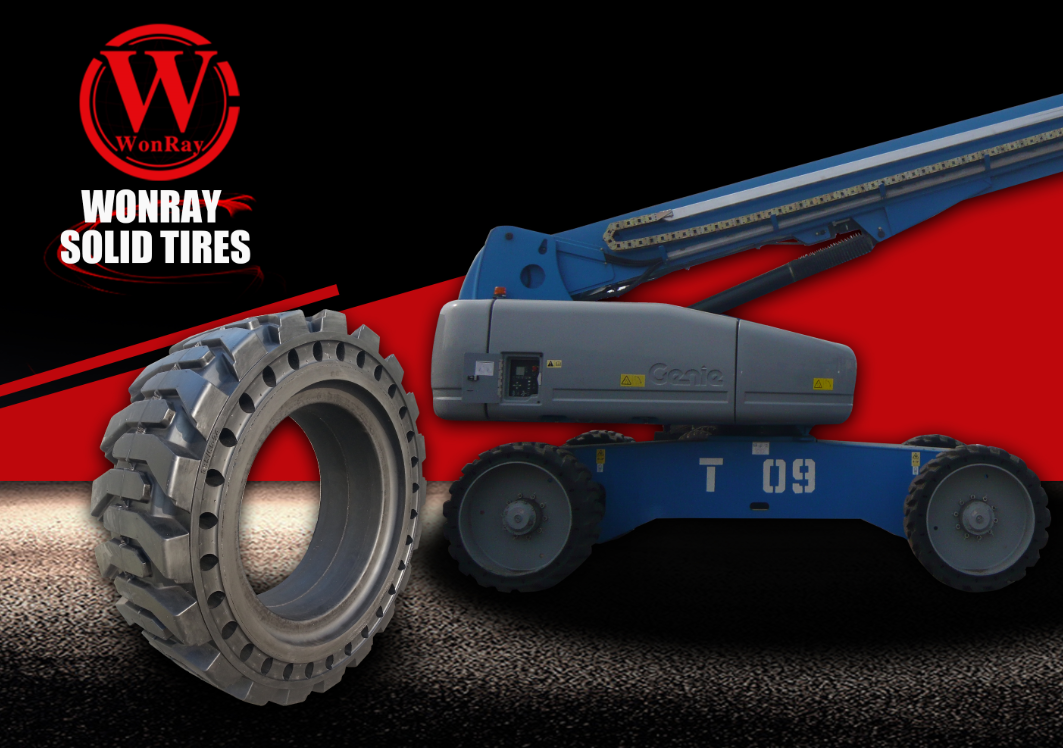
Safety Advantages of Solid Tires in Real Work Conditions
● Elimination of sudden deflation risk
Since there is no air inside the tire, there is no possibility of sudden failure during elevation.
● Improved machine balance during lifting operations
Solid tires maintain consistent height and pressure distribution, reducing platform tilt risk.
● Better performance on uneven surfaces
Construction sites and industrial floors often contain irregularities that solid tires can better absorb.
● Reduced vibration transfer to operator platform
Stable tire structure helps minimize vibration during vertical movement.
● Higher reliability during continuous operation cycles
Ideal for rental fleets and industrial maintenance teams working multiple shifts.
Application Impact Across Industries
In construction, improved tire stability reduces risk during steel structure installation and exterior work.
In warehouses, stable scissor lift operation improves safety during shelving and inventory tasks.
In industrial maintenance, consistent movement allows safer inspection of machinery and high installations.
In commercial building services, window cleaning and façade maintenance benefit from reduced vibration and smoother elevation.
Operational Efficiency Benefits Beyond Safety
While safety is the primary advantage, solid tires also improve efficiency.
Equipment requires fewer interruptions for maintenance, increasing utilization rates in rental fleets.
Operators experience more predictable machine behavior, reducing training complexity and improving workflow speed.
Downtime caused by tire damage is significantly reduced, allowing projects to stay on schedule.
Design Factors That Influence Performance
The performance of solid tires depends on material hardness, structural layering, and tread design.
A balance must be maintained between stiffness and shock absorption. Too rigid can increase vibration, while too soft may reduce load stability.
Wheel size also influences platform behavior, especially during elevation and lateral movement.
Future Trends in Aerial Work Tire Technology
As aerial work platforms become more electrified and intelligent, tire systems are evolving toward lower vibration, higher energy efficiency, and longer lifespan designs.
Smart fleet management systems also benefit from consistent tire performance, improving predictive maintenance accuracy.
Conclusion
Solid tires play a crucial role in improving safety standards in aerial work platforms. By eliminating puncture risk and ensuring stable machine support, they significantly reduce operational hazards in elevated environments.
For industries where safety is non-negotiable, solid tires are not just an upgrade—they are a structural safety improvement.
FAQ
1、Why are solid tires safer for aerial work platforms?
Because they eliminate sudden deflation risks and provide stable machine support.
2、Do they reduce vibration during operation?
Yes, they provide more consistent ground contact and reduce instability.
3、Are they suitable for construction sites?
Yes, especially for rough and debris-filled environments.
4、Do they improve operational efficiency?
Yes, by reducing downtime and maintenance interruptions.
Post time: 20-05-2026