
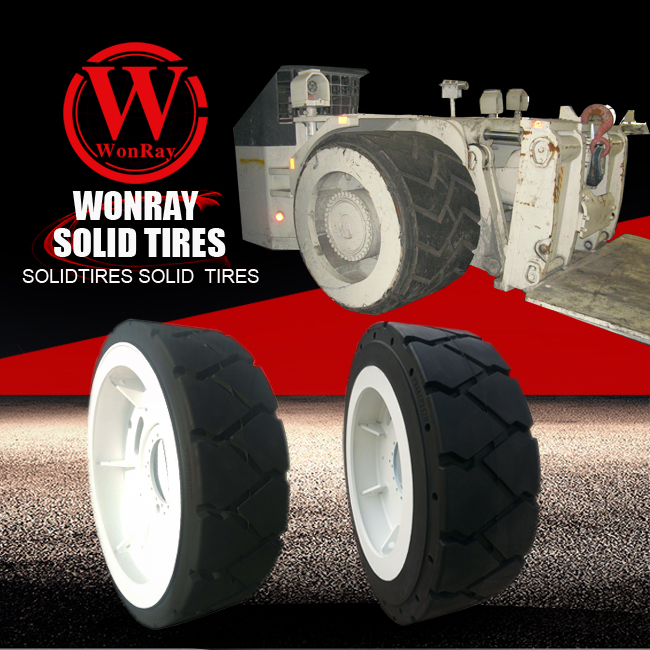
A Cured On Tire is useful when the wheel is expected to do more than simply roll. In heavy industrial service, repeated starts, braking, tight turns, sustained loads, vibration, and long working cycles place stress on the entire wheel assembly. If the tire and wheel interface is not stable, the result can be movement, uneven wear, extra heat, or repeated maintenance. A cured-on design approaches the problem differently: the rubber is molded and bonded directly onto the metal wheel center during production, so the rubber and rim work as one integrated unit.
The Real Problem Is Often the Wheel-Tire Interface
Industrial tire problems are often blamed on tread wear, but the tread is only one part of the system. Under high load, the wheel must transmit driving force, braking force, and side force through the tire without unwanted movement between components. Frequent directional changes can increase shear stress. Continuous load can create deformation and heat. Rough or contaminated floors can add impact and cutting forces.
With a conventional replaceable tire-and-rim arrangement, the mounting system must remain correct throughout the service cycle. A Cured On Tire removes one interface from the equation because the rubber is permanently bonded to the wheel center. That makes the assembly compact and structurally consistent, which is especially valuable where repeated wheel movement or frequent tire service is undesirable.
What the Integrated Structure Actually Does
The main value of a Cured On Tire is not that it is “harder” than every other tire. Its value comes from how the load is transferred through a bonded assembly.
First, the integrated construction helps keep the rubber and wheel center working together under torque. During acceleration and braking, the wheel does not rely on air pressure, and the rubber is not a separate loose component around the rim. This supports predictable response in slow-speed industrial equipment.
Second, the solid rubber section carries load without puncture-related air loss. Sharp debris can still cut or damage rubber, but a nail or metal fragment does not create the sudden pressure loss associated with a pneumatic tire.
Third, the construction can be engineered around the application. Rubber compound, tread profile, wheel center design, dimensions, color, and bonding process can be selected according to load, floor condition, operating hours, temperature, and cleanliness requirements.
Where Cured On Tires Solve the Most Practical Problems
The best application is not defined by industry name alone. It is defined by the combination of load, duty cycle, floor condition, and the consequence of wheel-related downtime.
Underground mining and support equipment. Mine support vehicles and continuous-duty underground equipment may encounter heavy loads, abrasive surfaces, sharp debris, and repeated low-speed movement. Here, a bonded solid wheel can reduce puncture-related interruptions while a suitable compound helps resist cutting and wear.
Passenger boarding bridges. Boarding bridge wheels need stable support because the bridge repeatedly extends, retracts, aligns, and stops in precise positions. A consistent solid wheel assembly helps maintain predictable movement under load without pressure checks.
Conveyor and material-transfer equipment. Mobile conveyors, transfer units, and industrial support equipment often work in repeated cycles. In these applications, stable rolling, controlled deformation, and heat management are more important than high road speed.
Special construction and industrial vehicles. Some low-speed vehicles use cured-on wheels where compact wheel geometry, heavy loading, and reduced tire service are important. The correct design depends on the vehicle, not simply on tire diameter.
Why Heat and Adhesion Matter More Than They First Appear
Every solid rubber tire generates heat as the rubber flexes under load. The problem becomes more serious when load, speed, travel distance, or turning frequency increases. Excessive heat can accelerate rubber aging and weaken long-term performance. That is why a Cured On Tire should never be selected only by outside diameter.
The rubber compound needs to balance load support, resilience, wear resistance, and heat build-up. The bond between rubber and steel is equally important. A good bonded assembly must maintain adhesion through repeated loading, vibration, and temperature changes. In demanding service, adhesion quality is not a cosmetic manufacturing detail; it is part of the wheel’s structural reliability.
When a Cured On Tire Is Not Automatically the Best Choice
The integrated structure also creates an important limitation: the rubber and wheel center are not intended to be separated during normal replacement. When the rubber reaches the end of its service life, the complete bonded assembly is normally replaced. For equipment designed around easily replaceable tires and reusable rims, another solid tire structure may be more practical.
A cured-on wheel is also not a universal answer for high-speed travel. Most industrial solid tire applications are low-speed and load-focused. If a vehicle travels long distances, runs at higher speed, or experiences unusual thermal conditions, the load-speed-duty cycle should be checked carefully before choosing the wheel.
How to Match a Cured On Tire to the Application
Start with the equipment rather than the tire catalog. Confirm the wheel dimensions, axle and mounting details, working load, load distribution, travel speed, travel distance, operating hours, turning frequency, floor surface, and environmental exposure. Then consider whether the application needs a smooth tread, traction pattern, non-marking rubber, cut resistance, lower heat build-up, or a special wheel-center design.
For repeated industrial duty, the most useful question is: what is causing the current wheel problem? If the problem is puncture, frequent pressure maintenance, unstable mounting, or repeated wheel-service downtime, a Cured On Tire may address the root cause. If the problem is excessive heat, rapid wear, or chunking, the compound and duty cycle must also be reviewed rather than simply changing to a solid design.
A Product Decision Should Be Based on the Working Cycle
A Cured On Tire is most effective when its integrated structure matches the real working cycle. WonRay produces mold-on/cured-on solid rubber tire solutions for industrial applications including underground mining equipment, passenger boarding bridges, conveyor systems, and other specialized vehicles. The useful part of this product category is the ability to match the rubber compound, wheel center, size, pattern, and application requirements as one assembly.
For industrial equipment that carries high loads at controlled speeds and cannot afford repeated puncture or mounting problems, a correctly engineered bonded wheel can simplify tire service while improving stability over the full operating cycle.
FAQ
What is a Cured On Tire?
A Cured On Tire, also called a mold-on tire, is a solid rubber tire in which the rubber is molded and bonded directly to the metal wheel center during production.
Can the rim be reused after the rubber wears out?
Normally no. The rubber and wheel center form an integrated assembly, so the complete wheel is generally replaced when the rubber reaches its service limit.
Where are cured-on tires commonly used?
Typical applications include underground mining support equipment, passenger boarding bridges, conveyor and transfer equipment, and other low-speed industrial vehicles.
What should be checked before selecting a cured-on tire?
Check dimensions, mounting, load, speed, travel distance, operating hours, turning frequency, floor condition, temperature, and any special requirements such as non-marking or cut resistance.
Post time: 07-08-2026