
Port operations are among the most demanding environments in the material handling industry, where vehicles operate under extreme loads, continuous working cycles, and harsh ground conditions. High-performance solid tires for port vehicles are designed specifically to meet these challenges by delivering superior durability, stability, and safety in heavy-duty logistics applications.
Unlike standard pneumatic tires, solid tires eliminate the risk of air-related failures, making them an ideal solution for container terminals, bulk cargo yards, and intermodal logistics hubs. In these environments, even a short downtime can disrupt the entire supply chain, making tire reliability a critical operational factor.
The Role of Solid Tires in Modern Port Operations
Port vehicles such as reach stackers, straddle carriers, terminal tractors, and heavy forklifts are constantly exposed to high axle loads and abrasive surfaces. The working conditions include uneven ground, steel plates, gravel, and frequent sharp debris, all of which significantly increase the risk of tire damage in traditional tire systems.
Solid tires are engineered with a full rubber structure that maintains performance integrity even under extreme pressure. This ensures continuous operation without interruptions caused by punctures, blowouts, or air leakage.
As global shipping volumes increase and ports become more automated and efficiency-driven, the demand for reliable tire systems has become more critical than ever.
Why Solid Tires Are Essential for Port Vehicles
Port logistics requires uninterrupted performance, and tire failure is one of the most common causes of unexpected downtime. Solid tires directly address this issue by providing a maintenance-free and failure-resistant solution.
The key reason they are widely used in port environments is their ability to withstand heavy static and dynamic loads without deformation. This allows vehicles to move containers and cargo with greater stability and predictability.
Additionally, port operations often run 24/7, which means equipment must perform reliably across long shifts without frequent maintenance interruptions.
Key Performance Advantages of Solid Tires in Port Applications
High-performance solid tires are designed to deliver consistent results under extreme working conditions. Their advantages extend across safety, durability, and operational efficiency.
● Exceptional Load-Bearing Stability
Solid tires maintain their structural integrity even under extreme container handling loads, ensuring consistent contact with the ground and reducing the risk of instability during lifting or transport.
● Zero Risk of Puncture or Air Leakage
Because there is no internal air chamber, solid tires eliminate the most common failure points found in pneumatic systems, significantly improving operational reliability.
● High Resistance to Abrasion and Impact
Port surfaces are highly abrasive and often contain sharp debris. Solid rubber construction provides excellent resistance to cuts, chips, and surface wear.
● Improved Operational Safety in Heavy-Duty Conditions
Stable tire performance reduces vehicle vibration and enhances steering control, which is essential when handling large containers and sensitive cargo.
● Reduced Downtime in Continuous Operations
With no need for inflation checks or frequent maintenance, port vehicles can remain in operation for longer periods, maximizing productivity.
These advantages make solid tires an essential component in modern port logistics infrastructure.
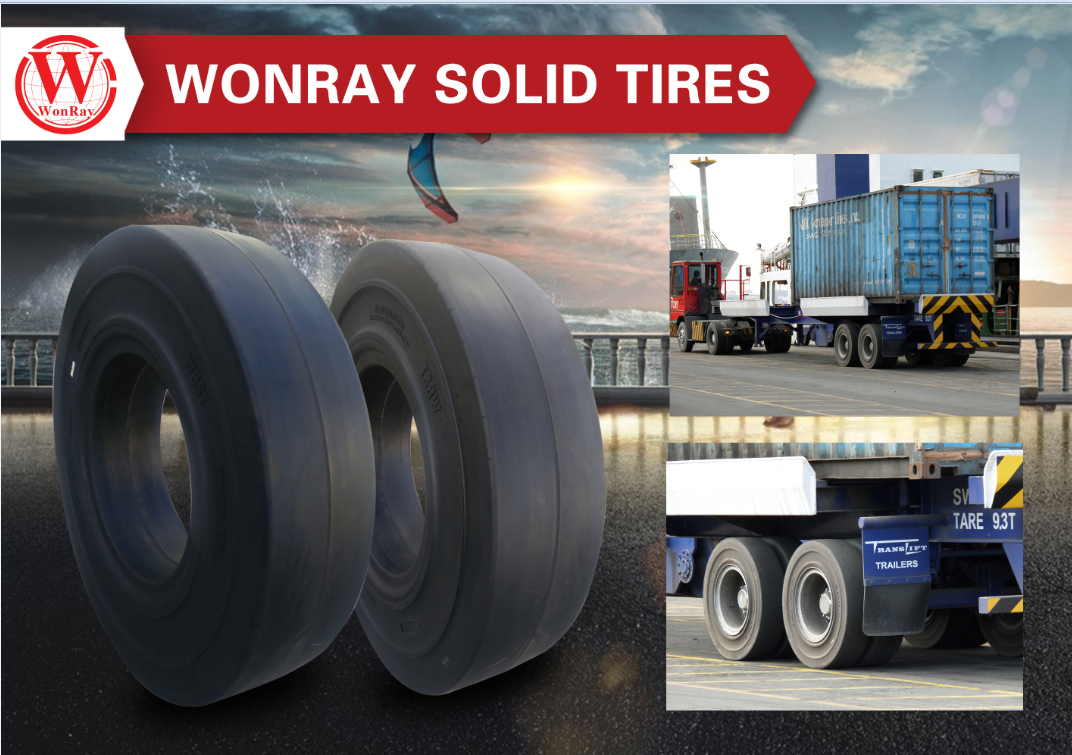
Applications in Port and Terminal Environments
Solid tires are widely used across different types of port vehicles and heavy material handling equipment. Their performance is particularly valuable in environments where load consistency and operational continuity are critical.
Common applications include:
● Container terminals handling import and export cargo
● Bulk material ports dealing with coal, ore, and aggregates
● Intermodal logistics hubs connecting sea, rail, and road transport
● Heavy-duty forklifts used for palletized cargo and industrial goods
● Straddle carriers and reach stackers for container stacking operations
In each of these applications, tire performance directly impacts operational efficiency and safety standards. A single tire failure can delay cargo movement and create bottlenecks in port workflows.
Structural Engineering and Design Features
Modern solid tires used in port applications are engineered with advanced materials and structural optimization to handle extreme working conditions.
● Multi-layer rubber construction combining tread, cushion, and base layers
● Reinforced sidewall design for lateral load resistance during sharp turns
● Heat-dissipation structure to prevent overheating during continuous operation
● Deep tread patterns designed for enhanced grip on mixed surfaces
● High-density rubber compounds for maximum wear resistance
These structural features ensure long-term performance stability, even in environments where vehicles operate under constant load stress and frequent directional changes.
Impact on Port Vehicle Performance
The use of solid tires significantly improves the overall performance of port vehicles. One of the most important benefits is improved load stability during container lifting and transport.
When handling stacked containers, even slight tire deformation can lead to imbalance. Solid tires eliminate this issue by maintaining consistent shape under pressure, ensuring safer lifting operations.
They also improve steering accuracy in confined terminal spaces, where large vehicles must maneuver precisely between stacks of containers and equipment.
Additionally, reduced vibration helps protect mechanical components such as axles, suspension systems, and chassis structures, contributing to longer equipment lifespan.
Key Factors in Selecting Solid Tires for Port Vehicles
Choosing the correct solid tire is essential for maintaining efficiency and safety in port operations. Several factors must be carefully evaluated before selection.
● Load capacity requirements based on vehicle type and container weight
● Surface conditions including asphalt, concrete, or mixed terrain
● Operating cycle intensity and shift duration
● Heat generation during continuous high-load operations
● Compatibility with specific port vehicle models and rim structures
Proper selection ensures optimal performance and minimizes operational risks in demanding environments.
Economic Value in Port Logistics Operations
From a cost perspective, solid tires provide strong long-term economic benefits. While initial investment costs are higher compared to pneumatic alternatives, the overall total cost of ownership is significantly lower.
This is primarily due to reduced downtime, fewer replacements, and minimal maintenance requirements. In high-volume port environments, even small improvements in uptime translate into substantial financial gains over time.
By ensuring continuous operation, solid tires help port operators maintain efficient cargo flow and reduce delays in shipping schedules.
Conclusion
High-performance solid tires for port vehicles are a critical component in modern maritime logistics systems. Their ability to withstand heavy loads, resist damage, and maintain stability under continuous operation makes them indispensable in port environments.
As global trade continues to expand and port efficiency becomes increasingly important, solid tire technology will remain a key factor in ensuring safe, reliable, and uninterrupted cargo handling operations.
FAQ
1. Why are solid tires widely used in port vehicles?
Because they eliminate puncture risks and provide stable performance under extremely heavy loads and continuous operation.
2. Can solid tires handle container lifting equipment?
Yes, they are specifically designed for heavy-duty port equipment such as reach stackers and container handlers.
3. Do solid tires improve safety in port operations?
Yes, they enhance stability and reduce vibration, which improves control during heavy cargo handling.
4. Are solid tires suitable for 24/7 port operations?
Yes, they are ideal for continuous multi-shift operations due to their durability and low maintenance requirements.
Post time: 21-05-2026