
Forklift solid tires are designed for working environments where stability, durability, and reduced downtime matter more than speed. For factories, logistics yards, ports, recycling plants, and material handling operations, tire failure can directly affect productivity and equipment availability.
Unlike pneumatic tires, forklift solid tires do not rely on air pressure. This makes them especially suitable for low-speed, heavy-load applications where punctures, sharp debris, rough surfaces, and frequent turning are common operating challenges.
What Are Forklift Solid Tires?
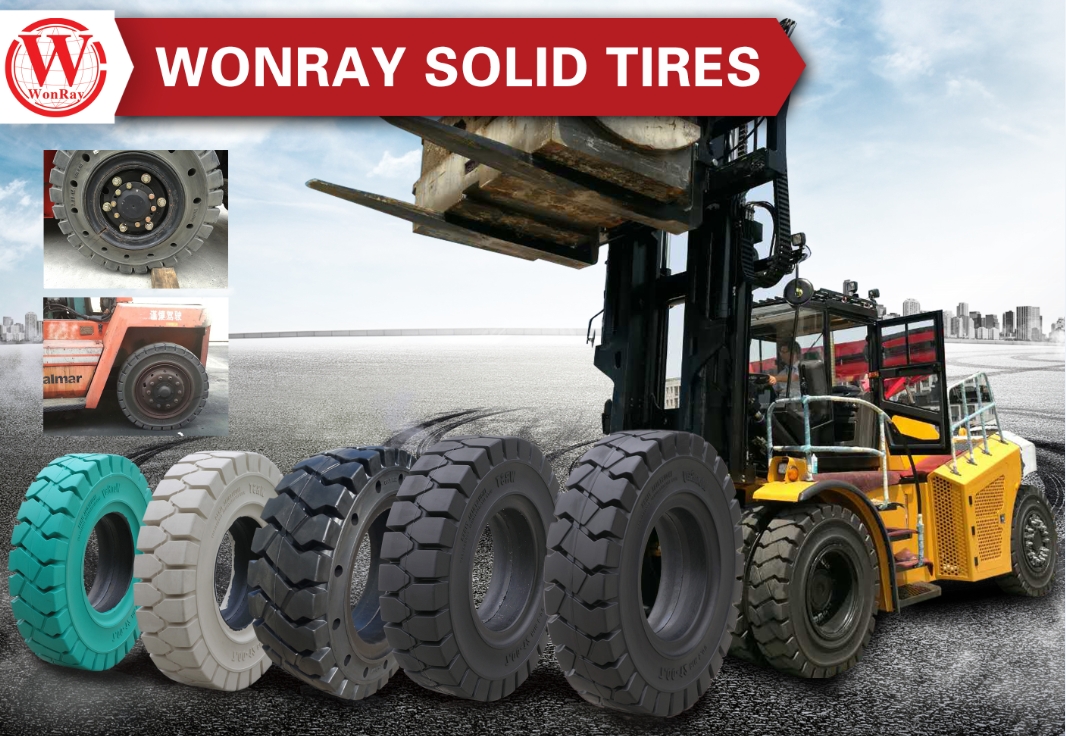
Forklift solid tires are industrial tires made from solid rubber compounds instead of an air-filled structure. They are commonly used on forklifts, electric forklifts, warehouse trucks, trailers, and other material handling vehicles that operate under repeated loading and unloading conditions.
WonRay forklift solid tires are designed to replace pneumatic tires in many low-speed and heavy-load working environments. They can be mounted on standard pneumatic tire rims, which helps equipment owners upgrade tire durability without changing the entire wheel system.
The main value of solid tires is simple: they help keep forklifts working for longer periods with fewer interruptions. In busy industrial operations, this can reduce maintenance pressure, improve equipment scheduling, and support more stable daily output.
Why Forklift Solid Tires Matter in Industrial Use
Forklifts often work in areas where ordinary tires face continuous stress. Concrete floors, outdoor yards, metal scraps, sharp stones, pallets, construction waste, and uneven surfaces can all shorten tire life. When a pneumatic tire is punctured or loses air pressure, the forklift must stop immediately, which can delay loading tasks and increase maintenance costs.
Forklift solid tires solve this problem through a puncture-free structure. Because there is no air chamber, the tire cannot go flat in the same way as a pneumatic tire. This makes solid tires suitable for demanding workplaces where reliability is more important than high-speed driving comfort.
In B2B operations, tire performance is not only about movement. It also affects safety, operating cost, driver confidence, and equipment utilization. A stable tire helps the forklift carry heavy loads more securely and maintain better contact with the ground during turning, stacking, and short-distance transport.
Key Performance Features of Forklift Solid Tires
A high-quality forklift solid tire needs more than basic rubber strength. It should be designed with a balanced structure that supports durability, elasticity, heat release, and rim stability. WonRay solid tires are commonly positioned around industrial performance, especially for heavy-load working conditions.
● Puncture-free structure helps reduce tire-related downtime in harsh working areas.
● Long service life supports continuous forklift operation and reduces replacement frequency.
● Heavy load capacity helps forklifts carry goods, pallets, raw materials, and industrial components more steadily.
● Low rolling resistance can help reduce energy consumption, especially for electric forklifts.
● Stable rim adherence improves safety during repeated turning, braking, and loaded movement.
● Shock absorption helps reduce vibration from rough surfaces and improves driving stability.
● Wear-resistant tread compound supports longer use on concrete floors, yards, and industrial sites.
● Reinforced base structure helps the tire remain securely fitted to the rim under demanding loads.
These features are especially important for factories and warehouses that operate forklifts for long hours every day. When the tire structure is stable, the forklift can perform more predictably across different work shifts.
Three-Compound Structure for Better Balance
Many industrial solid tires use a layered rubber structure to improve overall performance. WonRay forklift solid tires are often described with a three-compound design, which helps balance wear resistance, elasticity, and base strength.
The outer tread compound is responsible for ground contact. It must resist wear, cuts, and surface damage because it faces friction every time the forklift moves, turns, or brakes. A durable tread layer helps extend tire life and maintain reliable traction.
The middle compound is designed to provide resilience. This layer helps absorb impact from uneven surfaces and reduces vibration during operation. For forklift drivers, smoother movement can also help improve control during loading and stacking.
The base compound connects the tire to the rim. This part needs strong bonding and structural stability because forklifts often carry heavy loads and make frequent turns. A reinforced base helps reduce the risk of tire loosening and supports safer operation.
This type of structure makes forklift solid tires more suitable for demanding industrial environments than simple rubber tires with limited internal design.
Application Scenarios for Forklift Solid Tires
Forklift solid tires can be used in many industries where equipment must work reliably under pressure. They are especially useful in places where tire punctures and frequent maintenance are common concerns.
In logistics centers, solid tires support daily pallet movement and goods transfer. In manufacturing plants, they help forklifts move raw materials, semi-finished parts, and finished products across production areas. In ports and freight yards, they can handle heavy cargo movement on rougher ground. In recycling plants, waste treatment facilities, and construction-related sites, they reduce the risk of puncture caused by sharp debris.
Forklift solid tires are also suitable for electric forklifts. Their low rolling resistance and stable structure can help support energy efficiency and consistent operation, which matters for fleets that depend on battery-powered equipment.
How Forklift Solid Tires Help Reduce Operating Costs
For industrial users, the cost of a tire is not only the purchase price. The real cost includes replacement frequency, maintenance labor, forklift downtime, productivity loss, and possible delays caused by tire failure.
A puncture-free solid tire helps reduce emergency repairs. Since there is no air pressure to monitor, operators spend less time checking inflation levels. The longer service life can also reduce the need for frequent tire replacement, especially in tough environments where pneumatic tires may be damaged quickly.
Another cost advantage comes from equipment availability. When forklifts remain operational, work schedules become easier to manage. For companies with limited forklift fleets, reducing tire-related downtime can make a noticeable difference in daily efficiency.
Why Solid Tires Are Practical for Low-Speed Heavy-Load Work
Forklift solid tires are not designed for high-speed road travel. Their strength is in stable, repetitive, low-speed industrial movement. This makes them ideal for forklifts, trailers, and material handling vehicles working inside plants, yards, storage areas, and loading zones.
In these conditions, tire reliability is often more valuable than driving softness. Solid tires give operators the confidence to work around debris, rough floors, and heavy loads without worrying about sudden punctures.
Summary
Forklift solid tires provide a practical tire solution for heavy-duty material handling environments. With puncture-free performance, strong load capacity, long service life, and reduced maintenance needs, they help factories, warehouses, ports, and industrial yards keep forklifts working more consistently.
For WonRay, forklift solid tires can be positioned as durable and stable industrial tire products that support lower downtime, safer operation, and more efficient equipment use in demanding workplaces.
FAQ
1、What are forklift solid tires used for?
Forklift solid tires are used for forklifts, electric forklifts, trailers, and material handling vehicles operating in factories, warehouses, yards, ports, and industrial sites. They are suitable for low-speed and heavy-load conditions.
2、Can forklift solid tires replace pneumatic tires?
Yes. Many forklift solid tires are designed as replacements for pneumatic tires and can be mounted on standard pneumatic tire rims, depending on tire size and equipment requirements.
3、Why are solid tires better for harsh industrial environments?
Solid tires are puncture-free because they do not contain air. This makes them more reliable in workplaces with sharp debris, rough ground, heavy loads, and frequent turning.
4、Do forklift solid tires require less maintenance?
Yes. Since they do not need air pressure checks and are not easily punctured, forklift solid tires generally require less maintenance than pneumatic tires in demanding industrial applications.
Post time: 12-05-2026