
In the aviation industry, ground support equipment (GSE) plays a critical role in ensuring the smooth operation of airports. From baggage tugs and aircraft tow tractors to cargo loaders and fuel trucks, these vehicles are essential for efficient airport operations. Choosing the right tires for aviation ground equipment is vital for safety, reliability, and operational efficiency. Aviation Ground Equipment Solid Tires are increasingly being adopted across airports worldwide due to their durability, low maintenance, and enhanced performance in high-demand environments.
Understanding Aviation Ground Equipment Solid Tires
Aviation ground equipment solid tires are non-pneumatic tires made from solid rubber or resilient materials, designed to withstand the demanding conditions of airport operations. Unlike pneumatic tires, which can puncture or deflate, solid tires provide uninterrupted performance even under heavy loads and continuous use. These tires are specifically engineered to handle the unique challenges of aviation GSE, including high-density operations, rough surfaces, and frequent stop-and-go movements.
Key Advantages of Aviation Ground Equipment Solid Tires
● Exceptional Durability
Solid tires are highly resistant to cuts, punctures, and wear. In the busy environment of an airport, where vehicles frequently navigate around equipment, concrete ramps, and tarmac surfaces, durability is essential to prevent unexpected downtime and ensure smooth operations.
● Reduced Maintenance
Unlike pneumatic tires, solid tires require minimal maintenance. They do not need air pressure checks, repairs for punctures, or replacements due to flats. This feature reduces operational interruptions and saves airports significant maintenance costs over time.
● Enhanced Safety
The puncture-proof design of solid tires reduces the risk of sudden blowouts, ensuring a safer working environment for airport personnel and equipment. Reliable traction and stability are particularly critical for vehicles towing aircraft or transporting sensitive cargo.
● Improved Operational Efficiency
With consistent performance and robust construction, solid tires enhance the efficiency of aviation ground equipment. Vehicles equipped with solid tires maintain stability and traction under heavy loads, enabling faster and safer ground operations.
● Cost-Effectiveness
Although the initial investment in solid tires may be higher than pneumatic alternatives, their long lifespan and low maintenance requirements result in substantial long-term savings. For airports managing a large fleet of GSE, the return on investment is significant.
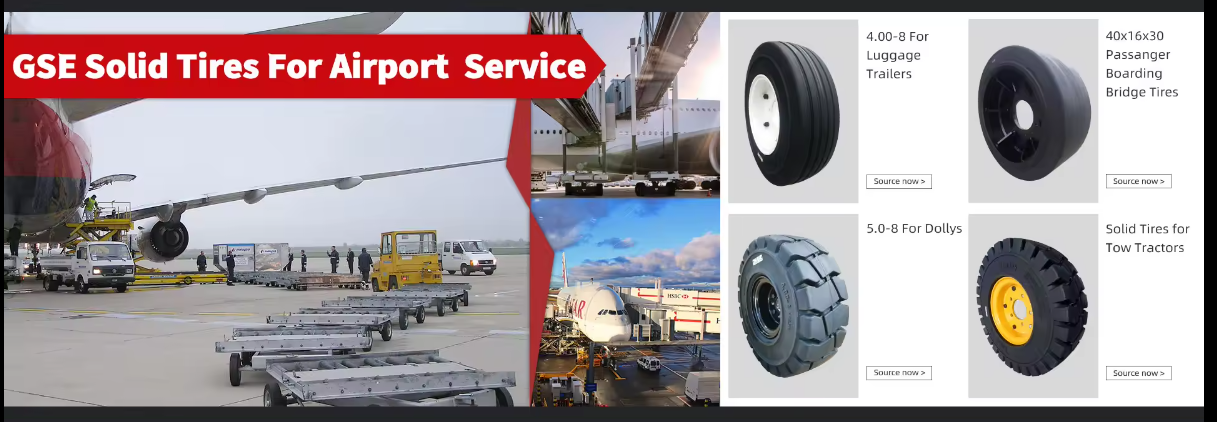
Applications of Solid Tires in Aviation Ground Equipment
● Baggage Tugs: Ensure smooth towing of luggage across tarmac surfaces.
● Aircraft Tow Tractors: Reliable traction and stability for moving aircraft safely.
● Cargo Loaders: Handle heavy cargo loads without tire failure.
● Fuel Trucks and Service Vehicles: Maintain uninterrupted operation during refueling and ground support tasks.
● Pushback Tractors: Deliver precision and reliability while maneuvering aircraft.
These applications benefit from the durability, safety, and low-maintenance features of solid tires, which are essential in high-traffic airport environments.
Why Airports Are Choosing Solid Tires
Airports are increasingly transitioning to solid tires for their GSE fleets due to the combination of safety, efficiency, and long-term cost savings. Reduced tire-related downtime means ground operations run more smoothly, while durability and resistance to damage lower replacement costs. Additionally, solid tires are capable of handling the high-density operations common at modern airports, where vehicles frequently carry heavy loads in tight schedules.
Selecting the Right Aviation Ground Equipment Solid Tires
When choosing solid tires for aviation ground equipment, consider:
● Load Capacity: Ensure the tires can support the weight of the vehicle and its cargo.
● Surface Conditions: Match tire construction to tarmac, asphalt, or concrete surfaces commonly found in airports.
● Operational Requirements: Select tires designed for frequent stop-and-go movements, high-speed towing, or heavy lifting.
● Brand Reliability: Opt for well-known tire manufacturers with proven track records in aviation ground equipment applications.
Proper selection ensures maximum efficiency, safety, and cost-effectiveness for airport operations.
Conclusion
Aviation Ground Equipment Solid Tires are essential for modern airport operations, providing durability, safety, and low-maintenance performance. Their robust construction allows GSE vehicles to operate reliably under heavy loads and high-frequency use, enhancing overall airport efficiency. While initial costs may be higher, the long-term benefits of solid tires, including reduced downtime, enhanced safety, and operational savings, make them a smart investment for airports worldwide.
For airports and ground support operators aiming to optimize their fleets, solid tires offer a practical solution that combines performance, reliability, and longevity. Upgrading your aviation ground equipment with solid tires ensures safer operations, increased efficiency, and reduced long-term costs, making them indispensable in today’s high-demand aviation environment.
Post time: 30-12-2025