
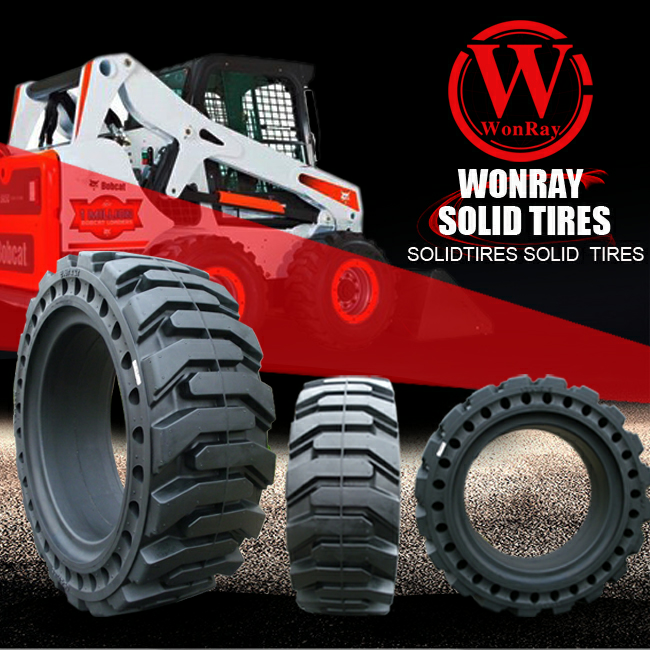
Solid tires for skid steer loaders have become one of the most reliable solutions for operators working in extremely demanding environments where tire damage, downtime, and unpredictable ground conditions are constant challenges. These machines are widely used in construction, demolition, agriculture, recycling, and industrial material handling, where traditional pneumatic tires often struggle to survive long-term due to punctures, sidewall cuts, and air pressure failures.
In contrast, solid tires are engineered as a fully rubber-based structure that eliminates air completely, allowing skid steer loaders to maintain continuous operation even in environments filled with sharp debris, uneven terrain, and heavy impact loads. This fundamental difference in structure is what makes them increasingly popular in high-intensity industrial applications.
Structural Design Built for Extreme Working Conditions
The performance of solid skid steer tires is directly linked to their internal engineering, which is designed to combine strength, stability, and controlled flexibility within a single integrated structure. Unlike pneumatic tires that rely on inflation, solid tires use layered rubber construction that distributes stress more evenly across the entire tire body.
Most advanced designs include a wear-resistant outer layer, a shock-absorbing intermediate layer, and a reinforced mounting core that ensures stability under heavy load pressure. This structure allows the tire to absorb impact from rough terrain while maintaining shape integrity even under continuous operational stress.
Because there is no internal air cavity, the tire cannot collapse or explode, which eliminates one of the most common failure points in skid steer operations.
Why Harsh Work Environments Depend on Solid Tires
Skid steer loaders are frequently deployed in environments where ground conditions are unpredictable and highly abrasive. These include demolition zones filled with concrete fragments, construction sites with steel debris, recycling yards with mixed waste, and mining support operations with sharp and unstable surfaces.
In such environments, tire reliability becomes a critical factor in maintaining productivity. Solid tires ensure that machines continue operating without interruption, even when exposed to conditions that would quickly damage conventional tires.
● Prevents sudden downtime caused by punctures or sidewall damage
● Withstands continuous exposure to sharp and abrasive materials
● Maintains structural stability under heavy load and impact pressure
● Reduces repair frequency in high-debris working environments
● Supports continuous operation in extreme industrial conditions
● Enhances overall machine reliability and jobsite efficiency
These advantages make solid tires particularly valuable for contractors and operators who prioritize uptime and operational continuity.
Applications Across Heavy Industrial Sectors
Solid tires for skid steer loaders are widely used across multiple industries where machines operate under constant stress and unpredictable terrain conditions. Their durability allows them to perform consistently in both construction and industrial environments where standard tires would fail prematurely.
In construction projects, they are used for excavation, grading, and material transport across uneven surfaces. In demolition work, they endure constant impact from broken concrete, rebar, and structural debris. In recycling operations, they handle sharp waste materials such as metal scraps, glass fragments, and mixed industrial waste.
They are also commonly used in ports, mining support zones, agricultural heavy-duty operations, and infrastructure development projects where machine downtime must be minimized.
● Construction and earthmoving operations
● Demolition and structural removal work
● Recycling and waste processing facilities
● Mining and quarry support environments
● Industrial logistics and heavy material yards
● Agricultural and large-scale farm operations
Operational Performance and Machine Efficiency
One of the key benefits of solid skid steer tires is their ability to improve overall machine efficiency by eliminating tire-related downtime. Since skid steer loaders rely heavily on maneuverability and frequent directional changes, tire stability directly affects operational precision.
Solid tires provide strong lateral support during turning operations, which improves control accuracy in tight working spaces. At the same time, modern designs incorporate internal cushioning layers that help reduce vibration transfer to the machine and operator.
This results in smoother operation, improved handling stability, and reduced mechanical stress on the equipment over time.
● Enhances turning stability in compact workspaces
● Improves control precision during frequent directional changes
● Reduces vibration impact on machine components
● Maintains consistent traction on uneven terrain
● Increases overall equipment productivity and uptime
Factors That Influence Tire Lifespan in Real-World Use
Although solid tires are designed for durability, their actual lifespan depends heavily on working conditions and operational behavior. In harsh environments, even high-quality tires will experience wear over time, and understanding the influencing factors helps optimize performance and reduce replacement costs.
Surface type is one of the most important variables, as highly abrasive or sharp terrain will accelerate wear. Load intensity also plays a major role, especially in continuous heavy-duty operations. Operator behavior, such as aggressive turning or sudden braking, can further increase tread wear.
Environmental temperature affects rubber elasticity, while proper machine maintenance ensures even load distribution across all tires.
● Ground roughness and material composition
● Load weight and operational frequency
● Driving behavior and steering patterns
● Temperature and environmental conditions
● Machine alignment and maintenance condition
Comparison With Pneumatic Tires in Heavy-Duty Applications
In demanding industrial environments, solid tires offer a clear operational advantage over pneumatic alternatives. While pneumatic tires may provide better cushioning in light-duty applications, they are significantly more vulnerable to punctures and sudden failure when exposed to sharp debris or harsh terrain.
Solid tires eliminate air pressure dependency entirely, ensuring that skid steer loaders remain operational even under extreme conditions. Although the ride may feel firmer compared to air-filled tires, modern engineering improvements have significantly reduced vibration levels and improved operator comfort.
For industries where downtime directly impacts productivity and cost, solid tires represent a more reliable long-term solution.
FAQ:
1. What makes solid tires better for skid steer loaders in harsh environments?
Solid tires eliminate puncture risk and maintain structural integrity in extreme conditions such as demolition sites, construction zones, and debris-heavy industrial areas.
2. Can solid skid steer tires handle continuous heavy-duty operation?
Yes, they are designed with high-density rubber structures that support long-term heavy-load and high-impact working cycles.
3. Do solid tires reduce machine comfort during operation?
They are firmer than pneumatic tires, but modern cushioning technology significantly reduces vibration and improves operator comfort.
4. Are solid tires suitable for all types of terrain?
They perform best in rough, abrasive, and industrial environments, while also maintaining stability on compact and uneven surfaces commonly found in construction and mining operations.
Solid tires for skid steer loaders continue to gain adoption as industries demand higher reliability, lower maintenance costs, and uninterrupted machine performance. As construction and industrial operations become increasingly intensive, their role in ensuring stable and efficient equipment operation will continue to expand.
Post time: 28-05-2026