
In demanding industrial environments, equipment reliability is not optional—it is a requirement for maintaining productivity and controlling operational costs. While engines and hydraulic systems often receive the most attention, the role of tires is equally critical. Solid tires have become a preferred solution for heavy-duty industrial vehicles because they address one of the most common sources of downtime: tire failure.
For B2B buyers managing fleets of forklifts, loaders, and other machinery, understanding the value of solid tires can lead to more efficient and cost-effective operations.
The Challenge of Tire Performance in Harsh Environments
Industrial vehicles frequently operate in conditions that are far more aggressive than standard road applications. Sharp metal debris, uneven surfaces, heavy loads, and continuous usage cycles all place extreme stress on tires.
Traditional pneumatic tires, which rely on air pressure, are vulnerable in these environments. A single puncture can halt operations, requiring immediate repair or replacement. Over time, repeated damage and maintenance interruptions reduce productivity and increase costs.
Solid tires, by contrast, are engineered specifically to overcome these challenges, offering a more reliable solution for high-intensity applications.
Structural Design: The Core Strength of Solid Tires
The defining feature of solid tires is their fully rubber construction, which eliminates the need for internal air pressure. This structural difference is what gives solid tires their superior durability and reliability.
Modern solid tires are not simply blocks of rubber. They are engineered with advanced multi-layer designs that provide a balance of strength and performance.
● Outer wear layer: Designed to resist abrasion and extend service life
● Elastic middle layer: Absorbs shocks and reduces vibration during operation
● Reinforced base layer: Ensures secure mounting and supports heavy loads
This combination allows solid tires to maintain performance even under continuous stress, making them suitable for the most demanding environments.
Key Advantages That Drive Industrial Adoption
The growing adoption of solid tires in industrial applications is driven by a range of practical benefits that directly impact business performance.
● Elimination of punctures: Solid tires completely remove the risk of flats, ensuring uninterrupted operation
● High durability: Engineered to withstand harsh surfaces and heavy loads over long periods
● Stable performance: Consistent structure provides predictable handling and improved control
● Reduced maintenance: No need for inflation, pressure monitoring, or frequent repairs
● Enhanced safety: Lower risk of sudden tire failure improves overall workplace safety
These advantages make solid tires a reliable solution for industries where equipment uptime is critical.
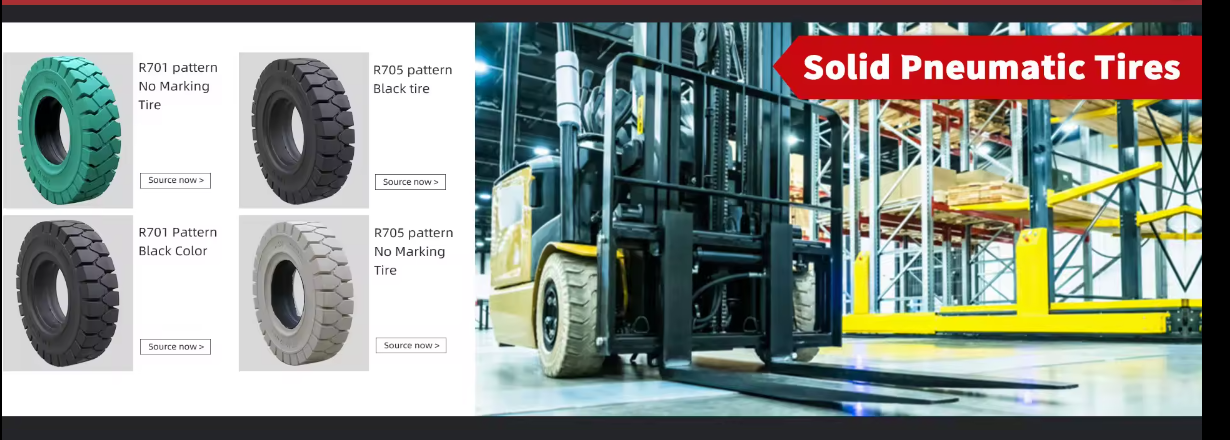
Application Areas Where Solid Tires Excel
Solid tires are particularly effective in environments where traditional tires struggle to perform reliably. Their design makes them suitable for a wide range of industrial applications.
● Recycling and scrap handling: Sharp debris requires puncture-proof tire solutions
● Steel and metal industries: High temperatures and heavy loads demand durable materials
● Ports and logistics terminals: Continuous operation requires long-lasting performance
● Construction and demolition: Rough terrain and debris increase the risk of tire damage
● Mining and quarrying: Extreme conditions require maximum resistance to wear and impact
In these industries, solid tires help maintain consistent productivity and reduce operational disruptions.
Operational Efficiency: A Measurable Impact
One of the most significant advantages of solid tires is their contribution to operational efficiency. By eliminating common failure points, they allow equipment to operate continuously without interruption.
This reliability translates into higher productivity, as machines spend more time working and less time undergoing maintenance. Additionally, the stable performance of solid tires improves handling precision, enabling operators to complete tasks more efficiently.
Over time, these improvements contribute to smoother workflows and better resource utilization.
Cost Perspective: Total Value Over Time
While solid tires may have a higher initial purchase cost, their long-term value is often significantly greater. Evaluating cost from a lifecycle perspective reveals their true economic benefits.
● Fewer replacements due to extended lifespan
● Lower maintenance costs due to reduced servicing needs
● Increased equipment uptime leading to higher productivity
● Reduced risk of unexpected failures and associated expenses
For B2B buyers, these factors make solid tires a strategic investment rather than a simple operational expense.
Important Considerations for Selecting Solid Tires
To maximize the benefits of solid tires, it is essential to select the right specifications for the intended application.
● Load capacity: Ensure the tire can handle the maximum operating weight
● Working conditions: Consider temperature, surface type, and presence of debris
● Tire compound: Choose the appropriate hardness and formulation for the environment
● Equipment compatibility: Verify proper sizing and installation requirements
Careful selection ensures optimal performance and long service life.
The Future of Solid Tire Technology
As industrial requirements evolve, solid tire technology continues to advance. Manufacturers are focusing on improving material performance, reducing energy consumption, and enhancing environmental sustainability.
Innovations include advanced rubber compounds with improved wear resistance, designs that reduce rolling resistance, and materials that are more environmentally friendly. These developments will further strengthen the role of solid tires in industrial applications.
Conclusion
Solid tires have proven to be a reliable and efficient solution for heavy-duty industrial vehicles operating in challenging environments. Their puncture-proof design, durability, and low maintenance requirements make them an essential component for improving equipment performance and reducing operational costs.
For businesses seeking to enhance productivity and maintain consistent operations, investing in high-quality solid tires is a practical and forward-looking decision that delivers long-term value.
FAQ
- Why are solid tires more reliable than pneumatic tires?
Because they do not rely on air pressure, eliminating the risk of punctures and blowouts. - Are solid tires suitable for all industrial vehicles?
They are ideal for heavy-duty applications but may not be the best choice for environments requiring high shock absorption. - How long do solid tires typically last?
Their lifespan depends on operating conditions but is generally longer than pneumatic tires in harsh environments. - Do solid tires require maintenance?
Maintenance is minimal, mainly involving periodic inspection for wear and damage.
Post time: 22-04-2026