
In modern warehouse logistics systems, forklifts carry out high-frequency and repetitive material handling tasks. Their operational stability directly affects order processing speed, inventory turnover, and overall efficiency. While tire selection may seem like a minor detail, it actually has a long-term impact on equipment utilization, maintenance costs, and workplace safety. More and more warehouses are shifting from pneumatic tires to solid tires, not because of a single advantage, but because solid tires better align with the core requirement of modern warehousing: stable and continuous operation.
Real Challenges Warehouse Environments Place on Forklift Tires
Although warehouse environments are less extreme than mining or construction sites, they demand consistent performance over time. Forklifts operate on smooth yet high-friction surfaces such as concrete or epoxy floors, which accelerate tire wear. At the same time, frequent starts, stops, and turns—combined with repetitive heavy loads—place continuous stress on tire structure.
In addition, warehouse operations often run for extended hours. Any unexpected tire issue can disrupt not only a single task but also the entire workflow. Under these conditions, tires must deliver not just durability, but long-term structural stability without performance fluctuations.
How the Structure of Solid Tires Matches Warehouse Needs
Solid tires replace air pressure with a high-density rubber structure, eliminating instability caused by pressure changes or air leakage. The molding and vulcanization process ensures uniform material density and consistent structural integrity, allowing the tire to maintain its shape and performance over long periods.
Most solid tires also feature a multi-layer design, combining different rubber compounds to balance load-bearing capacity with a certain level of shock absorption. The outer layer focuses on wear resistance, the middle layer provides limited elasticity, and the inner layer ensures strong load support. This engineered structure makes solid tires particularly reliable for high-frequency warehouse operations.
Why Solid Tires Significantly Improve Warehouse Efficiency
In real-world operations, efficiency improvements often come from reducing uncertainties. Solid tires contribute to smoother workflows by minimizing disruptions.
● Eliminate puncture and air leakage risks, allowing forklifts to operate continuously
● Prevent performance drops caused by insufficient tire pressure
● Reduce unexpected downtime, improving workflow consistency
● Increase equipment availability, making scheduling more efficient
Over time, these advantages translate into noticeable productivity gains.
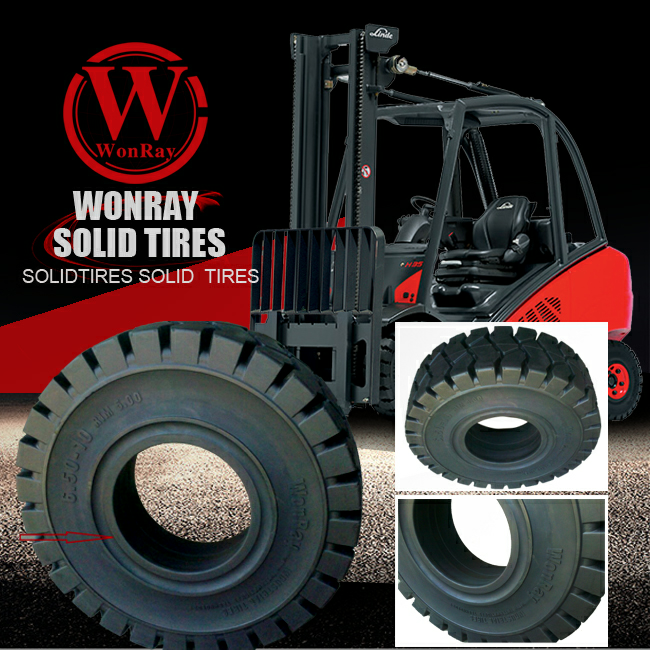
How Solid Tires Help Reduce Total Operating Costs
Although solid tires usually have a higher initial purchase cost, they offer better economic value over their lifecycle. Warehouse operators increasingly focus on total cost of ownership rather than upfront price.
● Lower maintenance frequency with no need for inflation or repairs
● Reduced labor costs due to minimal tire management requirements
● Longer replacement cycles, reducing spare parts inventory pressure
● Less downtime-related loss, minimizing hidden operational costs
These combined benefits make solid tires a cost-effective choice in the long run.
Practical Value in Terms of Safety
In warehouse environments, forklifts often operate in confined spaces while carrying heavy loads. Any instability can lead to safety risks. Tire reliability is therefore critical.
● Solid construction eliminates the risk of sudden blowouts
● Maintains shape under heavy loads, improving handling stability
● Provides consistent traction, reducing slipping risks
● Enhances operator confidence and reduces human error
Stable tire performance contributes directly to a safer working environment.
Adaptability of Solid Tires Across Different Warehouse Scenarios
As warehouse operations become more specialized, tire requirements vary across different applications. Solid tires offer strong adaptability.
● In general logistics warehouses, they provide wear resistance and continuous operation capability
● In e-commerce warehouses, they support high-frequency usage with low maintenance
● In food and pharmaceutical warehouses, non-marking tires help maintain cleanliness
● In cold storage environments, structural stability ensures reliable performance despite temperature changes
This versatility makes solid tires a practical choice for a wide range of warehouse applications.
How to Choose the Right Solid Tire Based on Real Needs
Selecting the right solid tire requires a practical approach that considers both equipment and environment.
● Match load capacity with forklift specifications
● Choose rubber compounds based on floor conditions and wear requirements
● Evaluate operating hours to determine durability needs
● Consider special requirements such as non-marking or anti-static properties
Proper selection not only improves tire performance but also extends the overall lifespan of the equipment.
Conclusion
Using solid tires on warehouse forklifts is not just about preventing punctures—it is about building a more stable, efficient, and predictable operational system. By reducing unexpected downtime, lowering maintenance costs, and enhancing safety, solid tires have become an essential component of modern warehouse operations. For businesses aiming to improve efficiency and control long-term costs, this is a strategic upgrade with clear and measurable benefits.
FAQ
1. Are solid tires suitable for all warehouse forklifts?
Most indoor warehouse environments can benefit from solid tires, especially in high-frequency operations.
2. Do solid tires affect forklift maneuverability?
No, in low-speed warehouse environments, they often provide more stable handling.
3. What is the biggest advantage over pneumatic tires?
The key advantage is consistent performance with minimal maintenance requirements.
4. Should different warehouse types use different solid tires?
Yes, depending on the environment, options such as non-marking or anti-static tires may be more suitable.
Post time: 10-04-2026