
An Airport Conveyor Solid Tire may look like a small component compared with a baggage conveyor or ground-handling unit, but a wheel problem can stop the whole task. Airport equipment works to tight schedules. A mobile conveyor may move from one aircraft position to another, stop precisely, carry changing loads, turn repeatedly, and then begin the same cycle again. In that environment, a tire is valuable when it keeps the equipment available, stable, and predictable through hundreds of repeated movements.
Airport Conveyor Duty Creates Four Tire Problems at the Same Time
The first challenge is repeated starting and stopping. Ground equipment rarely cruises at one steady speed. It accelerates over short distances, brakes, repositions, and starts again. This puts repeated torque into the tire and increases localized wear.
The second challenge is changing load. Baggage and cargo handling equipment may be lightly loaded on one trip and heavily loaded on the next. A tire needs to maintain its shape and support under different operating conditions.
The third challenge is debris and surface transitions. Aprons, service roads, loading areas, and maintenance zones can contain small metal fragments, stones, joints, drains, and rough patches. Pneumatic tires can lose air after puncture; solid tires remove that failure mode.
The fourth challenge is limited time for maintenance. A tire problem is not isolated when the equipment is part of a coordinated aircraft turnaround. The practical goal is to reduce avoidable tire service during active handling periods.
What Changes When the Equipment Uses a Solid Tire?
The most obvious difference is the absence of an air chamber. An Airport Conveyor Solid Tire does not depend on inflation pressure to carry its shape, so it cannot become flat from ordinary puncture-related air loss. This is useful in areas where small sharp objects may appear and where an unexpected flat can interrupt equipment movement.
Solid construction also provides a stable contact shape under load. That stability supports predictable steering and braking on low-speed airport equipment. For repeated duty, a well-matched rubber compound can resist abrasion while providing enough resilience to reduce harsh impact when the wheel crosses joints or uneven surfaces.
The tire still needs inspection. Solid does not mean indestructible. Cuts, chunking, abnormal wear, heat damage, wheel-center problems, or overloaded operation can still shorten service life. The difference is that routine pressure checking and puncture repair are removed from the maintenance list.
Where Airport Conveyor Solid Tires Can Be Used
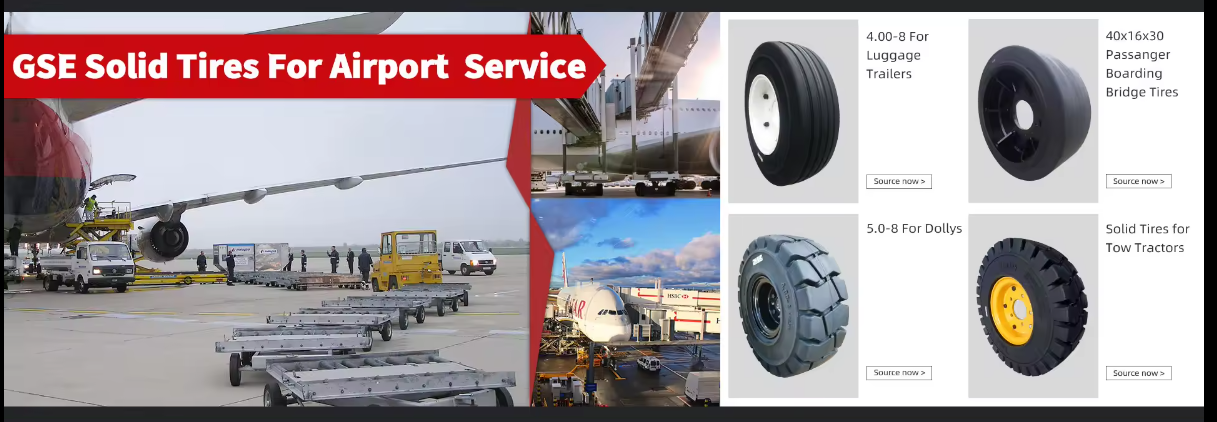
Mobile baggage conveyor and belt-loader equipment. These units repeatedly approach aircraft, position near the cargo door, move away, and travel between service areas. Stable low-speed rolling and resistance to sudden flats are useful in this cycle.
Cargo transfer and terminal support units. Equipment used to move freight or support cargo-handling tasks may carry high loads over short distances. Solid tires help maintain availability when the floor or apron contains debris.
Trolleys and maintenance support equipment. Smaller airport carts and service units can also benefit from solid rubber wheels when reliability and reduced pressure maintenance are more important than high-speed ride comfort.
Indoor or clean operating areas. Where floor marks matter, a non-marking compound may be more appropriate than standard black rubber. This is a different requirement from puncture resistance, so it should be specified separately.
The Application Is Low Speed, but Heat Still Matters
Low speed does not mean low stress. A heavily loaded solid tire can still generate heat when it flexes continuously. Short travel, frequent turning, repeated braking, and long operating hours can concentrate heat in the rubber. If the tire is too small for the load or the compound is not suited to the duty cycle, wear can accelerate even when the equipment never moves fast.
This is why tire selection should consider load and speed together with travel distance and operating time. A conveyor unit that moves for short periods with cooling time between cycles is different from equipment that travels almost continuously across a large airport.
A Better Selection Question: What Failure Are You Trying to Prevent?
If the current problem is repeated puncture, air-pressure loss, or emergency tire service, moving to a solid structure may directly reduce the interruption. If the problem is fast tread wear, however, the solution may involve rubber compound, tread pattern, wheel alignment, load distribution, or floor condition. If the problem is vibration, simply choosing the hardest tire can make the equipment harsher rather than better.
A useful specification therefore starts with the failure mode. Record where the tire wears, how long it runs, the load, the route, the number of turns, the floor condition, and whether heat is visible after a working cycle. Those observations are more useful than choosing by tire size alone.
What to Confirm Before Matching an Airport Conveyor Solid Tire
Confirm the original tire or wheel size, outside diameter, section width, rim or hub dimensions, axle mounting, load per wheel, maximum operating speed, typical travel distance, shift length, and turning frequency. Then add environmental details such as indoor or outdoor use, floor cleanliness, water exposure, oils or chemicals, and the presence of sharp debris.
The tread also needs to match the route. A smooth or less aggressive tread may suit clean, level floors and frequent turning, while a traction pattern may be more useful where grip is a priority. More tread is not automatically better; aggressive patterns can increase vibration and scrub on smooth indoor floors.
Keeping Airport Ground Equipment Moving Is the Real Product Value
The purpose of an Airport Conveyor Solid Tire is not to make airport equipment faster. Its value is to remove common air-related tire failures and support consistent low-speed movement under repeated airport duty. WonRay’s industrial solid tire range includes solutions for ground-support and material-handling applications where load stability, wear resistance, and reduced maintenance are important.
When the wheel dimensions, rubber compound, load capacity, and duty cycle are matched correctly, the tire becomes a quiet reliability component: it does its job without becoming the reason the baggage-handling task stops.
FAQ
What is an Airport Conveyor Solid Tire used for?
It is used on airport baggage conveyor, belt-loader, cargo-transfer, trolley, and related ground-support equipment that operates at low speed and needs reliable wheel performance.
Why use a solid tire instead of a pneumatic tire?
A solid tire removes puncture-related air loss and routine inflation checks, helping reduce unexpected tire downtime.
Are solid tires maintenance-free?
No. They still need inspection for cuts, wear, chunking, heat damage, wheel-center condition, and abnormal loading.
What information is needed to select the right tire?
Provide wheel dimensions, load per wheel, speed, travel distance, working hours, turning frequency, floor condition, and any special requirements such as non-marking rubber.
Post time: 07-08-2026