
Scissor Lift Wheels are specialized wheels used on mobile scissor lifts and aerial work platforms that move workers, tools, and materials to elevated work positions in warehouses, factories, construction sites, airports, shopping centers, exhibition halls, and maintenance facilities. Scissor lift wheels carry the machine weight, support platform stability during travel, protect the working surface, and help the equipment move accurately in narrow or busy spaces. Because scissor lifts are often used close to people, shelves, walls, finished floors, and building structures, wheel condition and wheel selection have a direct influence on safety and equipment availability.
A scissor lift may not travel as fast as a truck or loader, but its wheels work under concentrated load and frequent positioning. When the wheels are worn, cracked, too hard for the floor, too soft for the load, or poorly matched with the application, the lift may vibrate, leave floor marks, move unevenly, or require more maintenance. This is why scissor lift wheels should be selected according to the equipment model and jobsite conditions rather than treated as ordinary replacement wheels.
The wheel is part of the access equipment safety system
Scissor lifts are designed to raise workers safely. Most users pay attention to platform height, guardrails, controls, batteries, and hydraulic systems, but the wheels are equally important because they are the contact point between the machine and the ground. If wheel performance is poor, movement becomes less predictable.
Good scissor lift wheels help provide stable travel, controlled turning, reduced vibration, reliable load support, and safer positioning before lifting. In indoor facilities, they also help protect finished floors and reduce cleaning work. In rental fleets, reliable wheels reduce customer complaints and emergency service calls.
Indoor floors need clean and smooth movement
Many scissor lifts work inside completed buildings. These jobs include lighting repair, ceiling installation, sprinkler maintenance, warehouse picking support, indoor painting, HVAC maintenance, and facility inspection. Indoor floors may include polished concrete, epoxy coating, tiles, or sensitive finished surfaces.
For indoor use, scissor lift wheels should focus on:
- Non-marking performance
- Smooth rolling
- Low vibration
- Quiet movement
- Floor protection
- Stable turning in narrow areas
If the wrong wheel material is used, the scissor lift may leave black marks, scratch the floor coating, or create vibration that makes operation uncomfortable. Non-marking scissor lift wheels are commonly preferred in airports, shopping malls, warehouses, hospitals, food facilities, and exhibition halls where floor appearance matters.
Outdoor jobsites require stronger durability
Scissor lifts are also used outdoors on concrete slabs, asphalt areas, construction sites, industrial yards, and plant maintenance routes. These surfaces may be rougher and may contain small stones, dust, construction debris, or uneven joints. A wheel designed only for clean indoor floors may wear quickly in these environments.
For outdoor use, buyers should consider wear resistance, impact resistance, chunking resistance, load support, and tire hardness. The wheel should be strong enough to handle repeated movement without cracking or losing material. Outdoor scissor lift wheels do not need to behave like off-road tires, but they must be durable enough for hard industrial surfaces and site debris.
Wheel material changes the operating experience
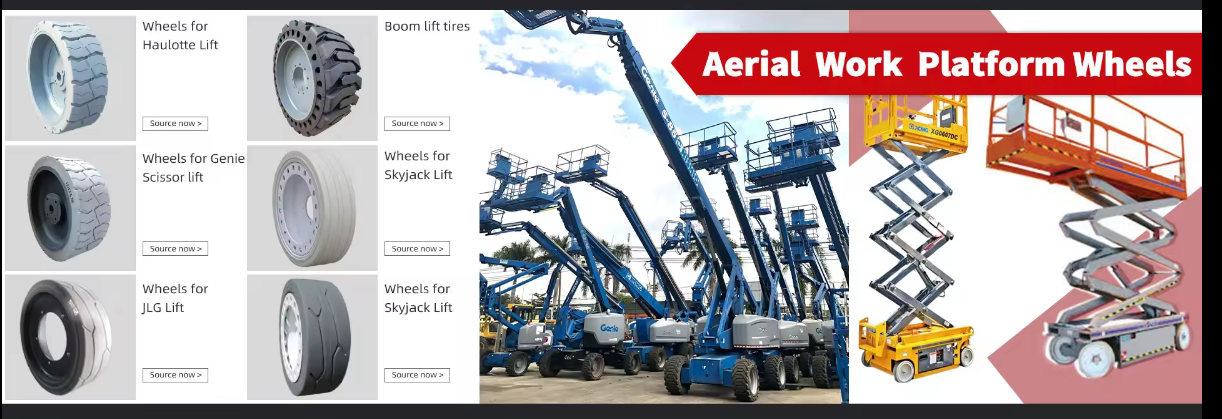
Scissor lift wheels may use rubber, polyurethane, or other industrial compounds. Each material has a different effect on rolling resistance, floor protection, load support, noise, and service life.
Rubber wheels may provide better cushioning and quieter movement, which can be useful on slightly uneven surfaces or in facilities where noise control matters. Polyurethane wheels often provide strong wear resistance, stable rolling on hard floors, and good load capacity. Non-marking materials are important for clean indoor environments, while heavier-duty compounds may be better for mixed-use or rental equipment.
The right choice depends on where the lift works most often. A scissor lift used only inside a clean warehouse should not be fitted with the same wheel strategy as a lift that moves between construction sites every week.
Common causes of scissor lift wheel damage
Wheel damage is often caused by a combination of working surface and operating habits. Frequent sharp turning, overloaded platforms, debris on the floor, poor storage, and using indoor wheels on rough outdoor ground can all shorten service life.
Maintenance teams should inspect scissor lift wheels for cracks, flat spots, uneven wear, missing material, abnormal noise, vibration, and loose installation. If the equipment begins to move unevenly or the operator feels stronger vibration, the wheel should be checked before the problem affects platform stability or other components.
Selection guide for scissor lift wheels
Before ordering scissor lift wheels, buyers should collect complete information from the machine and worksite. A basic selection process should include the scissor lift model, original wheel size, wheel position, machine weight, rated platform capacity, indoor or outdoor use, floor condition, and non-marking requirement.
For clean indoor applications, floor protection and non-marking performance may be the first priority. For outdoor maintenance, wear resistance and chunking resistance may matter more. For rental fleets, balanced performance and consistent quality are usually more important than choosing only one extreme feature.
WonRay scissor lift wheels for aerial work platforms
WonRay supplies industrial solid tires and wheels for a wide range of material handling and access equipment, including scissor lift wheels, boom lift wheels, forklift solid tires, skid steer solid tires, port vehicle solid tires, and other heavy-duty industrial applications. Scissor lift wheels require accurate dimensions, stable material performance, and reliable bonding because the equipment must move safely under load and often works near finished floors or building structures.
WonRay can support scissor lift wheel selection according to application requirements such as floor condition, non-marking needs, equipment model, load, and daily working frequency. For customers managing multiple lifts or rental fleets, consistent wheel quality helps simplify maintenance and reduce unexpected replacement.
Conclusion
Scissor lift wheels affect safety, platform movement, floor protection, maintenance cost, and equipment availability. The right wheels help scissor lifts move smoothly, turn safely, support concentrated loads, and reduce floor damage in indoor and outdoor access work. Buyers should consider equipment model, wheel size, material, load capacity, floor condition, and application frequency before ordering replacement wheels. With correct selection and regular inspection, scissor lift wheels can help aerial work platforms operate more safely and efficiently.
FAQ
Q1: What are scissor lift wheels used for?
A1: Scissor lift wheels are used on mobile scissor lifts and aerial work platforms to support movement, load stability, floor contact, and safe positioning.
Q2: Do scissor lift wheels need to be non-marking?
A2: Non-marking scissor lift wheels are recommended for clean indoor floors, epoxy floors, polished concrete, airports, shopping centers, hospitals, and warehouses.
Q3: What causes scissor lift wheels to wear quickly?
A3: Rough surfaces, sharp turning, overload, debris, wrong wheel material, and using indoor wheels outdoors can all cause faster wear.
Q4: How should buyers choose scissor lift wheels?
A4: Buyers should check the lift model, original wheel size, load capacity, floor type, indoor or outdoor use, non-marking requirement, and expected working frequency.
Post time: 07-07-2026