
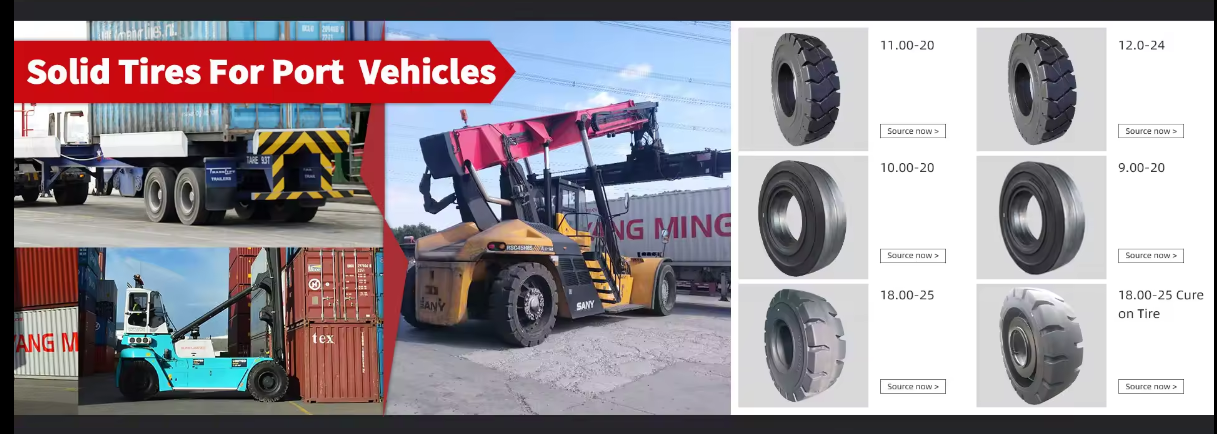
Ports are among the busiest industrial environments in the world. Reach stackers, empty container handlers, terminal tractors, heavy forklifts, and other cargo-handling machines work around the clock under demanding conditions. While engines, hydraulic systems, and lifting capacities often attract the most attention, the choice of tires can have an equally significant impact on daily operations.
For many terminal operators, solid tires have become the preferred option because they offer durability, predictable performance, and reduced downtime in environments where interruptions can lead to costly delays.
Why Port Operations Demand More from Tires
Unlike conventional industrial applications, port environments expose equipment to a unique combination of stresses that rapidly accelerate tire wear and failure.
Typical challenges include:
● Continuous operation across multiple shifts with limited downtime between tasks.
● Frequent movement of extremely heavy loads, including fully loaded containers and oversized cargo.
● Exposure to rough concrete surfaces that create constant abrasion.
● Contact with metal debris, broken pallets, nails, and other sharp objects scattered around working areas.
● Tight maneuvering requirements in crowded terminal spaces, resulting in repeated turning and side-loading forces.
These demanding conditions mean that standard pneumatic tires may struggle to deliver the reliability required by modern ports.
Downtime Costs More Than Tire Replacement
When equipment stops because of a tire issue, the consequences extend far beyond the maintenance department.
Unexpected downtime can result in:
● Delayed vessel loading and unloading schedules.
● Reduced cargo handling efficiency.
● Increased labor expenses caused by idle operators and support personnel.
● Congestion within terminal traffic flow.
● Missed delivery commitments that affect customer satisfaction.
Because port logistics depend heavily on timing, even short interruptions can trigger a chain reaction throughout the supply chain.
Solid tires help minimize these risks by removing one of the most common causes of equipment stoppage: puncture-related failures.
Why Puncture Resistance Matters in Ports
Port surfaces are often contaminated with materials capable of damaging conventional tires.
Potential hazards include:
● Steel bands used in cargo packaging.
● Metal fragments from containers and equipment repairs.
● Sharp wooden splinters from damaged pallets.
● Broken bolts, screws, and industrial waste.
● Crushed debris generated during cargo handling.
Since solid tires contain no air chamber, punctures do not result in sudden deflation. This allows equipment to continue operating even in environments filled with hidden hazards.
Supporting Heavy Loads Without Compromising Stability
Port equipment routinely handles loads weighing several tons. Tire stability directly affects how safely and efficiently these loads can be transported.
Solid tires provide advantages such as:
● Reduced deformation under heavy static loads.
● Improved machine balance during lifting operations.
● Consistent contact with the ground during acceleration and braking.
● Stable handling characteristics while carrying uneven cargo.
● Enhanced confidence for operators working in confined terminal spaces.
This stability becomes particularly valuable when handling expensive containers or time-sensitive shipments.
Longer Service Life in Abrasive Conditions
Port terminals rely heavily on reinforced concrete surfaces designed to support heavy machinery. Although durable, these surfaces accelerate tire wear.
Solid tires are engineered to resist this type of abrasion through:
● High-density rubber compounds.
● Reinforced structural designs.
● Enhanced resistance to tearing and chunking.
● Controlled wear patterns that extend usable lifespan.
Because of their durability, solid tires often require fewer replacements compared with pneumatic alternatives operating under similar conditions.
Predictable Maintenance Improves Fleet Planning
One of the greatest advantages of solid tires is not merely longevity but predictability.
Fleet managers benefit from:
● Easier scheduling of tire replacement intervals.
● Reduced emergency maintenance requirements.
● Improved spare parts planning.
● Better allocation of maintenance personnel.
● More accurate forecasting of operating expenses.
Predictable maintenance contributes to smoother operations and reduces the uncertainty associated with unexpected failures.
Safety Benefits Beyond Puncture Prevention
Safety is a major concern within busy port terminals where pedestrians, vehicles, and heavy equipment operate in close proximity.
Solid tires contribute to safer working conditions by:
● Eliminating blowout risks caused by air pressure failure.
● Maintaining stability during sudden directional changes.
● Reducing the likelihood of load shifts caused by tire instability.
● Providing more consistent machine behavior.
● Supporting operator confidence during demanding tasks.
A stable machine is easier to control, especially in high-traffic environments where precision is essential.
Environmental and Economic Considerations
Port operators are increasingly focused on sustainability and cost efficiency.
Solid tires can support these goals by:
● Reducing tire disposal frequency due to extended service life.
● Lowering overall material consumption.
● Minimizing operational disruptions that waste fuel and labor.
● Improving equipment utilization rates.
● Contributing to lower total ownership costs over the long term.
Rather than focusing solely on purchase price, many operators evaluate tires based on the total value they provide throughout their lifecycle.
Choosing the Right Tire Strategy for Port Equipment
The best tire choice depends on operational priorities. For ports where uptime, reliability, and safety are critical, solid tires often provide a compelling advantage.
They are particularly suitable for:
● Reach stackers handling container movements.
● Empty container handlers operating continuously throughout the day.
● Heavy-duty forklifts moving large cargo volumes.
● Terminal tractors working within congested port environments.
● Specialized equipment exposed to puncture hazards.
When the cost of interruption exceeds the cost of prevention, investing in tire reliability becomes a strategic decision.
Conclusion
Port operations are built on efficiency, timing, and reliability. In such demanding environments, tire performance influences far more than mobility—it affects productivity, maintenance planning, safety standards, and customer satisfaction.
Solid tires for port equipment offer a practical solution for operators seeking to reduce downtime, improve operational consistency, and maximize equipment availability. While no tire is suitable for every application, solid tires continue to prove their value where uninterrupted performance matters most.
FAQ
1. Why are solid tires widely used in port equipment?
Because they eliminate puncture-related downtime and provide dependable performance in harsh terminal environments.
2. Which types of port equipment commonly use solid tires?
Reach stackers, empty container handlers, terminal tractors, and heavy-duty forklifts frequently utilize solid tires.
3. Do solid tires last longer than pneumatic tires in ports?
In abrasive and debris-filled environments, solid tires often achieve a longer service life due to their puncture resistance and durable construction.
Post time: 15-06-2026