
Solid Rubber Tires are non-pneumatic industrial tires made from solid rubber compounds instead of an air-filled structure. They are designed for forklifts, trailers, skid steer loaders, wheel loaders, material handling vehicles, port equipment, warehouse trucks, recycling yard machines, and other industrial vehicles that need stable movement under frequent loading, sharp debris, rough ground, or long working hours. Unlike pneumatic tires, solid rubber tires do not depend on air pressure, so they are less affected by punctures, sudden deflation, and daily pressure checks. For many industrial sites, this makes them a practical tire choice when vehicle uptime is more important than road-speed comfort.
In a clean showroom, almost any tire can look acceptable. The real difference appears after months of operation, when vehicles keep turning in narrow aisles, carrying heavy pallets, crossing broken concrete, or working near metal scraps, wooden fragments, stones, and sharp edges. In these conditions, tire failure does not only mean changing a tire. It may stop one forklift, delay one production line, block a loading area, and force workers to rearrange schedules. That is why many buyers search for Solid Rubber Tires when they want a tire solution that can keep industrial vehicles moving with fewer interruptions.
Tire Failure Is Usually a Production Problem, Not Just a Tire Problem
For factories and logistics centers, tire damage often creates a chain reaction. A forklift with a flat tire cannot continue loading. A trailer with unstable wheels may move slowly or wait for repair. A loader working in a waste yard may stop during a busy shift because sharp metal has damaged the tire. Even when the tire cost is not high, the downtime, labor arrangement, and delayed shipment can become more expensive than the tire itself.
Solid Rubber Tires are used to reduce these risks because they are built without an air chamber. There is no inner tube to burst, no pressure loss to monitor every day, and no sudden collapse caused by a nail, steel wire, scrap, or broken pallet edge. This does not mean the tire cannot wear, but it means the vehicle is far less likely to stop immediately because of a simple puncture.
This is especially important in places such as:
- Recycling yards where metal pieces, glass, and hard debris are common
- Warehouses where forklifts run repeatedly on the same routes
- Ports and container yards where heavy loads and long shifts are normal
- Steel mills and foundries where heat, rough surfaces, and impact are frequent
- Construction or industrial sites where ground conditions change from day to day
For these environments, tire stability is directly connected with working efficiency.
A Different Tire Structure for Different Industrial Pressure
Air-filled tires are designed to absorb impact through air pressure, but that same air pressure becomes a weak point in harsh industrial environments. Solid Rubber Tires solve the problem in another way. Their structure relies on dense rubber and layered design to support the vehicle load, resist damage, and provide steady contact with the ground.
A typical industrial solid tire needs to balance several functions:
- The tread layer must provide wear resistance and traction.
- The middle rubber layer should help absorb impact and vibration.
- The base area must fit tightly with the rim and remain stable under load.
- The full tire body should resist cutting, chunking, and deformation during repeated operation.
This structure is why solid tires are widely used on forklifts, industrial trailers, skid steer loaders, wheel loaders, and other vehicles that work at low or medium speeds but carry heavy loads frequently. The tire is not chosen because it is soft like a pneumatic tire. It is chosen because it stays usable when the working surface is not friendly to normal tires.
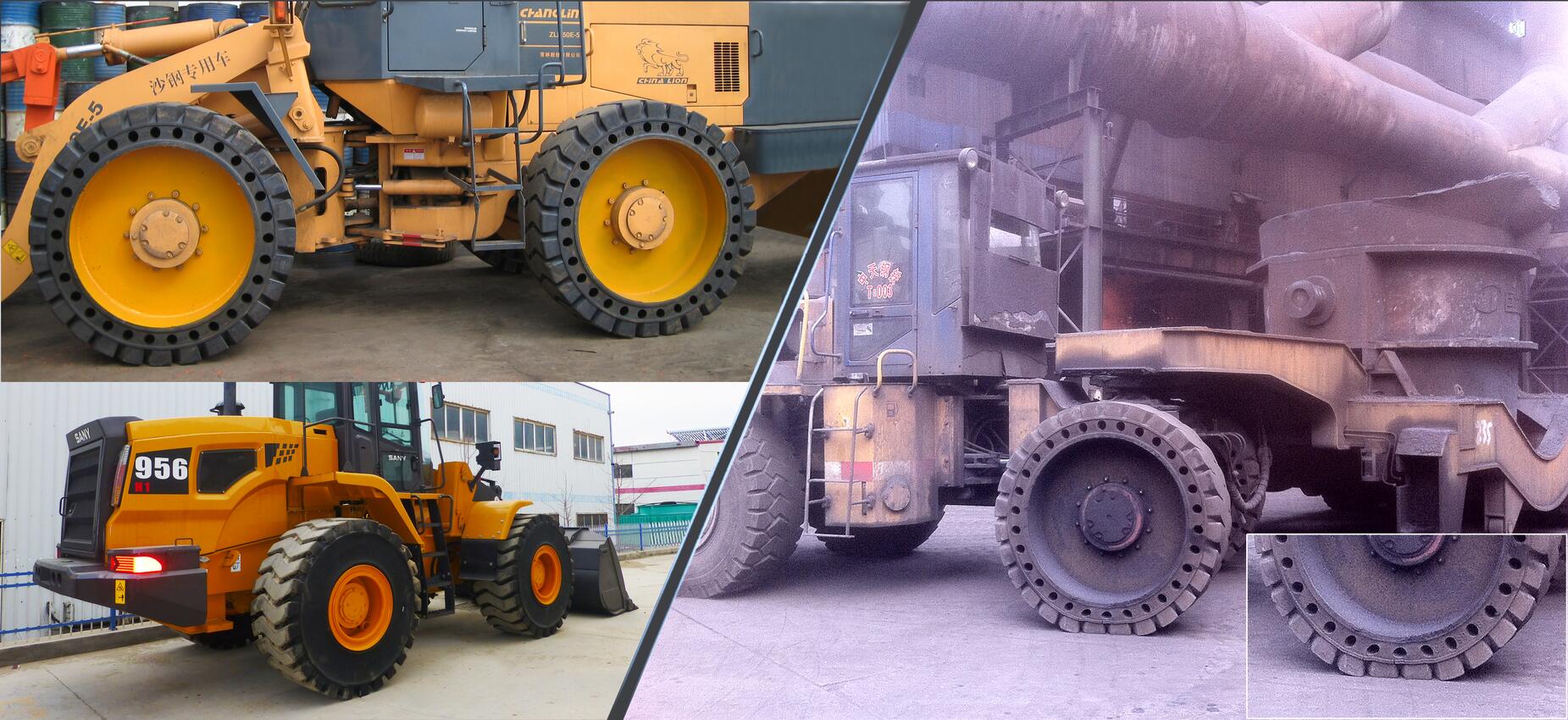
Where Solid Rubber Tires Make the Biggest Difference
Not every vehicle needs the same tire, and not every site has the same working pressure. However, Solid Rubber Tires are often more valuable when vehicles operate in enclosed or semi-enclosed industrial areas, where puncture risk, turning frequency, load weight, and maintenance time are the main concerns.
In warehouse operations, solid forklift tires can support repeated lifting and turning while reducing the risk of flat tires during busy loading periods. For indoor floors, non-marking versions can help reduce black marks and keep the working area cleaner.
In ports and container yards, heavy-duty solid tires can be used for trailers, container handling equipment, and other ground support vehicles that need strong load capacity. Since these vehicles often work for long hours, stable tire performance helps reduce unexpected service interruptions.
In recycling yards, scrap yards, and waste handling areas, puncture-proof performance becomes more important than driving comfort. A tire that can continue working around sharp debris can help equipment remain productive during harsh daily use.
In steel mills and metallurgical environments, heat resistance, cut resistance, and load stability are important tire characteristics. Solid rubber tires used in these areas need to deal with ground impact, high temperature zones, and heavy industrial movement.
Solid Rubber Tires and Total Working Cost
Many buyers compare tires only by unit price, but industrial tire cost should be judged by working life, maintenance frequency, and vehicle downtime. A cheaper tire may become expensive if it needs frequent replacement or causes equipment to stop during production.
Solid Rubber Tires can help control long-term operating cost in several ways:
- They reduce downtime caused by punctures and air leakage.
- They lower the need for daily pressure inspection.
- They are suitable for repeated stop-start operation.
- They can support heavy loads in demanding industrial areas.
- They offer longer usable life in many low-speed, high-load environments.
For companies operating multiple forklifts or industrial vehicles, this cost difference becomes more obvious. A single stopped vehicle may be manageable, but repeated tire problems across a fleet can affect labor planning, shipping schedules, and equipment availability.
Solid Rubber Tires for Different Industrial Vehicles
WonRay solid rubber tire solutions cover many industrial vehicle applications, including forklift solid tires, non-marking solid tires, skid steer loader solid tires, wheel loader solid tires, trailer solid tires, port vehicle solid tires, steel mill tires, and AWP wheels for scissor lifts or boom lifts. Different vehicles require different tread designs, rubber formulas, rim matching, and load performance, so the tire should be selected according to the real working scene.
For material handling equipment, stable rolling and long service life are often the main focus. For heavy-duty machinery, load capacity, impact resistance, and puncture resistance become more important. For indoor electric forklifts or food processing areas, clean non-marking performance may be required. For steel mills or harsh industrial sites, heat resistance and wear resistance need more attention.
This product range allows users to choose solid rubber tires according to both vehicle type and working environment, rather than using one general tire for every application.
When Solid Rubber Tires Are the Better Choice
Solid Rubber Tires are usually a better choice when the vehicle works in areas where punctures are common, loads are heavy, maintenance time is limited, and stable operation is more important than high-speed road comfort. They are especially suitable for forklifts, trailers, loaders, warehouse vehicles, port equipment, and industrial machines that operate on fixed sites.
For buyers who want fewer tire failures, lower maintenance pressure, and more stable daily operation, solid rubber tires provide a practical solution. The key is not simply choosing a solid tire, but choosing the right solid rubber tire for the vehicle, load, ground, and industry.
FAQ
Q1: What are Solid Rubber Tires used for?
Solid Rubber Tires are mainly used for forklifts, trailers, skid steer loaders, wheel loaders, port vehicles, warehouse equipment, recycling yard machines, and other industrial vehicles that need puncture-resistant and maintenance-free tire performance.
Q2: Are Solid Rubber Tires better than pneumatic tires?
Solid Rubber Tires are better for puncture-prone, heavy-load, and low-speed industrial environments because they do not rely on air pressure. Pneumatic tires may offer more cushioning for some outdoor driving conditions, but they are more vulnerable to punctures and pressure loss.
Q3: Can Solid Rubber Tires be used indoors?
Yes. Solid Rubber Tires can be used indoors, especially on forklifts and warehouse vehicles. For clean floors, non-marking solid tires are often used to reduce black marks and maintain a cleaner working environment.
Post time: 07-07-2026