
Skid loaders are widely used in construction, agriculture, landscaping, demolition, and material handling because of their compact structure and high maneuverability. However, what many operators overlook is that the performance of a skid loader is heavily influenced by its tires, especially when working in harsh, debris-filled, or high-load environments.
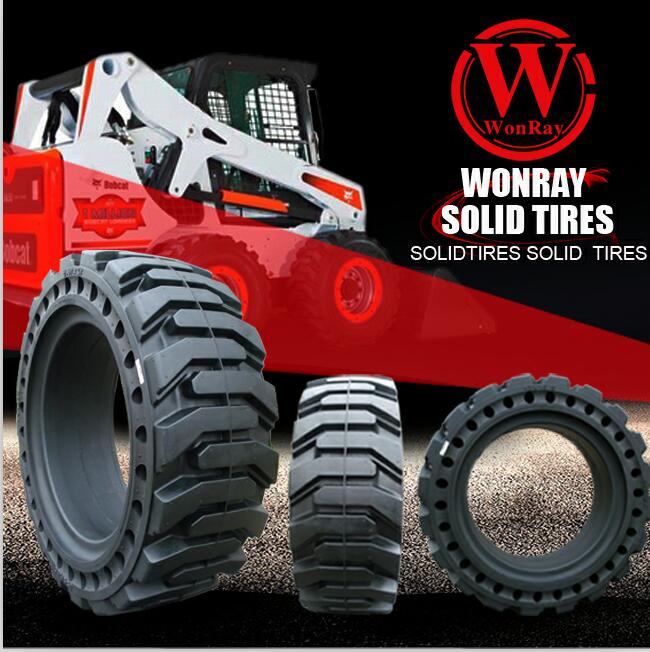
Skid loader solid tires are increasingly replacing traditional pneumatic options in many industrial applications because they offer higher resistance to damage, more predictable performance, and significantly reduced downtime. In environments where a single tire failure can stop the entire job site, solid tire systems are becoming a practical operational upgrade rather than just an alternative.
What Makes Skid Loader Solid Tires Different From Standard Tires?
Skid loader solid tires are designed with a completely different engineering logic compared to air-filled tires. Instead of relying on air pressure for load support, they use a full rubber or composite structure that eliminates puncture risk entirely.
Key structural characteristics include:
● Full-body solid rubber construction with no internal air chamber
● Reinforced internal geometry to distribute heavy load evenly
● High-density compounds designed to resist cutting and tearing
● Stable footprint design that maintains shape under continuous stress
This structure allows skid loaders to operate in environments where traditional tires would fail quickly.
How Solid Tires Improve Productivity on Job Sites
One of the biggest advantages of skid loader solid tires is not just durability, but operational continuity. In construction and industrial environments, downtime is often more expensive than equipment cost.
Solid tires improve productivity by:
● Eliminating downtime caused by punctures or air leakage
● Reducing emergency tire replacement during active projects
● Allowing continuous operation in debris-heavy environments
● Supporting stable performance under repeated load cycles
This reliability allows operators to focus on productivity rather than tire maintenance issues.
Load Stability and Machine Control Under Heavy Work Conditions
Skid loaders frequently operate with uneven or shifting loads, especially during lifting, digging, or material transport tasks. Tire stability directly affects machine control and operator safety.
Solid tires enhance load stability through:
● Consistent shape retention under heavy compression
● Reduced sidewall deformation during lifting operations
● Stable ground contact even under uneven weight distribution
● Predictable steering response during high-load turns
This makes the machine easier to control in precision work environments.
Performance in Extreme Job Site Conditions
Construction and demolition environments expose tires to constant mechanical stress and unpredictable surfaces.
Skid loader solid tires perform effectively in:
● Demolition zones with sharp concrete and steel debris
● Road construction sites with gravel and asphalt fragments
● Industrial yards with metal scrap and heavy waste materials
● Agricultural environments with compacted soil and rough terrain
● Recycling facilities with mixed hazardous ground surfaces
Their resistance to puncture and structural damage makes them suitable for extreme conditions where pneumatic tires struggle.
Heat Generation and Continuous Operation Capability
Skid loaders often operate in repetitive cycles, which generates significant heat in the tire structure due to friction and load pressure.
Solid tire systems manage heat effects through:
● Dense rubber compounds designed for thermal resistance
● Stable structure that reduces internal movement and friction
● Improved heat dispersion across the tire body
● Resistance to deformation under prolonged operation
This helps maintain consistent performance during long working shifts.
Operator Safety and Equipment Reliability
Safety is a major concern in skid loader operations due to the combination of heavy loads, confined spaces, and constant movement.
Solid tires contribute to safety by:
● Removing sudden deflation risks during heavy lifting
● Maintaining consistent machine balance during operation
● Reducing instability caused by uneven tire pressure
● Supporting predictable handling in tight working zones
This improves operator confidence and reduces accident risk in high-pressure environments.
When Should You Choose Solid Tires for a Skid Loader?
Solid tires are not necessary for every application, but they are highly recommended in specific working conditions.
They are most suitable when:
● Worksites contain frequent sharp debris or metal fragments
● Machines operate in demolition or recycling environments
● Downtime must be minimized due to project deadlines
● Equipment is used in multi-shift or continuous operation cycles
● Load stability is more important than ride comfort
In lighter-duty or smooth-surface environments, pneumatic tires may still be appropriate.
Future Trends in Skid Loader Tire Development
As construction equipment becomes more specialized, skid loader tires are also evolving toward hybrid and performance-optimized designs.
Key development directions include:
● Hybrid solid structures with improved shock absorption
● Advanced rubber compounds with lower heat buildup
● Multi-layer designs for enhanced energy efficiency
● Application-specific tire engineering for different industries
The goal is to combine durability with improved operational comfort.
Conclusion
Skid loader solid tires are becoming increasingly important in modern construction and industrial operations due to their ability to withstand extreme working conditions while maintaining consistent performance. In environments where tire failure directly affects productivity and safety, solid tire systems offer a practical and reliable solution.
They are not simply a replacement for pneumatic tires, but a strategic upgrade for operations that prioritize uptime, durability, and machine control under demanding conditions.
FAQ
1. Why are solid tires better for skid loaders in construction work?
Because they eliminate puncture risks and provide stable performance in debris-heavy and high-impact environments.
2. Do solid skid loader tires affect machine comfort?
Yes, they are generally firmer than pneumatic tires, but they significantly improve durability and operational reliability.
3. Can skid loader solid tires be used on all terrains?
They perform best on rough, debris-filled, and industrial surfaces, but may be less comfortable on smooth terrain.
4. How long do skid loader solid tires usually last?
Service life depends on workload and surface conditions, but they typically last much longer than pneumatic tires in harsh environments.
Post time: 10-06-2026