
Cleanrooms require careful control of airborne particles, surface contamination, and materials introduced by moving equipment. Even components that appear insignificant, such as wheels and tires on material-handling carts, can influence how easily a controlled environment is maintained. White Rubber Tires For Clean Rooms are often considered when visible marking and contamination management are important, but color alone does not determine whether a tire is suitable. Material composition, wear behavior, floor compatibility, and cleaning requirements all contribute to its performance.
Why Are White Rubber Tires Used in Cleanrooms?
A white tire may reduce the contrast associated with conventional dark rubber marks on certain floors. However, this does not mean that white rubber leaves no marks. Tire residue depends on the compound, surface condition, contact pressure, friction, and movement patterns. A white tire can still transfer material, generate particles, or leave visible traces if its formulation and application are unsuitable.
The distinction between appearance and cleanliness is particularly important in cleanroom operations. A tire that looks clean may still release microscopic particles through abrasion. Conversely, a tire that leaves a visible mark is not necessarily releasing the same amount or type of airborne contamination as another tire. Visual inspection can identify some problems, but it cannot independently establish cleanroom suitability.
The correct objective is therefore to select a tire that meets the facility’s contamination-control requirements while supporting the load and movement demands of the equipment. White coloration can be one selection consideration, but it should not replace an assessment of material properties and performance.
How Does Tire Design Influence Contamination Control?
Tire design affects how the wheel interacts with the floor during straight travel, turning, stopping, and repeated loading. Each movement creates contact forces and friction, which can gradually change the tire surface and the material transferred to the floor.
The rubber compound is one important factor. Different formulations can vary in abrasion resistance, hardness, elasticity, and resistance to cleaning agents. A compound that wears excessively under frequent turning may release more debris over time. However, hardness alone is not a reliable indicator of cleanliness because the relationship between deformation, friction, and wear depends on the complete tire formulation and operating conditions.
Tread and surface geometry also matter. A smooth contact surface may be appropriate for some cleanroom floors and handling applications, while other equipment may require a different profile to meet traction or load requirements. The choice should reflect the facility’s operating conditions rather than assume that one tread design is suitable for every controlled environment. The tire’s interaction with the floor is equally important. Repeated pivoting, sharp turns, abrupt braking, and concentrated loads can increase friction or create localized wear. Even a suitable tire may perform poorly if it is used beyond its intended load capacity or operated in a way that causes unnecessary sliding.
For this reason, White Rubber Tires For Clean Rooms should be evaluated as part of a complete wheel-and-floor system. Tire material, wheel construction, equipment design, floor finish, and operating procedures all contribute to contamination control. Selecting the tire in isolation may overlook factors that have a greater influence on actual performance.
What Types of Contamination Should Be Considered?
Particulate contamination can arise when a tire or another wheel component gradually wears during movement. The amount and characteristics of the released material depend on the compound, surface condition, load, and frequency of use. Dust and loose debris already present on the floor may also become redistributed as equipment passes over them.
Surface marking is a separate concern. Rubber transfer can affect the appearance of floors and may indicate that friction, compound compatibility, or operating practices need attention. However, the absence of visible marks does not prove that particle generation is negligible.
Chemical contamination may also matter in sensitive applications. Certain cleanrooms have strict requirements concerning extractable substances, residues, or compatibility with cleaning and disinfection agents. A tire’s suitability in these environments cannot be established through color or general descriptions such as “cleanroom grade” alone. Relevant material documentation and application-specific validation may be necessary.
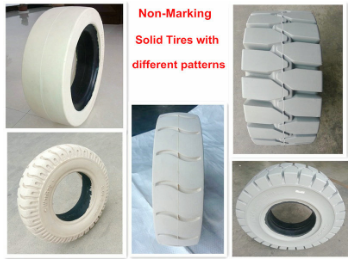
How to Evaluate White Rubber Tires for Cleanroom Applications
A structured evaluation helps connect tire characteristics with the actual demands of a controlled environment. Rather than relying on appearance or a single material claim, facility operators should examine the intended application and verify the relevant performance requirements.
- Particle and wear behavior: Ask whether the tire material has been assessed for abrasion under conditions relevant to the intended load, movement, and floor surface. Where particle limits are critical, determine whether suitable test data or application validation is available.
- Floor marking and compatibility: Check whether the tire compound is appropriate for the floor finish and whether repeated turning or braking produces unwanted marks. Testing under representative conditions is more informative than relying on color alone.
- Chemical and cleaning compatibility: Review the cleaning agents, disinfectants, and exposure conditions used in the facility. Confirm that the tire material can tolerate these conditions without unacceptable deterioration or residue.
- Load and movement requirements: Verify the rated capacity, wheel dimensions, operating speed, and movement pattern of the equipment. Frequent turning, concentrated loads, and continuous use may affect wear differently from occasional straight-line movement.
- Facility requirements: Identify the applicable cleanroom classification, contamination-control procedures, and any material documentation required by the quality or engineering team. A tire should meet the needs of the specific process rather than rely on a broad suitability claim.
How Can Tire Wear Affect Long-Term Cleanroom Conditions?
Tire condition changes over time. Repeated loading, turning, contact with floor joints, and exposure to cleaning chemicals may alter the surface and influence how the tire performs. As wear progresses, a tire that initially meets the application’s requirements may no longer provide the same results.
Inspection frequency should reflect how often the equipment operates and how sensitive the environment is to contamination. High-use carts may require closer monitoring than equipment used only occasionally. Inspections can look for surface cracking, unusual abrasion, embedded debris, deformation, and changes in marking behavior. Cleaning also needs to be considered carefully. Removing visible residue from a tire does not necessarily eliminate particles generated by ongoing wear. Similarly, using an aggressive cleaning agent without checking material compatibility may damage the rubber and create further maintenance problems. Cleaning procedures should therefore follow the facility’s approved practices and the tire material’s documented requirements.
Replacement decisions should account for both mechanical condition and contamination performance. A tire may still support the load while showing excessive wear or leaving residue that no longer meets facility expectations. Including wheel condition in preventive maintenance helps identify these changes before they disrupt routine operations.
Exploring White Rubber Tire Options for Controlled Environments
When evaluating tires for cleanrooms and other controlled work areas, it is useful to consider the full application rather than color alone. WonRay offers industrial solid tire options for different equipment and operating requirements. Facility operators can compare suitable configurations by considering load capacity, wheel dimensions, floor conditions, wear behavior, and the intended working environment. Where contamination limits are strict, material documentation and application testing should be reviewed before a final selection is made.
Conclusion
White rubber tires can be a practical consideration where visible marking and cleanroom maintenance are important, but white coloration does not guarantee low particle generation or contamination control. The rubber compound, tread design, floor compatibility, operating conditions, and cleaning process all influence performance. Choosing suitable White Rubber Tires For Clean Rooms requires matching these factors to the facility’s specific requirements and verifying performance under realistic conditions. Regular inspection and appropriate maintenance help ensure that tire behavior continues to meet the needs of the controlled environment.
FAQs
1. Are white rubber tires automatically suitable for cleanrooms?
No. White coloration does not establish particle performance, chemical compatibility, or compliance with a particular cleanroom classification. Suitability should be verified against the facility’s requirements and relevant material documentation.
2. Can white rubber tires leave marks on cleanroom floors?
Yes. Marking depends on the rubber formulation, floor material, contact pressure, friction, and operating practices. Testing the tire on a representative floor surface can help identify potential problems.
3. What is the difference between non-marking tires and low-particle tires?
Non-marking tires are designed to reduce visible residue on floor surfaces. Low-particle tires focus on limiting particle release during use. These properties are related to cleanliness but are not interchangeable, so both may need to be evaluated separately.
4. How often should cleanroom tires be inspected?
Inspection frequency depends on usage intensity, contamination sensitivity, and facility procedures. Regular checks should identify wear, cracking, embedded debris, and changes in marking behavior, with more frequent inspections where equipment operates continuously or contamination limits are especially strict.
Post time: 22-10-2026