
Trailer solid tires and forklift solid tires share a solid rubber construction, but they serve different equipment needs. Trailers carry materials while being towed; forklifts transport and lift loads, steer through tight spaces, and stop frequently. These differences affect tire capacity, dimensions, mounting, and wear. When comparing Trailer Solid Tires and Forklift Solid Tires, appearance is not enough to determine suitability. The correct choice depends on how the equipment carries weight, how its wheels function, and where it operates. Understanding these factors helps avoid incompatible replacements.
Equipment Function Sets the Selection Priorities
Industrial trailers and carts move goods between work areas. Their wheels support the trailer and its cargo while following a towing vehicle. Tire selection should reflect the trailer’s construction, load, route, and turning conditions.
Forklifts perform more varied tasks. They carry materials, raise and lower loads, reverse, turn, and brake repeatedly. Their tires support the vehicle while responding to forces created during lifting and maneuvering.
A trailer tire must suit the trailer’s wheel configuration and towing conditions. A forklift tire must match the truck model, wheel position, and driving or steering requirements. Even if two tires look similar, they should not be treated as interchangeable without checking their specifications.
Load Distribution and Capacity Are Different
A trailer’s total loaded weight is shared by its supporting wheels. The load on each tire depends on the number of wheels, axle arrangement, cargo position, and trailer design. Unevenly positioned cargo can place extra pressure on particular wheels. Selecting Trailer Solid Tires therefore requires more than knowing the trailer’s maximum payload. The load at each wheel and the manufacturer’s rated conditions must also be considered.
A forklift has a different load pattern. Its front axle commonly carries a substantial share of the vehicle’s weight, particularly when the forks are loaded. The rear axle has another role and is often responsible for steering. Tire loading changes as materials are lifted, lowered, or moved.
Load center and attachment weight can further affect the forces acting on forklift tires. A tire’s capacity should therefore be checked against the truck specifications, wheel position, load conditions, and operating speed. Capacity alone cannot confirm compatibility; dimensions and mounting must also match.
Wheel Position Changes the Forces on the Tire
Trailer wheels mainly support the trailer and allow it to roll along the towing route. Their operating forces depend on the trailer’s design and movement pattern. A unit that travels mostly in straight lines may experience different forces from one that turns frequently in confined areas. Alignment and cargo distribution also affect wear.
Forklift wheels have more specialized functions. Driving wheels transmit power and experience traction and braking forces. Steering wheels control direction and are exposed to repeated directional changes and lateral forces. The exact arrangement varies by truck design, so the wheel position must be identified before ordering a replacement.
Frequent tight turns can contribute to uneven wear, particularly when the tire is unsuitable for the surface or work cycle. Forklift Solid Tires should therefore be selected according to their intended axle position, rather than treating every tire on the vehicle as interchangeable.
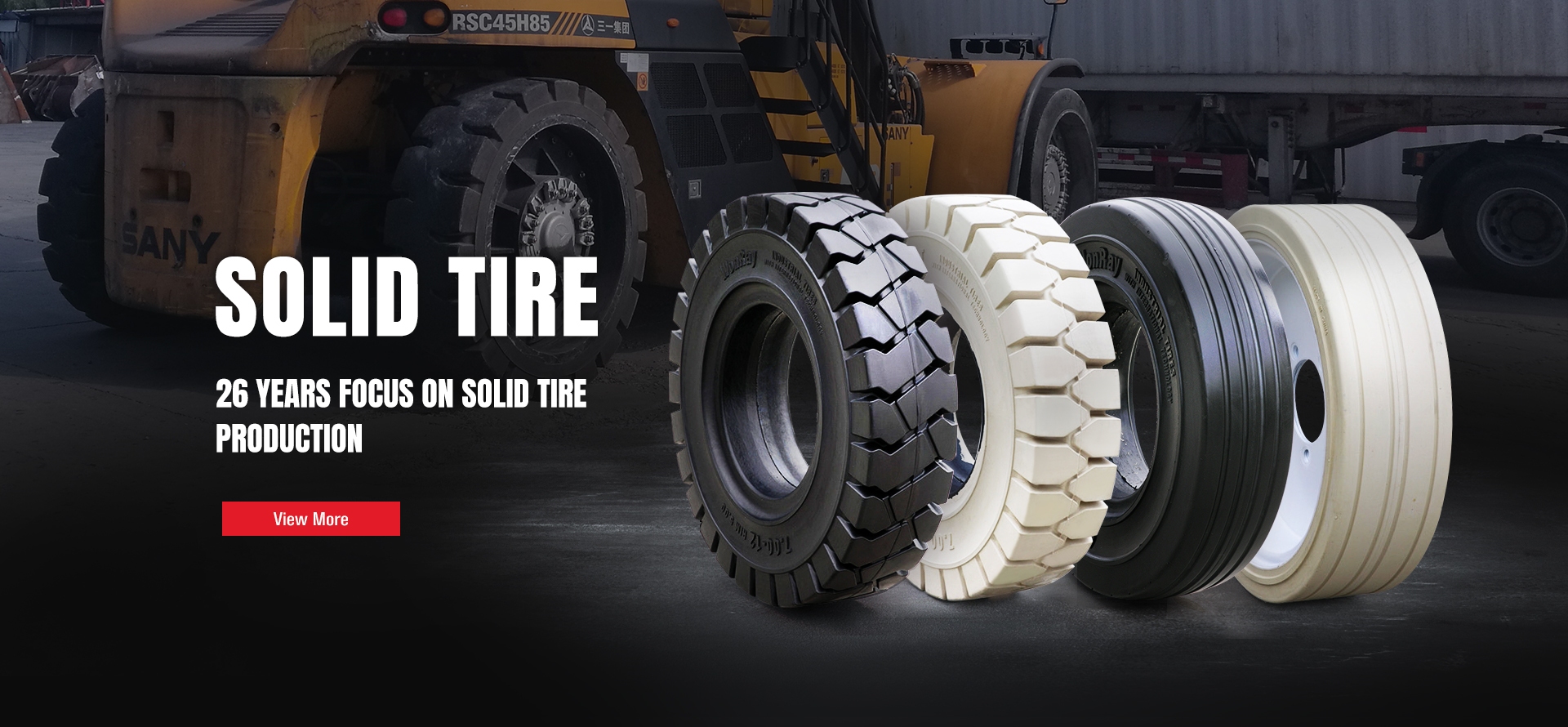
Dimensions and Mounting Must Match
Similar outside dimensions do not prove that two solid tires fit the same wheel. A replacement must match the complete size, rim design, and mounting method.
Trailer solid tires are available in different size and rim combinations. The correct configuration depends on the original wheel design, required load capacity, and installation arrangement. Some applications use complete tire-and-rim assemblies.
Forklift tires also have distinct mounting systems. Solid pneumatic-profile tires are designed for compatible pneumatic tire rims. Press-on tires use another arrangement and require a matching wheel structure and suitable installation equipment. These designs should not be assumed interchangeable.
|
Comparison factor |
Trailer solid tires |
Forklift solid tires |
| Main function | Supporting towed cargo | Supporting lifting and material handling |
| Load pattern | Cargo shared across trailer wheels | Vehicle weight and lifted loads affect axle loading |
| Wheel function | Supporting and rolling | Driving, steering, and supporting |
| Movement | Follows the towing vehicle | Frequent starting, stopping, and turning |
| Mounting | Matches trailer wheel design | Matches forklift rim and mounting system |
| Selection priorities | Load, size, wheel arrangement | Wheel position, construction, size, duty cycle |
Before ordering, check the full tire size, rim dimensions, and mounting method. Use the original equipment specification or clear photographs and measurements of the existing assembly. Do not select a replacement based only on a similar sidewall or outside diameter.
Operating Conditions Influence Wear
Trailers and forklifts often follow different work cycles. Industrial trailers may travel at relatively low speeds while carrying materials over a defined route. Their tires must support repeated movement within recommended load and speed conditions. Travel distance and floor condition influence wear.
Forklifts commonly work through repeated short cycles. They move to collect materials, stop, reverse, turn, and travel between loading and unloading points. These actions create repeated acceleration, braking, and steering forces.
Speed and operating duration matter in both applications. Excessive loading, unsuitable speeds, rough surfaces, and prolonged operation can increase heat buildup and accelerate deterioration. Solid construction removes the need to maintain air pressure, but it does not make a tire immune to heat, impact damage, or overloading.
When comparing Trailer Solid Tires with Forklift Solid Tires, consider the complete operating cycle rather than load capacity alone. Working speed, movement frequency, surface condition, and duration of use help determine whether a tire is suitable.
Compound and Tread Should Suit the Work Surface
Rubber compound and tread design influence traction, wear, and operating stability. The appropriate configuration depends on the equipment and the surface where it works.
Trailer tires may be used in warehouses, production facilities, and industrial transport areas. Their compound and tread should suit the floor, cargo weight, and movement frequency.
Forklift tires experience additional forces from steering, braking, and changing loads. Their compound needs to balance wear resistance, resilience, and stability. Tread design should match the surface and traction requirements.
No single compound or tread pattern is ideal for every application. Choosing only by softness, hardness, or visible tread depth can overlook load, floor condition, and operating frequency. Review manufacturer specifications and match them to the working environment.
Why Direct Substitution Can Cause Problems
Choosing between trailer and forklift tires based only on appearance can overlook equipment requirements. A trailer tire may have suitable dimensions but lack the mounting structure required by a forklift. A forklift tire may not match a trailer’s wheel assembly or load conditions. Similar dimensions do not establish compatibility.
Before considering a substitution, verify:
- · Equipment type, model, and original tire specification.
- · Complete tire dimensions, rim requirements, and mounting method.
- · Load carried by each wheel during normal operation.
- · Intended speed, movement frequency, and working environment.
- · Whether the wheel performs a driving, steering, or support function.
These checks are especially important for older equipment or when original specifications are unavailable. Photographs of the existing tire, rim, and equipment identification plate can help clarify the required configuration.
WonRay offers solid rubber tire options for trailer and forklift applications. Providing the equipment model, tire dimensions, load requirements, and working conditions can help identify an appropriate configuration and confirm compatibility before ordering.
Conclusion
Trailer solid tires and forklift solid tires share solid rubber construction, but their applications create different requirements for load distribution, wheel function, mounting, and operating conditions. Trailer tires are selected around cargo transport and trailer configuration, while forklift tires must also accommodate lifting, steering, driving, and changing axle loads. Checking these differences before ordering helps prevent unsuitable substitutions.
FAQs
1. Can trailer solid tires be used on forklifts?
Not automatically. The tire must match the forklift’s wheel assembly, mounting structure, load requirements, and equipment specifications. Similar dimensions do not guarantee compatibility.
2. Are forklift solid tires suitable for industrial trailers?
That depends on the trailer’s wheel design, load rating, mounting requirements, and operating conditions. Compatibility should be confirmed before using a forklift tire on a trailer.
3. What is the main difference between trailer and forklift solid tires?
Trailer tires mainly support towed cargo transport. Forklift tires must also accommodate driving, steering, lifting-related load changes, and frequent maneuvering.
4. What information is needed when ordering solid tires?
Provide the equipment type and model, existing tire size, rim dimensions, required load capacity, wheel position, and working environment. These details help verify the correct product configuration.
Post time: 23-11-2026