
Solid tires, also known as flat-free tires or solid rubber tires, are airless industrial tires widely used for forklifts, pallet jacks, and heavy-duty material handling machines. Unlike pneumatic tires that depend on compressed air to support loads and absorb shocks, solid tires are made of dense vulcanized rubber or polyurethane. They have become a top choice for warehouses, ports, construction sites, and manufacturing facilities because they eliminate punctures, reduce downtime, and lower long-term maintenance costs. This guide covers the working principle, main types, typical applications, and frequently asked questions about solid tires for industrial buyers and fleet managers.
How Do Solid Tires Work?
Solid tires have no internal air cavity. They support weight and maintain performance using the natural stiffness and elasticity of solid elastomer materials. Most industrial-grade solid tires use a 3-layer structure to balance strength, cushioning, and durability:
- Base Layer: Steel-reinforced rubber that attaches tightly to the wheel rim to prevent slipping under heavy loads and high torque.
- Cushion Layer: Semi-elastic rubber that absorbs small shocks and reduces vibration to protect equipment axles and operators.
- Tread Layer: Wear-resistant outer material designed for traction, resistance to sharp debris, oil, and chemicals.
Since solid tires do not use air, they cannot go flat, blow out, or leak. Even when exposed to nails, metal pieces, broken concrete, or glass, they continue working safely. Solid tires require no air pressure checks, tube replacements, or puncture repairs, making them ideal for 24/7 industrial operations.
Main Types of Industrial Solid Tires
Different types of solid tires are designed for specific working environments, load requirements, and floor conditions.
Press-On Band Solid Tires
Press-on solid tires are made of rubber bonded to a steel band and mounted with a hydraulic press. They are the standard choice for electric forklifts and narrow-aisle machines on smooth indoor concrete floors.
- Benefits: Stable, low-profile, low rolling resistance, energy-efficient.
- Best for: Warehouses, distribution centers, clean indoor facilities.
Solid Resilient Tires
Solid resilient tires have the same shape as pneumatic tires but are fully solid. They fit standard pneumatic wheel rims without replacement. They offer better shock absorption for mixed indoor-outdoor use.
- Benefits: Puncture-proof, easy to retrofit, suitable for slightly rough surfaces.
- Best for: Loading docks, manufacturing plants, forklifts on concrete with expansion joints.
Polyurethane (PU) Solid Tires
PU solid tires are cast from synthetic polyurethane. They provide excellent wear resistance and non-marking performance. In ideal indoor conditions, they last 3–5 times longer than rubber tires.
- Benefits: Non-marking, chemical-resistant, low rolling resistance, quiet.
- Limitations: Poor shock absorption, not for rough outdoor terrain.
- Best for: Food processing, pharmaceutical warehouses, cleanrooms, retail centers.
Non-Marking Solid Tires
Non-marking solid tires use carbon-free rubber to avoid black scuffs on polished concrete, epoxy, or tile floors. They offer the same durability as standard rubber tires.
- Best for: Hospitals, airports, retail spaces, food-grade facilities.
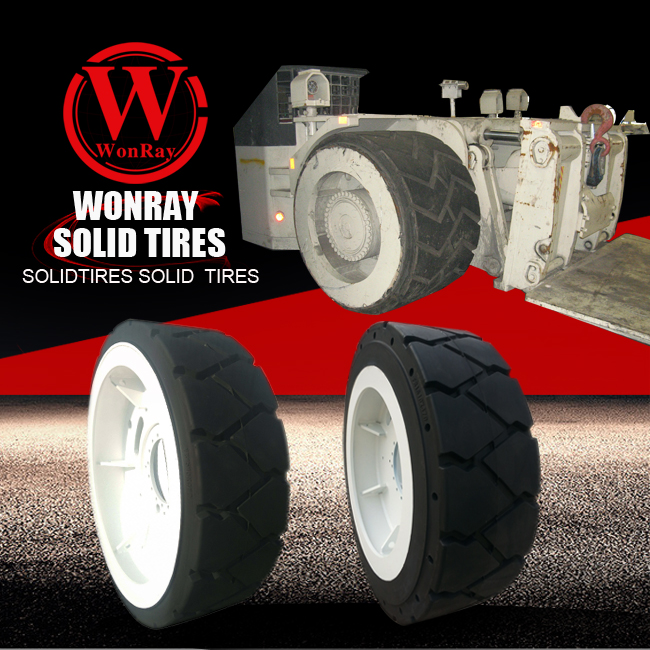
Heavy-Duty Industrial Solid Tires
Heavy-duty solid tires feature reinforced steel cores and ultra-dense rubber for extreme loads and harsh environments. They resist cutting, chunking, and heavy impact.
- Best for: Ports, scrap yards, demolition sites, mining equipment.
Typical Applications of Solid Tires
Solid tires perform best in environments where pneumatic tires fail easily. Tire selection can be made by industry scenario based on working environment, floor conditions, and load requirements:
Warehousing & Material Handling
Forklifts, pallet jacks, reach trucks, order pickers, and AGVs are the most typical applications of solid tires. Warehouse floors are mostly smooth concrete or epoxy, and equipment is expected to run continuously around the clock — the maintenance-free, puncture-proof nature of solid tires significantly reduces downtime, while the low rolling resistance of press-on or PU tires cuts energy consumption on electric forklifts and extends battery life per charge.
Selection tip: For smooth indoor floors, prioritize PU solid tires (lighter, energy-saving, non-marking); where durability and cost matter most, standard rubber press-on tires are a solid choice.
Ports & Terminals
Container handlers, terminal tractors, and dock forklifts operate under heavy loads and high-frequency duty cycles in yards often littered with metal scraps, spilled ore, and oil. The reinforced steel cores and ultra-dense rubber of heavy-duty solid tires resist cutting and chunking, and their airless construction prevents large equipment from being stranded in the work zone by a puncture — a costly scenario to avoid.
Selection tip: Prioritize heavy-duty industrial solid tires; when short runs across soft yard surfaces are required, consider solid resilient tires for added cushioning.
Construction & Demolition
Skid steer loaders, compact loaders, and concrete mixers work on sites covered with rebar, concrete blocks, and glass shards, where pneumatic tire puncture rates are extremely high. Solid tires keep equipment working on high-risk ground, and their stable support improves handling on sloping terrain.
Selection tip: Go with heavy-duty solid tires as the primary choice; on sites with large amounts of uncompacted gravel or mud, assess the impact of limited shock absorption on equipment lifespan.
Recycling & Waste Management
Scrap loaders, waste compactors, and debris-handling machines operate in extreme environments such as metal scrap piles, crushed glass, and compacted garbage, where conventional tires are easily punctured or torn. The cut resistance and chemical resistance of heavy-duty solid tires are nearly irreplaceable in these conditions.
Selection tip: Choose heavy-duty solid tires with cut-resistant compounds and inspect tread chunking regularly.
Manufacturing Plants & In-Plant Logistics
Tow tractors, floor sweepers, and assembly-line transfer equipment travel through plants where floors are often contaminated with oil, coolant, and metal chips. Solid tires resist oil and chemicals, require no maintenance, and non-marking versions protect workshop floor coatings — a good fit for lean workshop management.
Selection tip: Standard rubber solid tires for general workshops; non-marking PU tires for cleanrooms and precision manufacturing.
Clean & Public Environments
Hospitals, airports, food and pharmaceutical plants, and retail centers have strict floor cleanliness requirements. Non-marking solid tires leave no black scuffs on polished floors or tiles, and their tubeless construction eliminates the risk of floor contamination from air leaks, meeting food-grade and hygiene management standards.
Selection tip: For food, pharmaceutical, and cleanroom scenarios, always use non-marking PU tires and verify the corresponding food-grade certifications.
Other Supplementary Scenarios
- Airport ground services: Baggage tractors and passenger stairs use solid tires to avoid apron punctures and cut ground-service maintenance time.
- Mining & underground operations: Auxiliary transport vehicles on hard rock surfaces benefit from fewer blowouts with heavy-duty solid tires, though speed limits must be observed.
- Cold-chain warehousing: Low-temperature environments in cold storage affect rubber elasticity, so solid tires with cold-resistant compounds are required.
- Distribution centers & e-commerce warehouses: High-density racking areas involve frequent start-stop and turning; solid tires respond quickly with no sidewall flex, enabling precise narrow-aisle operation.
FAQ
Q1: Are solid tires completely puncture-proof? A1: Yes. Solid tires have no air chamber, so nails, glass, or metal cannot cause flats or deflation. They keep working safely with minor surface damage.
Q2: How long do solid tires last? A2: Rubber solid tires last 2,500–4,000 operating hours. Polyurethane solid tires last 4,000–6,000 hours, depending on surface, load, and usage.
Q3: Can solid tires be used outdoors? A3: Yes, on paved concrete or asphalt surfaces. They are not recommended for mud, deep gravel, or extremely rough terrain due to limited shock absorption.
Q4: What maintenance do solid tires need? A4: Only regular visual inspections for cracks, chunking, and tread wear. No inflation, repairs, or replacements are needed under normal use.
Q5: Can I replace pneumatic tires with solid tires on a forklift? A5: Yes. Solid resilient tires fit standard pneumatic rims. Press-on tires require special steel bands and professional installation. Always follow OEM load ratings.
Q6: What is the 60J safety line on solid tires? A6: The 60J line is a molded wear indicator on the sidewall. Replace tires immediately when tread wears down to this line to avoid failure.
Q7: Are solid tires heavier than pneumatic tires? A7: Yes, but their weight improves load stability. PU solid tires are lighter and help save battery on electric forklifts.
Post time: 24-09-2026