
Wheel loaders operate in environments where failure is not an option and downtime directly translates into financial loss. In mining sites, quarry operations, and heavy construction projects, machines are pushed to their operational limits every day. While engine power and hydraulic systems often receive the most attention, tire performance is one of the most decisive factors affecting real productivity.
Solid tires for wheel loaders are not simply a replacement for pneumatic tires. They represent a different operating philosophy—one focused on continuity, resistance, and predictable performance under extreme conditions. Understanding their role requires looking at how they behave inside real production environments rather than comparing product specifications alone.
Why Wheel Loader Workloads Are More Severe Than Most Equipment
Wheel loaders are not designed for linear or predictable operation. Instead, they operate in continuous cycles that combine multiple stress factors in a single working pattern.
Typical operational conditions include:
● Constant loading and unloading of heavy materials
● Repeated short-distance travel under full load
● Frequent direction changes in confined spaces
● Contact with sharp, abrasive, and uneven ground materials
● Long operating shifts with minimal cooling breaks
These combined factors create a high-stress environment where tire fatigue accumulates rapidly.
What Changes When Solid Tires Replace Pneumatic Tires
The transition from pneumatic to solid tires is not just a material change. It fundamentally alters how the machine interacts with the ground.
Key operational changes include:
● Removal of air-pressure dependency as a failure point
● Structural load-bearing instead of pressure-based support
● More consistent shape retention under heavy compression
● Reduced sensitivity to punctures and external damage
This shift improves reliability in environments where tire damage is frequent and unpredictable.
How Tire Stability Impacts Daily Production Output
In heavy industrial operations, productivity is measured by cycle consistency rather than peak performance. Even small interruptions can significantly reduce output over time.
Solid tires contribute to production stability by:
● Reducing unexpected downtime caused by tire failure
● Maintaining consistent rolling behavior during loaded cycles
● Supporting uninterrupted operation in abrasive environments
● Eliminating emergency tire replacement interruptions
Over long shifts, this stability directly improves usable working hours.
Why Mining and Quarry Sites Accelerate Tire Wear
Wheel loaders used in mining and quarry operations face some of the harshest ground conditions in the industry. These environments are highly destructive to traditional tire structures.
Common challenges include:
● Sharp rock surfaces that cut and chip rubber compounds
● Uneven terrain causing continuous structural impact
● High-density materials increasing load stress per cycle
● Mixed debris including metal fragments and hard minerals
In such conditions, pneumatic tires experience frequent punctures and sidewall damage, leading to repeated maintenance cycles.
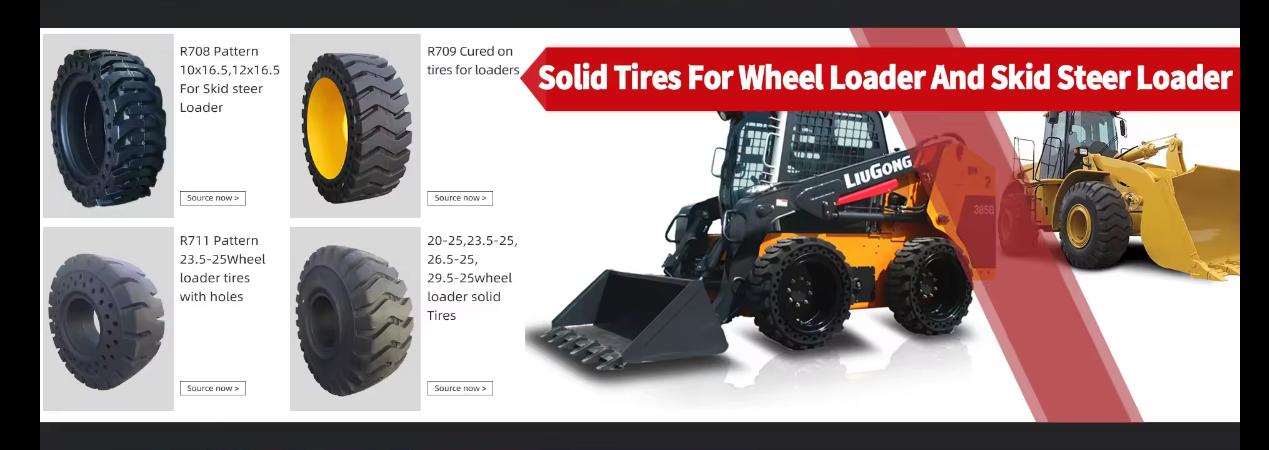
Heat Accumulation and Its Effect on Tire Lifespan
One of the most underestimated factors in wheel loader operations is heat generation. Continuous operation under heavy load produces significant thermal stress inside tires.
Solid tires manage heat differently by:
● Using high-density materials with greater thermal resistance
● Eliminating internal air movement that increases friction heat
● Distributing thermal load more evenly across the structure
● Maintaining performance stability during long duty cycles
This helps prevent performance degradation during extended shifts.
Load Distribution and Machine Control Precision
Wheel loaders rely heavily on balance and precise control during lifting and dumping operations. Tire behavior plays a direct role in how stable and predictable the machine feels during operation.
Solid tires improve control by:
● Maintaining consistent ground contact under uneven load
● Reducing deformation during lifting cycles
● Supporting stable steering response under pressure
● Minimizing instability during directional changes
This improves both operator confidence and operational accuracy.
Wear Behavior and Predictable Maintenance Planning
Unlike pneumatic tires that may fail suddenly, solid tires typically wear in a more controlled and gradual manner.
This creates operational advantages such as:
● More predictable wear progression over time
● Reduced risk of sudden operational failure
● Easier planning for scheduled replacement
● More stable long-term performance forecasting
For fleet managers, this predictability simplifies maintenance planning and reduces unexpected interruptions.
Cost Analysis Beyond Initial Purchase Price
Although solid tires generally have a higher upfront cost, their real value is measured over the full operational lifecycle.
Long-term cost factors include:
● Reduced frequency of tire replacement
● Lower downtime-related productivity losses
● Decreased emergency maintenance requirements
● Improved machine utilization rates per shift
In high-intensity environments, total operating cost is often lower despite higher initial investment.
When Solid Tires Deliver the Most Value
Solid tires are not universally required for all wheel loader applications. Their advantages become most visible under specific operating conditions.
They are most effective when:
● Operations involve continuous heavy-duty loading cycles
● Working environments contain sharp or abrasive materials
● Equipment downtime directly impacts project cost
● Machines operate across multiple shifts daily
● Terrain conditions are unpredictable and harsh
In lighter applications with smooth surfaces, pneumatic tires may still provide better comfort and efficiency balance.
The Future of Wheel Loader Tire Engineering
Modern industrial tire development is moving toward more specialized and performance-focused designs rather than universal solutions.
Key trends include:
● Hybrid tire structures combining flexibility and rigidity
● Advanced compounds with improved heat resistance
● Application-specific designs for mining, construction, and recycling industries
● Enhanced durability with controlled performance characteristics
The focus is shifting from simple durability to system-level optimization.
Conclusion
Solid tires for wheel loaders are becoming increasingly important in modern heavy-duty industries because they directly support operational continuity, stability, and predictable performance. In environments where machine downtime is more costly than equipment itself, tire selection becomes a critical operational decision rather than a simple replacement choice.
They are not just an alternative to pneumatic tires—they represent a different approach to how machines are expected to perform under real industrial stress.
FAQ
1. Why are solid tires used in wheel loader operations?
Because they provide higher reliability and reduce downtime in harsh and abrasive working environments.
2. Do solid tires improve productivity?
Yes, they improve productivity mainly by reducing interruptions and maintaining stable operation cycles.
3. Are solid tires suitable for all wheel loader jobs?
No, they are most suitable for heavy-duty, high-abrasion, and continuous operation environments.
4. What is the main advantage of solid tires over pneumatic tires?
The main advantage is operational continuity and reduced risk of sudden tire failure.
Post time: 12-06-2026