
Skid steer loaders are designed for tough jobs, often operating in environments filled with debris, sharp materials, and high friction surfaces. In these conditions, tire failure is one of the most common causes of downtime. This is why more operators are turning to solid tires for skid steer loaders as a reliable and long-lasting solution.
Unlike pneumatic tires, solid tires eliminate punctures, reduce maintenance, and provide consistent performance in demanding applications. This article focuses specifically on solid tires, answering key user concerns and helping you choose the best option for your skid steer operations.
Why choose solid tires for skid steer loaders
One of the most frequently asked questions is whether solid tires are worth the investment. The answer depends on your working environment, but in most heavy-duty applications, solid tires offer clear advantages.
They are especially beneficial because they:
● Completely eliminate punctures and air leaks
● Provide consistent performance without pressure adjustments
● Reduce unexpected downtime caused by tire damage
● Offer longer service life under harsh conditions
For operators working in construction, recycling, or demolition, these benefits translate directly into higher productivity.
How solid tires handle harsh job site conditions
Skid steer loaders are often used in environments where the ground is covered with nails, metal fragments, rocks, or broken concrete. Pneumatic tires can easily be damaged in such conditions.
Solid tires are built to withstand:
● Sharp debris that would normally cause punctures
● Rough and abrasive surfaces
● Continuous friction from skid steering
● Heavy loads during lifting and transport
Their solid rubber structure ensures reliability even in the most challenging environments.
Key performance advantages of solid skid steer tires
Solid tires are not just about durability—they also improve overall machine performance.
Puncture-proof reliability
Because they do not contain air, solid tires cannot go flat. This eliminates one of the most common operational issues.
Consistent traction
Solid tires maintain stable contact with the ground, providing reliable traction across different surfaces.
Improved stability
Their rigid structure reduces tire deformation, improving machine balance during operation.
Reduced maintenance
No need for air pressure checks, repairs, or frequent replacements.
These advantages make solid tires ideal for high-intensity work cycles.
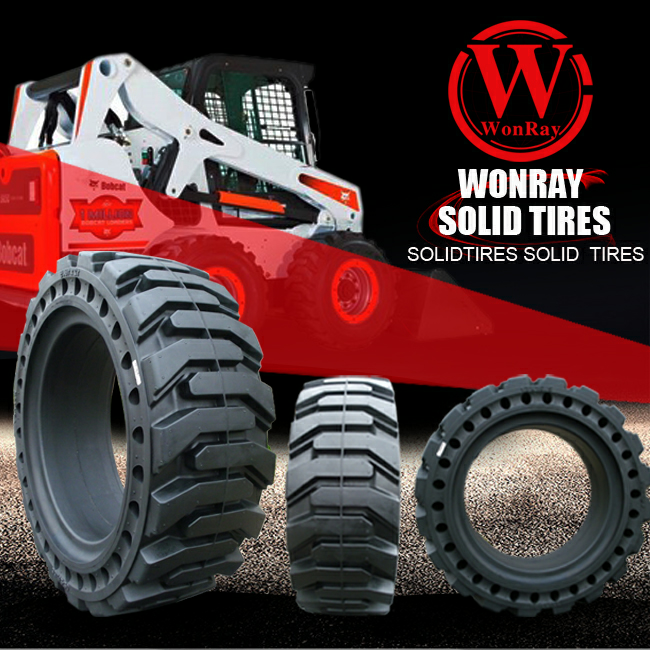
Tread design and its impact on performance
Even within solid tires, tread design plays a critical role in performance.
● Smooth tread: best for indoor or hard surfaces with minimal wear
● Block tread: suitable for construction sites and heavy-duty applications
● Deep lug tread: ideal for loose or muddy terrain
Choosing the right tread ensures optimal traction and efficiency.
Load capacity and structural strength
Skid steer loaders frequently handle heavy materials, which puts significant stress on tires.
Solid tires are designed to:
● Support high load capacities without deformation
● Distribute weight evenly across the tire
● Maintain structural integrity under pressure
● Enhance safety during lifting operations
This makes them particularly suitable for demanding applications.
Are solid tires suitable for all applications
While solid tires offer many benefits, they are best suited for specific environments.
They are ideal for:
● Construction and demolition sites
● Recycling yards with sharp materials
● Industrial environments with heavy equipment
● Waste management operations
However, for soft or highly uneven terrain, pneumatic tires may still offer better flexibility.
Cost vs long-term value
Another common concern is cost. Solid tires typically have a higher upfront price compared to pneumatic tires.
However, their long-term value is significant:
● Fewer replacements over time
● Minimal maintenance costs
● Reduced downtime losses
● Improved operational efficiency
When considering total cost of ownership, solid tires are often the more economical choice.
How to choose the right solid tires
Selecting the right solid tires requires understanding your working conditions.
● Match tire size with skid steer specifications
● Choose tread pattern based on terrain
● Ensure load capacity meets operational needs
● Consider compound quality for durability
Working with a professional supplier can help ensure the best fit.
Product selection recommendations
For businesses operating in demanding environments, investing in high-quality solid tires is a strategic decision. Look for products with reinforced structures, wear-resistant compounds, and proven performance in similar applications.
Choosing the right supplier ensures compatibility, durability, and long-term reliability.
FAQ
Q1: Are solid tires better than pneumatic tires for skid steer loaders?
In harsh environments, yes. They offer better durability and eliminate puncture risks.
Q2: Do solid tires last longer?
Yes, they generally have a longer service life due to their wear resistance.
Q3: Will solid tires affect machine performance?
They improve stability and reliability, although ride comfort may be slightly reduced.
Q4: Are they suitable for indoor use?
Yes, especially when using non-marking solid tires for clean floors.
Conclusion
Solid tires for skid steer loaders provide a durable, low-maintenance, and highly reliable solution for demanding applications. Their ability to eliminate downtime, withstand harsh conditions, and deliver consistent performance makes them an essential upgrade for many operators.
For businesses focused on efficiency, safety, and cost control, switching to solid tires is not just an option—it is a smart investment in long-term productivity.
Post time: 01-04-2026