
Solid tires for forklifts are a critical component that directly impacts the safety, productivity, and overall efficiency of operations across various industries. Unlike pneumatic tires, which contain air and are prone to punctures or blowouts, solid tires are made entirely of solid rubber. This design eliminates the risk of sudden deflation, providing reliable performance even in challenging working environments. In this article, we explore the key benefits, features, and considerations for selecting the right solid tires for forklifts, helping businesses maximize safety and operational efficiency.
Benefits of Solid Tires for Forklifts
Enhanced Safety
One of the most significant advantages of solid tires for forklifts is the enhanced safety they offer. Traditional pneumatic tires can fail unexpectedly due to punctures, leading to accidents, equipment damage, and operational downtime. Solid tires, on the other hand, are impervious to punctures and do not deflate, ensuring that forklifts maintain stability even on rough or uneven surfaces.
● Operators can navigate challenging environments confidently, including warehouses, construction sites, and outdoor industrial settings.
● Reduced tire failure decreases the risk of workplace accidents, protecting both operators and nearby personnel.
● Solid tires offer superior load support, preventing equipment tilt or instability during lifting operations.
Safety is particularly crucial in material handling, where even minor disruptions can lead to significant operational hazards. Using solid tires ensures consistent performance and reduces the likelihood of accident-related downtime.
Improved Efficiency
Solid tires play an important role in enhancing operational efficiency. Since these tires are resistant to punctures and damage, forklifts experience minimal downtime for tire maintenance or replacements. This uninterrupted operation translates into higher productivity and better workflow management.
● Reduced tire-related interruptions enable forklifts to handle more tasks in less time.
● Solid tires’ durability minimizes frequent replacement needs, allowing maintenance teams to focus on other critical tasks.
● Forklifts equipped with solid tires can operate continuously in high-demand industrial settings, such as manufacturing floors, ports, and distribution centers.
Efficiency improvements not only save time but also contribute to better utilization of workforce and equipment resources, increasing overall operational output.
Cost Savings
While solid tires typically have a higher initial cost compared to pneumatic tires, their long-term benefits outweigh the upfront investment. Solid tires are engineered for longevity, reducing the frequency of replacements and lowering maintenance expenses.
● Businesses can save on the cost of frequent tire changes and repairs.
● Extended tire life decreases total cost of ownership over the lifetime of the forklift.
● Reduced downtime from tire issues translates into operational cost savings and improved profitability.
Investing in high-quality solid tires is a cost-effective solution that balances upfront investment with long-term operational efficiency and durability.
Environmental Sustainability
Another notable benefit of solid tires is their contribution to environmental sustainability. Unlike pneumatic tires, which often require inner tubes and can generate waste when damaged, solid tires are long-lasting and do not produce additional waste.
● Fewer discarded tires contribute to reduced environmental impact.
● Eliminating the need for frequent tube replacements reduces material consumption and waste generation.
● Companies adopting solid tires demonstrate a commitment to sustainable industrial practices and a lower carbon footprint.
By switching to solid tires, businesses not only improve operational efficiency but also align with eco-friendly practices, supporting corporate social responsibility goals.
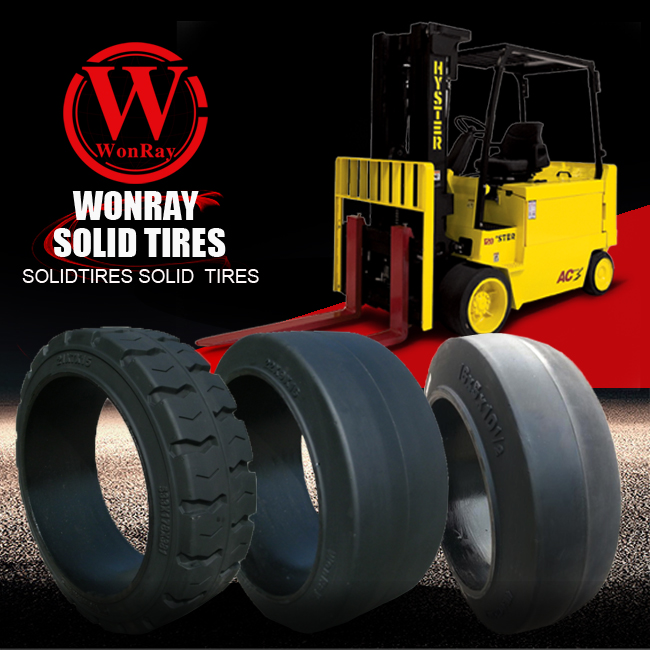
Key Features of Solid Tires for Forklifts
Solid tires are designed to withstand harsh industrial environments while providing reliable performance. When selecting solid tires for forklifts, understanding their features is essential:
● Solid Rubber Construction: Provides unmatched durability and eliminates risks associated with punctures and deflation.
● Deep Tread Patterns: Enhance traction on various surfaces, from smooth warehouse floors to outdoor terrains.
● Heat-Resistant Properties: Prevents degradation under continuous operation or high-load conditions.
● Wear-Resistant Materials: Extend tire life and reduce frequent replacement needs.
● Compatibility with Different Forklift Configurations: Suitable for a wide range of forklift models, including electric, diesel, and gas-powered equipment.
These features make solid tires a reliable choice for businesses seeking a balance between durability, safety, and operational efficiency.
Selecting the Right Solid Tires for Forklifts
Choosing the correct solid tires is crucial to ensure optimal performance and safety. Businesses should consider the following factors when selecting solid tires for forklifts:
● Forklift Type: Different forklift models have varying weight capacities and design requirements. Select tires that match your specific forklift configuration.
● Application Requirements: Consider the type of surface (indoor, outdoor, rough, smooth) and operational conditions (high traffic, heavy loads, frequent turns).
● Load Capacity: Ensure that the tire can support the maximum load your forklift will handle. Overloading can lead to excessive wear and reduced performance.
● Tire Size and Tread Design: Match the size and tread pattern to the operating environment for maximum efficiency and safety.
● Manufacturer Quality: Choose reputable brands with proven industrial performance to guarantee durability and reliability.
Consulting with tire experts or suppliers can help identify the best options for your forklift fleet, ensuring a balance between cost, safety, and performance.
Conclusion and Recommendations
Solid tires for forklifts are essential for enhancing safety, improving operational efficiency, and reducing long-term costs in material handling operations. Their puncture-resistant construction, long-lasting durability, and ability to operate in diverse environments make them an ideal choice for industrial applications.
By investing in quality solid tires, businesses can:
● Increase workplace safety by reducing the risk of tire-related accidents
● Improve productivity through continuous, uninterrupted forklift operations
● Lower maintenance costs and extend tire life for cost-effective operations
● Contribute to environmental sustainability by reducing waste and resource consumption
When selecting solid tires for forklifts, it is important to consider tire size, tread pattern, load capacity, operating environment, and manufacturer reputation. Taking these factors into account ensures that your forklifts perform efficiently while maximizing safety and longevity.
Switching to solid tires for forklifts is a strategic decision that delivers long-term operational benefits, cost savings, and enhanced workplace safety. Partnering with trusted tire suppliers and consulting experts can further optimize tire selection and help businesses achieve consistent, reliable performance.
FAQ
Q1: How long do solid tires for forklifts typically last?
A1: With proper maintenance and usage within load limits, solid tires can last several years, often longer than pneumatic tires.
Q2: Can solid tires be used outdoors on rough terrain?
A2: Yes, solid tires with deep tread patterns are suitable for outdoor and rough surface operations.
Q3: Do solid tires require frequent maintenance?
A3: No, solid tires require minimal maintenance compared to pneumatic tires, though regular inspection and cleaning are recommended.
Q4: Are solid tires cost-effective despite their higher initial price?
A4: Yes, due to their long lifespan, reduced downtime, and minimal maintenance needs, solid tires offer significant long-term savings.
Post time: 15-01-2026