
Solid Tire Manufacture is the process of designing, compounding, molding and inspecting airless rubber tires for forklifts, industrial trailers, loaders, port vehicles, access platforms and other work vehicles. It matters because a solid tire is not only a rubber shape with a size marking. Its rubber formula, internal structure, tread pattern, rim fit and curing quality all affect how the vehicle moves under load. For industrial buyers, understanding Solid Tire Manufacture helps explain why two tires with the same size can perform very differently in daily operation.
Rubber compound is the foundation of solid tire performance
The first important part of Solid Tire Manufacture is rubber compound development. Different applications require different balances between hardness, elasticity, wear resistance, heat resistance, cut resistance and rolling comfort. A warehouse forklift tire needs stable rolling and repeated turning resistance. A scrap yard tire needs stronger resistance against metal debris. A steel mill tire may require better heat resistance. A port trailer tire needs long-shift durability and load support.
- Wear-resistant compounds help extend service life on concrete and rough surfaces.
- Cut-resistant compounds help protect tires in recycling yards and debris-filled areas.
- Heat-resistant rubber is important for steel mills, foundries and hot industrial zones.
- Non-marking compounds help reduce black marks on clean indoor floors.
- Balanced elasticity can reduce harsh movement while keeping the tire stable under load.
A solid tire compound should match the environment. If the rubber is too soft for a heavy-load site, it may wear quickly. If it is too hard for frequent turning, the ride may feel harsh and the tire may lose grip on some surfaces. This is why manufacturing quality begins before molding, with correct material selection and compound control.
Tire structure and molding decide load stability
A quality solid tire usually has more than one functional area. The tread area contacts the ground and resists wear. The middle rubber body provides support and helps manage impact. The base area connects with the rim and keeps the tire stable during turning, braking and loading. During manufacture, these parts must be formed and cured correctly so the tire can hold shape under repeated compression.
- Design the tire structure according to vehicle type and load requirement.
- Prepare rubber compounds with controlled mixing and material consistency.
- Build or mold the tire body with attention to layer position and dimensions.
- Cure the rubber under controlled temperature and time conditions.
- Inspect dimensions, surface quality, hardness and fit before delivery.
If molding and curing are not controlled, a tire may appear acceptable at first but show early problems in use. Common issues include uneven wear, cracking, poor rim fit, chunking or deformation. These problems can create vehicle instability and shorten service life.
Why size accuracy and rim fit are critical
Industrial tires work under load, so size accuracy is not just about installation convenience. A solid tire must match the rim properly. Poor rim fit can affect vehicle handling and may cause movement between the tire and wheel assembly. For forklifts, this can influence stability during lifting. For trailers and loaders, it can affect rolling consistency and safety under load.
- Confirm outer diameter and section width.
- Check rim size, bead/base design and mounting method.
- Review press-on, standard solid, mold-on or wheel assembly requirements.
- Make sure the tire type matches the axle position and vehicle application.
- Use correct installation procedures to avoid damage during mounting.
In Solid Tire Manufacture, dimensional control helps the final tire work as part of the vehicle system. A tire that fits correctly can support smoother movement and more predictable wear.
Quality inspection should reflect real industrial use
Inspection should not focus only on appearance. A good quality process checks whether the tire can support the intended application. Important inspection points include surface finish, cracks, air pockets, hardness consistency, size tolerance, tread quality and base condition. For specialized tires, additional attention may be needed for non-marking performance, heat resistance or compound durability.
WonRay manufacturing focus for industrial applications
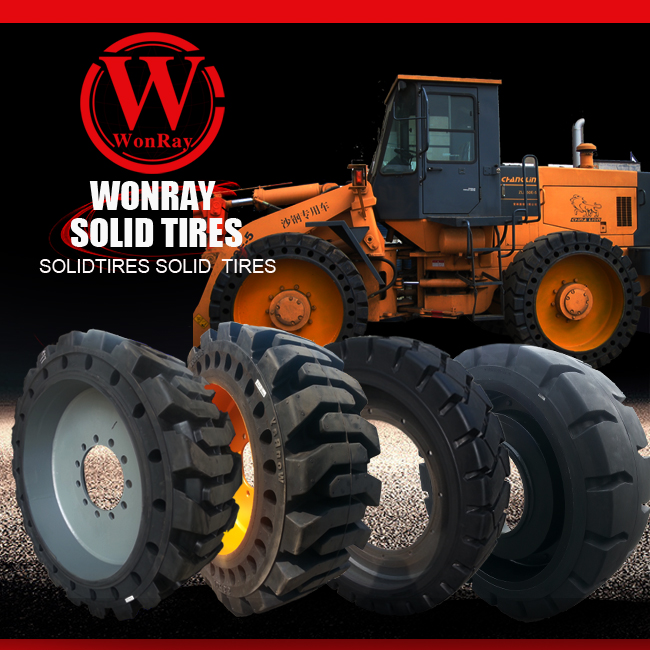
WonRay solid tire applications cover forklift solid tires, non-marking solid rubber tires, press-on band cushion tires, skid steer solid tires, wheel loader solid tires, trailer tires, port vehicle tires, steel mill tires, scissor lift wheels, boom lift wheels, mold-on tires and rims. These different product categories require different manufacturing attention. A scissor lift wheel needs accurate fit and stable movement. A wheel loader tire needs load support and resistance to rough surfaces. A steel mill tire needs heat and impact durability. A forklift tire needs stable handling under repeated lifting.
This is why Solid Tire Manufacture should always connect product design with application. The best tire is not simply the heaviest tire or the hardest tire. The best tire is the one manufactured with the correct compound, structure and fit for the vehicle and working condition.
Summary
Solid Tire Manufacture affects every part of industrial tire performance, from wear resistance and load stability to rim fit and long-term reliability. Buyers should look beyond size and price and consider rubber compound, structural design, molding accuracy, curing control and inspection standards. When the manufacturing process is aligned with the real application, solid tires can help forklifts, loaders, trailers and other industrial vehicles work with fewer stoppages and more predictable maintenance.
FAQ
Q1: What does Solid Tire Manufacture include?
It includes rubber compounding, tire structure design, molding, curing, dimensional control and quality inspection for airless industrial tires.
Q2: Why can two solid tires with the same size perform differently?
They may use different rubber compounds, tread designs, base structures and curing quality, which affect wear resistance, load support and service life.
Q3: What should buyers check when evaluating solid tire quality?
Buyers should check tire size, rim fit, compound suitability, tread quality, hardness consistency, application match and visible defects such as cracks or poor finish.
Q4: Does manufacturing affect maintenance cost?
Yes. A properly manufactured solid tire can reduce premature wear, unexpected stoppages and replacement frequency when matched to the correct application.
Post time: 09-07-2026