
Replacing forklift tires involves more than matching the size printed on the old tire. The replacement must also fit the wheel assembly, support the required load, and suit the forklift’s operating conditions. A mismatch can cause installation problems, uneven wear, or added costs. Before ordering Solid Rubber Forklift Tires, check the specifications that determine compatibility and performance. The following points provide a practical way to verify a replacement before confirming an order.
Record the Complete Tire Size
Start with the markings on the existing tire sidewall. Record the full size designation, including every number, letter, and suffix. Do not rely on a partial measurement or a product photo alone, because similar-looking tires may have different dimensions.
Also verify the outside diameter, section width, and required rim dimensions. Outside diameter can affect ground clearance and the relationship between the forklift and its working surface. Section width matters because the tire must fit within the available space without contacting nearby components. Rim dimensions determine whether the tire can be mounted correctly.
If the sidewall marking is worn or missing, check the forklift manual or equipment specification sheet. Measurements and clear photographs can support the check, but they do not replace the manufacturer’s specifications.
Identify the Tire Construction and Mounting Method
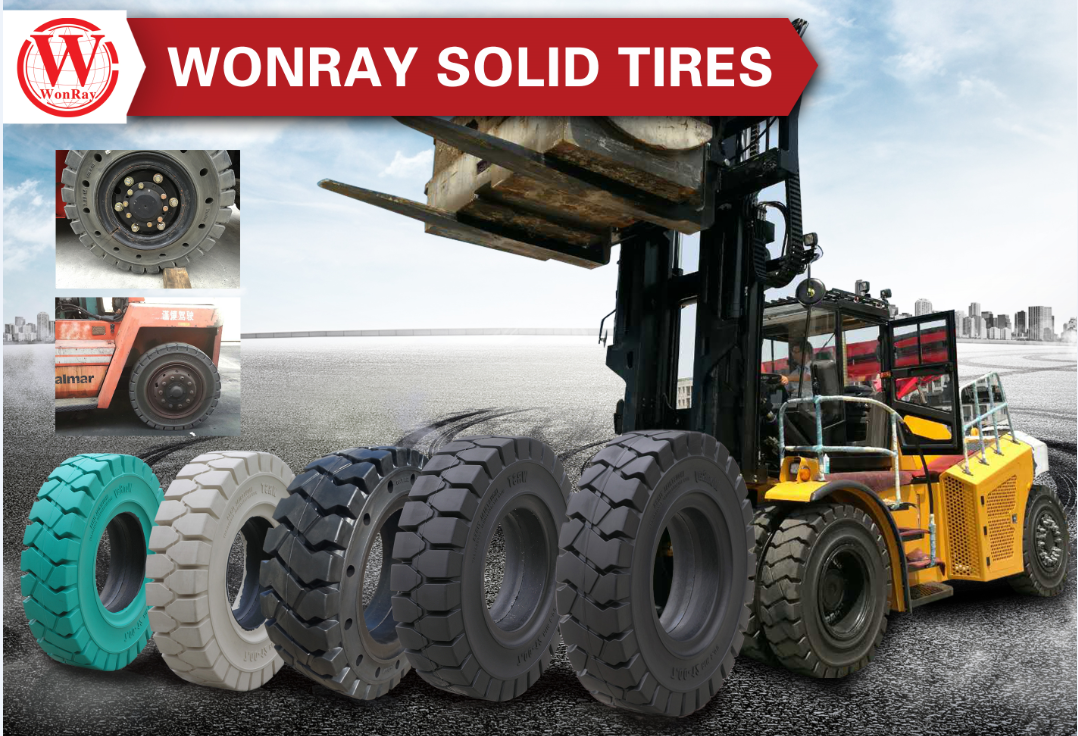
Not all Solid Rubber Forklift Tires use the same construction. Two common types are solid pneumatic-profile tires and press-on tires, and their mounting requirements are different.
A solid pneumatic-profile tire has a shape similar to a conventional pneumatic tire. It may allow the original wheel to be reused, but the exact tire and rim combination must be verified.
A press-on tire is built around a metal band and is fitted to a compatible wheel by pressing equipment. It is used on forklifts designed for this mounting system. Similar outside dimensions do not make it interchangeable with a pneumatic-profile tire.
Before ordering, confirm the current tire type, rim or wheel design, mounting method, and axle position. This is especially important for older forklifts or equipment with a modified wheel assembly. A tire may have the correct diameter but still be unsuitable if its base construction does not match the wheel.
Verify Load Requirements for Each Wheel Position
Forklift tires carry the combined weight of the vehicle, attachments, and transported loads, but the load is not distributed evenly. Front tires usually carry a substantial share of the load, particularly when material is lifted, while rear tires have different steering and support duties.
Use the forklift’s data plate and manufacturer documentation as starting points. The rated lifting capacity is only one factor; attachment weight, load center, and axle loading also affect tire requirements.
Check whether the proposed tire is approved for the relevant wheel position and operating conditions. Load ratings should be considered together with speed and duty cycle, rather than as isolated figures. A tire that is overloaded or used beyond its specified conditions may experience excessive deformation, heat buildup, and accelerated wear.
Choosing the highest available load rating is not automatically the best solution. The tire must still match the forklift’s dimensions, wheel assembly, and operating requirements. If the load information is unclear, confirm the specification with the forklift manufacturer or a qualified tire specialist before ordering.
Confirm the Forklift Model and Wheel Assembly
The forklift’s brand and model help identify its original tire configuration, but the model name alone may not be enough. Specifications can vary between production years, model versions, and equipment configurations. Similar-capacity forklifts may use different wheel dimensions or mounting systems.
Record the complete model designation and, where possible, the serial number or production version. Check whether the forklift has been modified, especially around the wheels, rims, axles, or attachments. Changes to these components may mean that the original tire specification is no longer accurate.
Prepare the following details when requesting a quotation:
| Information | Why It Matters |
|---|---|
| Forklift brand and model | Identifies the equipment configuration |
| Existing tire size | Provides the initial dimensional reference |
| Rim or wheel specification | Confirms mounting compatibility |
| Front or rear position | Helps verify position-specific requirements |
| Tire construction | Identifies the correct mounting system |
| Working environment | Helps determine suitable tread and compound options |
Providing this information together reduces repeated clarification and makes it easier to compare technically equivalent products.
Match the Compound and Tread to the Worksite
Once compatibility has been established, consider where and how the forklift operates. Smooth warehouse floors, rough industrial surfaces, loading areas, and mixed indoor-outdoor routes place different demands on tires. Travel distance, turning, braking, load cycles, and operating hours affect wear and heat.
The rubber compound influences wear resistance, resilience, and behavior under repeated loading. No single compound is ideal for every application. Choose according to the required balance of service life, cushioning, traction, and floor conditions.
Tread design should also reflect the worksite. A forklift operating mainly on clean, smooth floors may have different requirements from one working on rough or contaminated surfaces. For indoor environments where visible floor marks are a concern, non-marking options may be considered. However, non-marking compounds do not guarantee a completely mark-free floor; debris, floor condition, and operating practices also matter.
When discussing Solid Rubber Forklift Tires, describe the actual surfaces and operating pattern instead of selecting by appearance or a general product label. These details help identify a suitable configuration.
Check Installation and Replacement Conditions
A compatible tire must also be installable using the correct process. Some solid tires require specialized pressing equipment, while other designs use a different mounting procedure. Confirm whether the existing wheel can be reused and whether the installer has the equipment required for the selected tire.
Inspect the wheel assembly during replacement. A damaged rim, worn mounting surface, or other defect can affect the fit of the new tire. Installing a tire on an incompatible or damaged assembly can create safety and operating problems.
Do not force a tire onto a wheel or use improvised tools to complete the installation. Follow the tire and forklift manufacturers’ instructions, and use qualified service personnel when specialized equipment is required.
For fleets with several forklifts, keep records of tire sizes, constructions, wheel positions, and replacement dates. Grouping orders by verified specifications can simplify inventory planning and reduce the risk of mixing incompatible tires.
Provide Complete Information When Requesting a Quote
A clear inquiry helps identify suitable replacement options. Instead of asking only for a general forklift tire, provide the forklift model, complete tire size, rim or wheel details, tire construction, wheel position, required quantity, and working environment. Photographs of the sidewall and wheel assembly can support the specification check.
If some information is unavailable, state what is known and what still needs confirmation. This helps identify missing details before product selection. Resolve uncertainties before ordering, not during installation.
When comparing quotations, check that the proposed products share the same key specifications. Differences in construction, load rating, compound, or mounting requirements can make two tires unsuitable for direct price comparison, even if their dimensions look similar.
WonRay offers solid tire options for forklift applications. Customers considering Solid Rubber Forklift Tires can share their equipment specifications and operating conditions to discuss suitable configurations before placing an order.
Conclusion
Selecting replacement Solid Rubber Forklift Tires requires more than matching the old tire’s size. Construction, rim compatibility, load requirements, forklift configuration, compound, and installation conditions all affect whether a tire is suitable. Confirming these details before ordering helps reduce fitment problems, avoid unnecessary costs, and choose a replacement that matches the forklift’s actual work.
FAQs
1. Can solid rubber forklift tires replace pneumatic tires?
Some solid pneumatic-profile tires are designed for compatible pneumatic rims. Check the tire dimensions, rim profile, and forklift requirements before assuming they can be interchanged.
2. Can the same solid tire be used on the front and rear axles?
Not always. Front and rear positions can have different load and functional requirements. Verify the specification for each wheel position.
3. What information should I provide when ordering replacement tires?
Provide the forklift brand and model, tire size, rim or wheel details, tire construction, wheel position, quantity, and operating environment.
4. Should I choose a tire with a higher load rating than the original?
The rating must meet the forklift’s actual requirements and the tire manufacturer’s stated operating conditions. A higher rating alone does not guarantee compatibility or better performance.
Post time: 23-11-2026