
Electric forklifts are widely used in warehouses, distribution centers, and indoor material handling operations where controlled movement and consistent equipment performance are important. Although battery systems and electric motors receive much of the attention, tire selection also affects how efficiently a forklift moves, turns, and handles loads.
Choosing Solid Press On Forklift Tires for an electric forklift involves more than confirming the tire dimensions. Rolling resistance, traction, heat generation, load requirements, and wheel compatibility all influence whether a tire is suitable for the equipment and its working environment.
Why Tire Selection Matters for Electric Forklifts
An electric forklift relies on battery power to drive its wheels and operate its lifting system. The tires form the contact point between the vehicle and the floor, so their characteristics influence how effectively the forklift moves.
Rolling resistance is one important consideration. When a tire deforms as it rolls, energy is required to overcome that resistance. Tire construction, rubber compound, load, floor condition, and operating temperature can all affect the amount of resistance encountered during movement.
If rolling resistance is unsuitable for the application, the forklift may require more energy to perform the same travel task. However, choosing a tire solely because it has low rolling resistance is not a reliable solution. Traction, stability, and load capacity must also meet the equipment’s requirements.
For electric forklifts operating through repeated travel cycles, Solid Press On Forklift Tires should be evaluated as part of the overall equipment configuration rather than as an isolated replacement component.
Rolling Resistance and Battery-Powered Operation
Rolling resistance describes the force that opposes a tire’s movement across a surface. In industrial applications, it is influenced by several interacting factors rather than by the tire material alone.
A tire that deforms excessively under its working load may require more energy to keep the forklift moving. On the other hand, a tire that is too rigid for the application may not provide the desired contact behavior or handling characteristics.
The operating environment also matters. Smooth warehouse floors, rough concrete, floor joints, and uneven transitions create different rolling conditions. A forklift that travels long distances across a consistent floor may have different tire requirements from one that makes short movements between closely spaced storage locations.
- Actual wheel load: The load carried by each tire changes with the forklift configuration, load position, and lifting operation. Tire selection should reflect the required load at each wheel position.
- Floor condition: Rough or damaged surfaces can increase resistance and create additional stress on the tire. Floor maintenance can therefore support more consistent equipment operation.
- Operating cycle: Frequent starts, stops, and direction changes create different demands from continuous travel at a relatively steady speed.
- Tire specification: Dimensions, construction, and compound influence deformation and contact behavior. The complete specification should be checked rather than relying on a general description such as low rolling resistance.
A suitable tire helps the forklift operate within its intended conditions, but it cannot compensate for an overloaded vehicle, unsuitable floor, or poorly maintained equipment.
Traction During Starting, Turning, and Braking
Electric forklifts often operate in confined spaces where precise movement is essential. They may need to start on the spot, turn within narrow aisles, reverse repeatedly, and stop close to racks or loading positions.
These movements place different demands on the tires. During acceleration, the drive tires must transmit motor torque to the floor. During braking, they must help the vehicle slow down without excessive slipping. While turning, the tires experience lateral forces as the forklift changes direction.
Insufficient traction can affect movement control, while unsuitable tire characteristics may contribute to excessive wear or heat under demanding operating conditions.
Traction depends on more than tread appearance. Rubber compound, tire construction, surface condition, contamination, load, and operating technique all play a role. A clean, dry concrete floor presents different conditions from a surface contaminated with dust, water, oil, or other materials.
For this reason, the best Solid Press On Forklift Tires are not necessarily those with the most aggressive tread. The appropriate design depends on the floor and the movements performed throughout the working day.
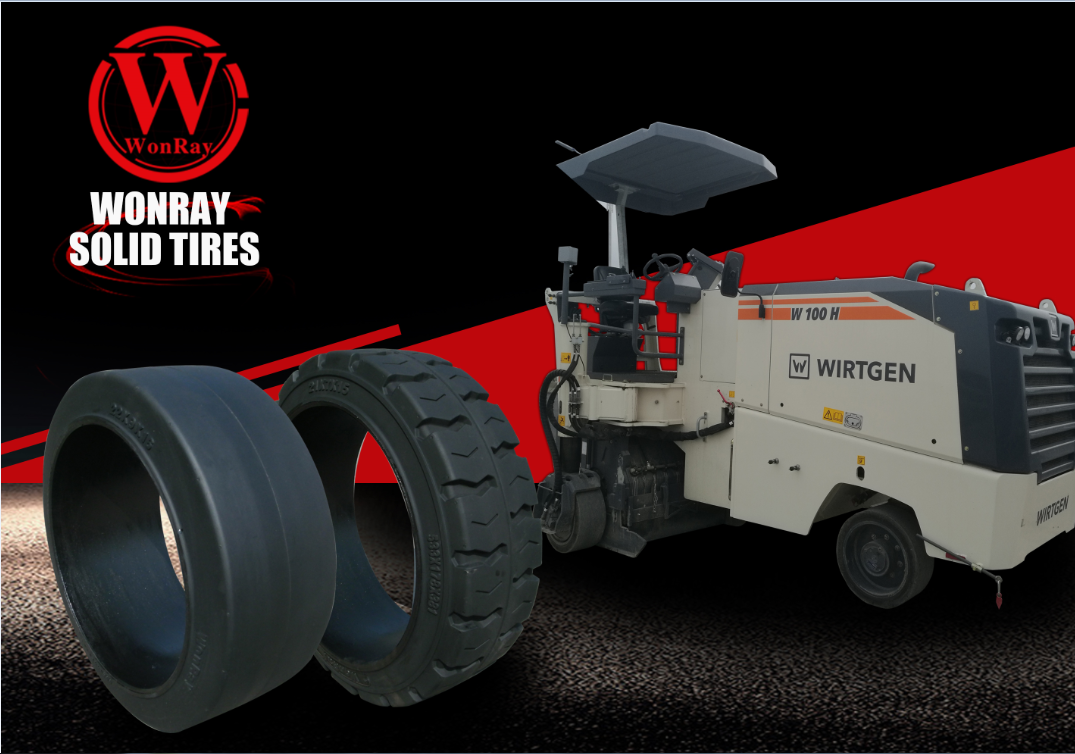
Heat Management During Repeated Operating Cycles
Electric forklifts may complete many short operating cycles during a shift. Repeated acceleration, braking, turning, and load handling can increase the mechanical demands placed on solid tires.
Solid tires do not rely on air pressure, but they still generate heat through repeated deformation and contact with the floor. Excessive heat can accelerate rubber deterioration and affect service life.
- High loads increase the demands placed on the tire structure.
- Frequent acceleration and braking create repeated stress during movement.
- Extended operation at unsuitable speeds can increase heat generation.
- Rough floors and repeated impacts can add stress to the tire.
- Incorrect tire specifications may result in unsuitable operating conditions.
Heat management should therefore be considered alongside rolling resistance and traction. A tire that performs acceptably during occasional use may not be appropriate for a forklift operating continuously over long shifts.
The forklift’s speed, load, duty cycle, and floor conditions should all be considered when confirming a suitable tire specification.
Matching Press-On Tire Specifications to the Forklift
Electric forklifts use different wheel arrangements and tire dimensions depending on their design and load capacity. A press-on tire must match the intended wheel assembly and the equipment’s operating requirements.
| Specification | Why it matters |
|---|---|
| Tire dimensions | Ensures the replacement matches the required size |
| Wheel and rim configuration | Confirms compatibility with the intended mounting assembly |
| Load requirements | Helps establish whether the tire is suitable for the actual wheel load |
| Operating speed | Helps determine whether the tire is appropriate for the working cycle |
| Floor conditions | Supports selection of suitable construction and compound |
| Forklift model | Helps verify the original equipment configuration |
Press-on tires are designed for installation on compatible wheel assemblies. Their mounting requirements differ from those of conventional pneumatic-profile solid tires, so similar outside dimensions do not automatically mean that two tire types can be exchanged.
The replacement should also be consistent with the forklift manufacturer’s specifications. If the equipment has been modified or operates under conditions different from its original application, those changes should be considered before ordering.
When Solid Press-On Tires Are Suitable for Electric Forklifts
Solid Press On Forklift Tires can be considered for electric forklifts used in indoor material handling environments where puncture resistance and a solid tire construction are required.
Their suitability still depends on the equipment and working conditions. A warehouse forklift traveling on smooth concrete may have different requirements from an electric forklift handling heavy loads on rough industrial floors.
For applications involving frequent turning, evaluate traction and steering behavior. For long operating hours, consider heat generation and the tire’s suitability for the required duty cycle. Where floor protection is important, check whether the available compound meets the site’s requirements.
It is also important to distinguish between drive tires and other wheel positions. Different positions perform different functions, and the correct tire specification should be confirmed for each one.
Providing the Right Information When Sourcing Replacement Tires
A clear description of the application makes it easier to identify a suitable press-on tire. Instead of requesting a replacement based only on the tire name, provide the forklift model, existing tire dimensions, wheel assembly information, load requirements, and typical operating conditions.
It is also useful to describe the floor surface, average daily operating hours, travel distance, and frequency of turning or braking. If the existing tires show unusual wear or damage, photographs can provide additional context.
WonRay provides industrial solid tire options for forklift applications. When discussing Solid Press On Forklift Tires, sharing the equipment details and working conditions can help narrow down the appropriate product configuration without assuming that every press-on tire is suitable for every electric forklift.
Conclusion
Tire selection contributes to the operating performance of electric forklifts. Rolling resistance, traction, heat generation, load capacity, and mounting compatibility should be evaluated together rather than treated as separate purchasing considerations. By matching press-on tire specifications to the forklift and its actual working cycle, users can make a more informed selection and support consistent material handling operations.
FAQs
Do solid press-on tires affect electric forklift battery consumption?
They can influence the energy required for movement because rolling resistance affects how much force is needed to keep the forklift moving. Actual battery consumption also depends on load, speed, travel distance, floor condition, and driving habits.
Are press-on tires suitable for every electric forklift?
No. Compatibility depends on the forklift model, wheel assembly, tire dimensions, load requirements, and operating conditions. The equipment manufacturer’s specifications should be checked before replacement.
Is low rolling resistance the most important factor when choosing electric forklift tires?
No. Rolling resistance is one consideration, but traction, stability, heat behavior, load capacity, and wheel compatibility are also important. The correct balance depends on the application.
Can electric forklifts use solid press-on tires in continuous operation?
They may be suitable for continuous-duty applications when the tire specification matches the required load, speed, and operating conditions. Heat generation and the manufacturer’s operating recommendations should be considered.
Post time: 24-11-2026