
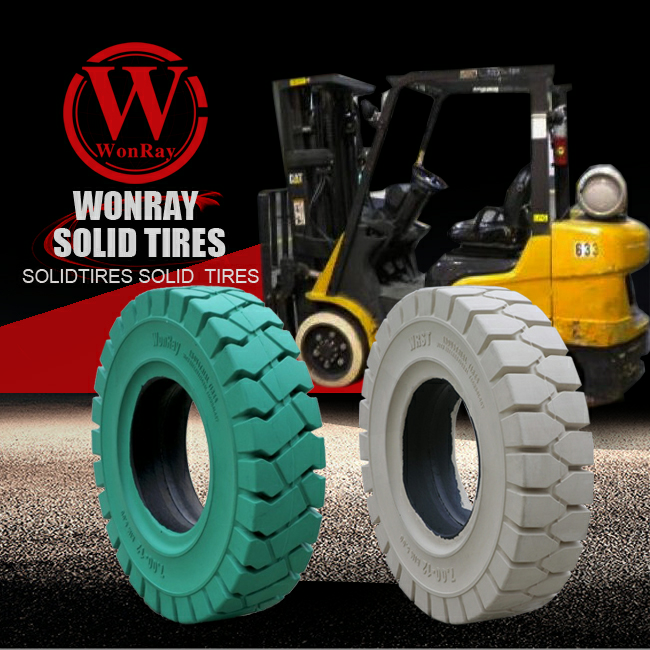
Solid Pneumatic Tires For Forklift are built in pneumatic-style dimensions but use solid rubber construction rather than a pressurized air chamber. This combination makes them suitable for many forklifts that were designed around pneumatic-format tires but operate in industrial environments where punctures, pressure maintenance, and sudden flats create avoidable downtime. Solid Pneumatic Tires For Forklift can support indoor, outdoor, or mixed service, but their performance depends strongly on load, travel distance, speed, surface, and operating temperature.
The absence of air solves one specific problem: loss of tire function caused by pressure loss or puncture. It does not remove the need to manage heat, wear, traction, vibration, and correct fitment. In fact, because solid rubber supports the load through material deformation rather than air pressure, duty cycle becomes especially important. A forklift that travels short warehouse routes and a forklift that runs continuously across a large yard may use the same nominal tire size but require different construction or compound priorities.
What “solid pneumatic” actually describes
The term refers to the external format and mounting style associated with pneumatic forklift tires while the tire body itself is solid. This allows the tire to fit appropriate pneumatic-style rims while providing an airless structure. Many designs use multiple rubber zones so the tread, cushioning layer, and base area perform different functions. The exact construction varies by product, but the objective is to combine load support and puncture resistance with more resilience than a very hard cushion tire.
Solid Pneumatic Tires For Forklift are therefore distinct from press-on band tires. Press-on tires are rubber bonded to a steel band and are typically lower profile. Solid pneumatic tires have a larger section and can provide more cushioning for outdoor or mixed surfaces. The correct choice depends on the forklift design and approved wheel configuration; one type should not be substituted for another without confirming dimensions and machine requirements.
Puncture resistance is valuable only when the rest of the duty is matched
Sites with nails, pallet fragments, metal pieces, glass, and construction debris can experience repeated failures with air-filled tires. A solid tire does not deflate when penetrated, so minor surface cuts can be monitored instead of becoming immediate stoppages. This makes Solid Pneumatic Tires For Forklift attractive in recycling plants, production yards, ports, factories, warehouses with damaged pallets, and mixed industrial areas.
However, puncture resistance should not become the only selection criterion. A solid tire carrying excessive load or operating too long at high thermal stress can still deteriorate prematurely. Likewise, a tire with the wrong tread may deliver poor traction on wet concrete or loose aggregate. The purpose of the solid design is to improve continuity under puncture-prone conditions, but service life still depends on matching the complete operating environment.
Heat is generated inside the tire, not only at the tread surface
Every rotation compresses and relaxes the rubber. This repeated deformation creates internal heat. The effect increases with load, speed, travel distance, frequent turning, and long continuous shifts. Unlike air-filled tires, solid tires have a large volume of rubber, so compound design and internal structure influence how heat is generated and dissipated.
For Solid Pneumatic Tires For Forklift, thermal management is particularly important in high-cycle applications. A truck that travels continuously over a large logistics yard may heat the tire much more than a truck that performs short moves with regular idle periods. Excessive temperature can accelerate aging, soften or fatigue rubber, and contribute to separation or chunking. When a tire shows unusual heat damage, the solution may involve operating cycle, load, speed, or tire specification rather than simply choosing a harder compound.
Surface and tread should be considered together
Smooth warehouse floors, wet loading areas, asphalt yards, compacted gravel, broken concrete, and steel plates create different traction requirements. A relatively closed tread can provide stable contact and lower vibration on hard floors, while a more open pattern may help on loose or contaminated surfaces. There is no universal pattern that is optimal everywhere.
Solid Pneumatic Tires For Forklift used in mixed service should be selected around the route that dominates tire stress. If the truck spends most of its shift indoors, excessive tread aggressiveness may add scrub and vibration. If it spends long periods outdoors on uneven surfaces, additional tread depth and cut resistance may be more valuable. The correct decision considers both where the forklift travels and how it turns, brakes, and carries load on those surfaces.
Ride behavior is different from air-filled pneumatic tires
Pneumatic tires absorb surface irregularities by compressing air and flexing the casing. Solid tires cannot reproduce the same response because their load support comes from rubber. Modern resilient solid constructions can provide useful cushioning, but the ride will generally be firmer. This matters when the truck carries fragile loads, travels over rough ground, or operates for long periods where vibration affects the operator and machine components.
The comparison should therefore be based on operational priorities. Solid Pneumatic Tires For Forklift are often preferred where uptime, puncture resistance, and load stability are more important than maximum cushioning. Air-filled tires may remain appropriate where terrain shock and ride compliance are dominant and puncture risk is low. Neither design is automatically superior in every environment.
Load capacity and tire dimensions must be verified as a system
Nominal size is essential, but correct replacement also depends on rim dimensions, machine axle load, wheel position, and clearance. Front forklift tires typically carry the highest working load because the load center is forward of the axle. Rear steer tires experience different turning stress. Even when front and rear tires look similar, their service demands are not identical.
Before fitting Solid Pneumatic Tires For Forklift, the current tire markings, rim size, equipment model, rated capacity, attachments, and typical load should be confirmed. Overloading or changing attachments can increase actual axle load beyond what was assumed when the original tire was selected. Tire wear and heat should be reviewed after any significant change in equipment use.
How to read common wear signals
A solid tire provides visible evidence of how the forklift is being used. Rounded shoulders may reflect repeated tight turning. Flat spots can be associated with severe braking or prolonged skidding. Chunking may result from debris, heat, high scrub, or material mismatch. Cracking can be related to aging, environmental exposure, thermal stress, or operation beyond the tire’s design conditions.
Monitoring these patterns allows maintenance teams to use Solid Pneumatic Tires For Forklift more effectively. The objective is not to keep a worn tire in service indefinitely because it cannot go flat. Replacement should occur before wear affects stability, clearance, traction, or structural integrity. A solid tire still has a finite service life and should be managed by condition.
Where this tire format is most useful
Solid pneumatic format is commonly useful on forklifts working in production plants, outdoor storage yards, recycling areas, ports, building-material sites, warehouses with damaged pallets, and mixed routes where puncture exposure is significant. It can also suit applications where operators prefer to eliminate pressure checks and valve-related maintenance.
The strongest application case combines moderate operating speed, industrial load, controlled vehicle use, and a meaningful risk of punctures or air-pressure loss. If the truck operates at unusually high speed, covers very long continuous distances, or requires maximum ride cushioning, the full duty should be reviewed before choosing Solid Pneumatic Tires For Forklift.
Conclusion
Solid Pneumatic Tires For Forklift provide an airless solution in a familiar pneumatic-style format, but their real performance is determined by more than puncture resistance. Load, heat generation, route surface, tread, turning frequency, travel distance, and rim compatibility all influence whether the tire is well matched to the machine.
WonRay offers industrial solid tire options for forklifts across different sizes and working environments. A complete description of the forklift model, tire size, rim, load, surface, and duty cycle makes it possible to match Solid Pneumatic Tires For Forklift to the application instead of selecting only by nominal dimensions.
Frequently Asked Questions
Are Solid Pneumatic Tires For Forklift filled with air?
No. They use solid rubber construction but are produced in pneumatic-style dimensions for compatible forklift rims.
What is the main difference between solid pneumatic and press-on forklift tires?
Solid pneumatic tires have a larger resilient section and mount on pneumatic-style rims. Press-on tires use rubber bonded to a steel band and are generally lower profile. Equipment compatibility must be confirmed.
Can Solid Pneumatic Tires For Forklift be used outdoors?
Yes, depending on tread, compound, load, speed, and route. They are commonly used in mixed indoor-outdoor and debris-prone industrial areas.
Do solid pneumatic forklift tires require maintenance?
They do not require air-pressure maintenance, but they still need inspection for wear, cuts, chunking, heat damage, rim fit, and safe replacement condition.
Post time: 18-08-2026