
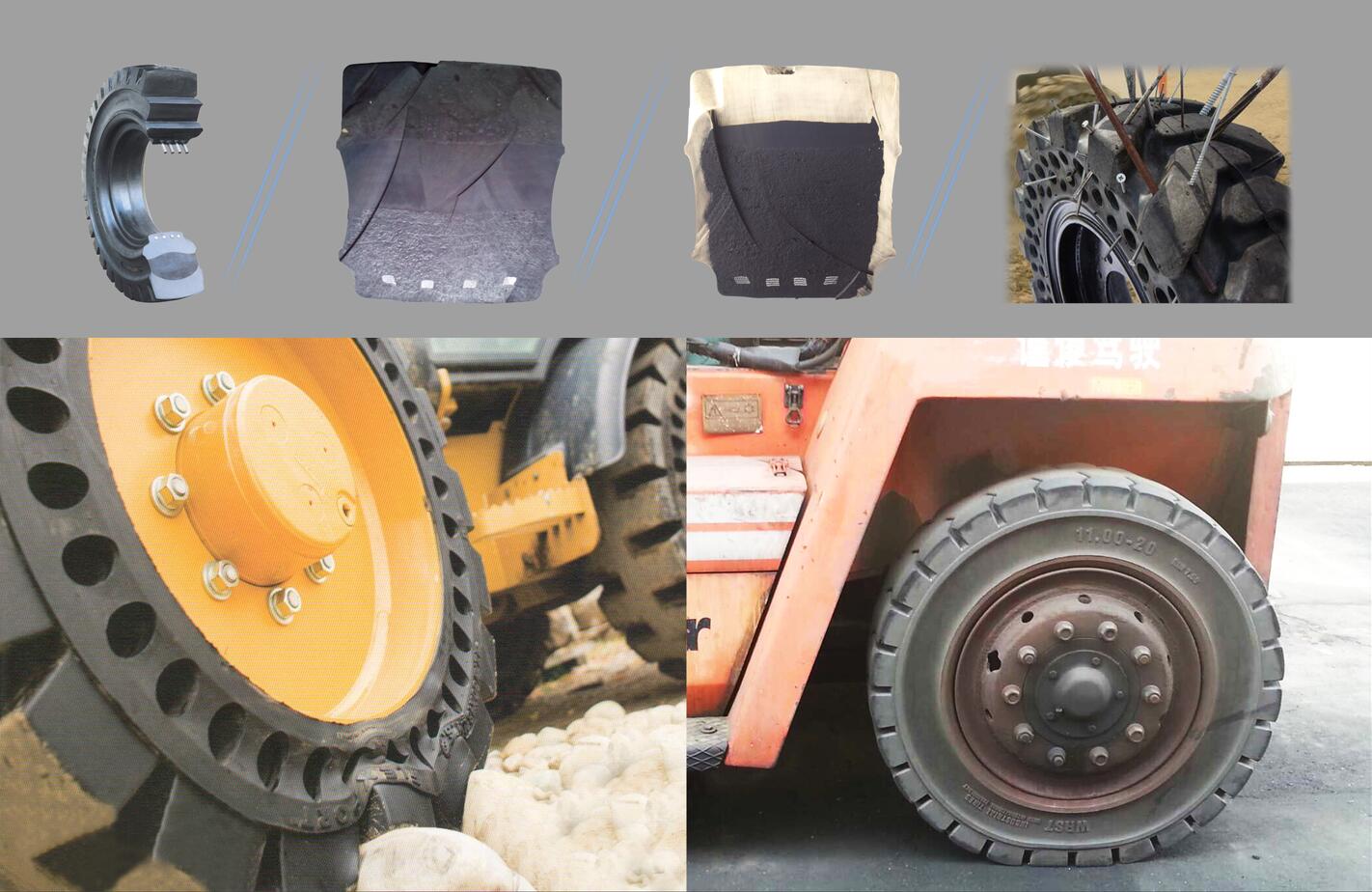
Puncture Proof Tyres are used on industrial vehicles that work where nails, wire, broken pallet fasteners, metal fragments, sharp stone or construction debris can repeatedly damage air-filled tires. Their main difference is structural: the tire does not depend on compressed air to carry the load, so an ordinary penetration cannot create the sudden pressure loss associated with a pneumatic tire.
For forklifts, skid-steer loaders, industrial trailers and other low-speed equipment, Puncture Proof Tyres can reduce one common source of interruption. They are not damage-proof, however. Rubber can still wear, cut, overheat or lose pieces under severe service, which means the correct construction still has to match load, speed, wheel design and the surface.
How Puncture Proof Tyres Remove the Air-Loss Failure Mode
A conventional pneumatic tire carries load through an air chamber. When the casing, valve or bead loses pressure, the tire changes shape quickly and the vehicle usually has to stop. A solid rubber tire carries the load through rubber instead. A nail can enter the tread without releasing air because there is no pressurized cavity to empty.
This structural difference is especially useful on repetitive industrial routes where a single flat can stop a machine in the middle of a production or handling cycle. The tire still needs enough rubber strength to resist cuts and enough resilience to manage impact, but the failure pattern becomes more gradual and visible.
Three Common Constructions Used to Avoid Flats
• Solid pneumatic-profile tires have a full rubber body shaped to fit compatible pneumatic-type rims. They are widely used on forklifts, loaders and industrial vehicles where puncture exposure is frequent.
• Press-on or cushion tires use rubber bonded to a steel band and are pressed onto a matching wheel center. They suit compatible compact forklifts and other equipment working mainly on hard industrial floors.
• Mold-on rubber wheels bond rubber directly to a metal or engineered center. They are common on access equipment, carts and specialized industrial machines where the wheel is supplied as an assembly.
These constructions can all be described as puncture-free in normal use, but they are not interchangeable. Rim profile, hub dimensions, overall diameter, wheel offset and available clearance determine which form can be installed.
Where Puncture Proof Tyres Are Most Useful
The strongest case for Puncture Proof Tyres is a site where air-loss failures are frequent enough to affect daily operation. Scrap handling areas, recycling yards, factories with metal offcuts, construction-material storage sites, waste facilities and outdoor industrial yards are typical examples. Forklifts and skid steers in these locations often turn under load while crossing debris, so puncture resistance must be combined with tread strength and shoulder stability.
Industrial trailers and tow vehicles can also benefit when they follow fixed routes containing nails or damaged pavement. Because these machines may travel for long periods, heat and rolling resistance deserve attention in addition to puncture resistance.
Puncture Resistance Does Not Eliminate Wear, Cuts or Heat
Puncture Proof Tyres remove a specific failure mechanism; they do not remove every tire problem. Sharp scrap can still slice the tread. Tight pivot turns can scrub the shoulders. Long travel under heavy load can build heat in solid rubber. Repeated impact can start chunking around an existing cut. These conditions should be inspected before the damage reaches the base or wheel interface.
• Uniform tread wear usually indicates normal surface abrasion.
• Fast shoulder wear often points to frequent tight turns or high lateral scrub.
• Deep cuts and missing blocks indicate cutting or tearing rather than ordinary abrasion.
• Repeated cracking after long travel can indicate excessive heat, overload or an unsuitable duty cycle.
Fitment Still Begins With the Wheel and the Machine
A Puncture Proof Tyres specification should start with the machine model, existing tire size and wheel system. A solid replacement may have a different mass and stiffness from a pneumatic tire, and the actual outside diameter can affect clearance and ride height. When converting from air-filled to solid construction, confirm that the wheel, load rating and machine geometry are suitable for the change.
For tires already designed as solid replacements, the most useful information includes tire size, rim dimensions, axle position, maximum load, average travel distance, surface condition, turning frequency and the type of debris encountered. This information helps distinguish between a tire intended mainly for smooth indoor duty and one intended for harsher outdoor service.
Choosing Puncture Proof Tyres by Application Rather Than by Label
The term Puncture Proof Tyres describes the absence of normal air-loss punctures, but it does not define tread, compound, cushioning or wheel fit. A forklift on clean concrete, a skid steer in demolition debris and an industrial trailer on a long yard route need different balances even if all three use non-pneumatic construction.
WonRay supplies industrial solid tires, cushion tires and molded wheel assemblies for different material-handling and access-equipment applications. Matching should be based on wheel dimensions, load and the real operating surface so puncture resistance is combined with appropriate tread, heat control and wear behavior.
Frequently Asked Questions
1. Are Puncture Proof Tyres completely immune to damage?
No. They do not lose air after a normal puncture, but the rubber can still cut, wear, crack, overheat or chunk under severe conditions.
2. Can a solid puncture-proof tire replace any pneumatic tire?
No. The machine, rim, tire dimensions, load and clearance must be compatible with the solid construction.
3. Where are Puncture Proof Tyres most useful?
They are most useful where nails, wire, metal fragments, sharp stone or other debris causes repeated flats on industrial vehicles.
4. Do Puncture Proof Tyres require inspection?
Yes. Check tread wear, cuts, shoulder damage, heat-related cracking and the wheel interface even though air pressure is not required.
Post time: 28-08-2026