
Non Marking Forklift Tires are widely used in warehouses, distribution centers, manufacturing facilities, and other indoor environments where clean floors are important. However, choosing a tire labeled as non-marking does not always guarantee that the floor will remain completely free of visible marks. Dark streaks, colored traces, or surface residue may still appear after forklifts have been operating for some time.
This can create confusion when selecting replacement tires. If the purpose of using non-marking tires is to protect indoor floors, why do marks still appear? The cause is not necessarily poor tire quality. Rubber composition, floor conditions, contamination, and driving habits can all influence the result. Understanding these factors helps users identify the problem and select more suitable Non Marking Forklift Tires.
Why Can Non-Marking Forklift Tires Still Leave Marks?
Non-marking tires use specially developed rubber compounds designed to reduce the transfer of dark rubber residue onto floors. Conventional black rubber tires may leave visible streaks when repeated friction transfers small amounts of material onto the surface.
However, non-marking does not mean completely mark-free under every operating condition. Different compounds respond differently to floor materials, surface finishes, temperature, and friction.
For example, a forklift making frequent sharp turns on a smooth warehouse floor creates different contact conditions from one traveling mainly in straight lines. During tight turns, the tires may slide sideways slightly instead of rolling normally. This additional friction can leave visible traces even when the tire is designed for non-marking applications.
It is also important to distinguish rubber transfer from other floor contamination. Dust, oil, metal particles, and cleaning residue can accumulate on indoor surfaces. When forklift tires pass over these materials, they may spread or compress them, creating marks that resemble rubber stains.
Identify the Source Before Replacing the Tires
Replacing tires without identifying the cause of floor marks can lead to unnecessary expenses. If the problem comes from floor contamination or cleaning practices, installing another set of Non Marking Forklift Tires may not solve it.
Start by observing where and when the marks appear. Continuous streaks along frequently used routes may indicate repeated tire contact, while isolated spots near loading areas may be related to oil, dust, or other materials.
- Inspect the tire surface: Check for accumulated dirt, embedded particles, unusual residue, and visible changes in the contact area. Compare tires on different forklifts to determine whether the problem is limited to one vehicle.
- Examine the floor and operating route: Identify whether marks appear mainly near turning points, loading zones, or particular floor sections. Check for oil, dust, cleaning residue, and other contaminants.
If marks only appear in certain areas, investigate those locations before assuming the tire compound is unsuitable. If several forklifts leave similar marks under comparable conditions, the floor surface or operating environment may also be responsible.
How Tire Compound Influences Marking Performance
Rubber composition is one of the main factors affecting whether forklift tires leave visible marks. Traditional black rubber contains materials that give it its characteristic color. When friction causes small amounts of material to transfer onto a floor, dark streaks may become visible.
Non-marking compounds are formulated to reduce this visible transfer. Depending on the product, they may use different raw materials and color formulations from conventional black rubber. White and other light-colored tires are common options for applications where dark marks need to be minimized.
However, color alone does not determine marking performance. Two tires with similar appearances may have different material compositions and operating characteristics. A light-colored tire should not automatically be assumed to leave no residue.
Users should also avoid selecting a tire based only on its non-marking description. The compound must remain suitable for the equipment’s load, operating speed, floor conditions, and working intensity. A tire that reduces visible rubber transfer but cannot meet the vehicle’s operating requirements is not an appropriate replacement.
When evaluating Non Marking Forklift Tires, it is useful to confirm the compound characteristics and the conditions for which the product is intended.
Why Floor Conditions Can Change the Results
The same tire may produce different results on different indoor floors. Surface finish, coating condition, cleanliness, and friction all influence how the tire interacts with the ground.
Polished concrete and epoxy-coated floors may show marks more clearly than rougher surfaces. A small amount of transferred material that is barely noticeable on one floor may become highly visible on another.
Floor coatings also deserve attention. If a coating is worn, damaged, or affected by cleaning chemicals, its surface may become more vulnerable to discoloration or residue accumulation. In some cases, what appears to be a tire mark may actually be a change in the floor coating.
Cleaning practices can further complicate the problem. Some cleaning products leave residue that attracts dust or changes the appearance of the floor. Repeated forklift movement over these areas may create streaks that resemble rubber transfer.
Therefore, tire selection should consider the actual floor material and condition rather than relying only on general descriptions such as smooth or indoor. If a facility has recently changed its flooring or coating, the existing tire specification may need to be reviewed.
How Forklift Operations Contribute to Visible Marks
Even when the tire compound is suitable, operating conditions can affect the friction between tires and the floor. Frequent turning, sudden acceleration, hard braking, and unnecessary wheel spinning may increase sliding contact.
Turning is particularly relevant in warehouses with narrow aisles. Forklifts often need to change direction within limited spaces, causing the tires to move sideways rather than roll straight ahead. Repeated movement in the same area can make small traces more noticeable.
Load conditions also influence tire-to-floor contact. Heavy loads change the forces acting on the tires, while uneven weight distribution may create different pressure levels across wheel positions. These conditions can affect tire behavior during turning and braking.
Operators can reduce unnecessary friction by making smoother turns, avoiding abrupt speed changes, and keeping loads within the vehicle’s rated capacity. Keeping travel routes clean is equally important because loose debris can become trapped between the tire and floor.
What Should You Check Before Buying Replacement Tires?
When existing tires leave unwanted marks, replacement should begin with identifying the actual problem rather than simply requesting a lighter-colored tire.
Before ordering Non Marking Forklift Tires, users should confirm several details:
- Equipment specifications: Provide the forklift type, existing tire dimensions, mounting requirements, and load information.
- Floor conditions: Explain whether the equipment operates on polished concrete, coated floors, or other indoor surfaces.
- Working intensity: Describe daily operating hours, typical loads, turning frequency, and whether the forklift runs continuously or intermittently.
- Marking problems: Explain where the marks appear and whether the issue started after a tire replacement or a change in floor conditions.
These details help determine whether the current tire compound, operating environment, or another factor is responsible. They also make it easier to identify a replacement that meets both floor protection and equipment requirements.
Selecting Non Marking Forklift Tires for Indoor Operations
Choosing Non Marking Forklift Tires requires more than confirming that a product is designed to reduce dark rubber traces. The tire must also match the forklift, support the required load, and perform appropriately on the facility’s flooring.
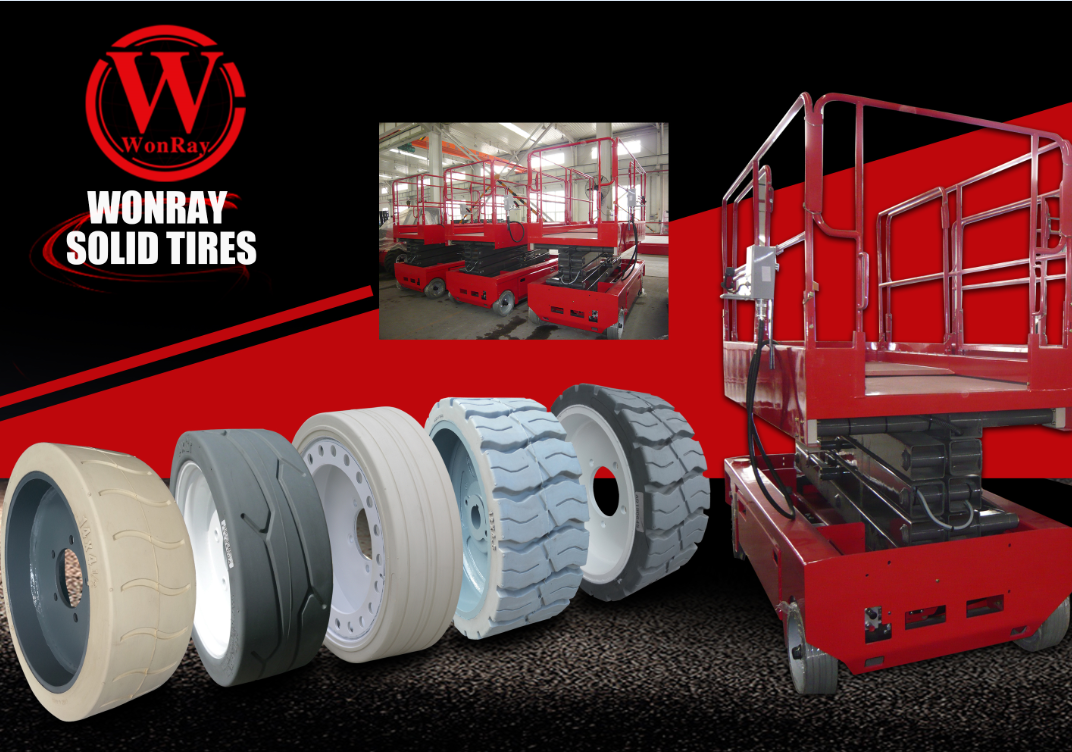
WonRay provides industrial solid tire options for forklift applications and different working environments. When evaluating replacement tires, users can consider equipment specifications, floor materials, operating frequency, and marking concerns together. Providing these details helps identify a suitable product direction instead of selecting a tire based only on color or a general non-marking description.
Conclusion
Non Marking Forklift Tires can help reduce visible rubber marks in indoor working environments, but they cannot guarantee completely mark-free floors under every condition. Tire composition, floor coatings, contamination, turning frequency, and load conditions all influence the result. Identifying the source of the marks before replacing the tires is essential. Matching tire characteristics to equipment requirements and floor conditions helps users make better purchasing decisions and avoid repeating the same problem.
FAQs
1. Are white forklift tires always non-marking?
Not necessarily. White or light-colored tires are commonly used in non-marking applications, but color alone does not confirm their marking performance. The compound and intended application should also be checked.
2. Can non-marking forklift tires be used on epoxy floors?
They may be suitable, but compatibility depends on the tire compound, floor coating, equipment load, and operating conditions. Users should confirm the requirements of both the flooring system and the tire before selecting a product.
3. Do non-marking tires need regular cleaning?
Yes. They should be inspected and cleaned regularly to remove accumulated dirt, oil, and debris. Cleaning methods should be compatible with the tire material and follow the relevant maintenance recommendations.
4. How can a facility test whether replacement tires will leave marks?
A controlled trial under representative operating conditions can help evaluate the result. Use the intended floor surface, typical loads, and normal turning patterns, then inspect the area for visible residue. This provides useful application-specific information, although it cannot guarantee identical results under every future condition.
Post time: 12-11-2026