
A Mold On Tire is a solid tire manufactured by molding and curing rubber directly around a wheel center. Instead of supplying a separate rubber tire that is later fitted onto a wheel, the rubber and wheel center are combined during the manufacturing process to form an integrated wheel assembly.
This construction is particularly relevant to industrial equipment where the wheel must provide stable support without relying on air pressure. It can be found in applications such as underground mining equipment, passenger boarding bridges, conveyor systems, and certain construction vehicles.
However, understanding a Mold On Tire requires more than knowing that it is a type of solid tire. The manufacturing method affects the relationship between the rubber and wheel center, the replacement process, and the information required when matching a replacement assembly. For this reason, buyers looking for a Mold On Tire should consider the complete wheel structure rather than selecting a tire based only on its outside dimensions.
The Rubber and Wheel Center Are Designed as One Assembly
The key feature of a Mold On Tire is the direct molding process.
During production, the prepared wheel center is positioned inside a mold. Rubber is then formed around the center and cured under controlled conditions. The mold determines the final dimensions and tread configuration, while the wheel center provides the mounting structure required by the equipment.
Once the curing process is completed, the rubber is integrated with the wheel center. This is fundamentally different from a conventional pneumatic tire, where the tire and wheel remain separate components during normal use.
The construction also differs from solid tires that are installed onto a wheel after the rubber tire has already been manufactured. In a molded assembly, the relationship between the rubber and wheel center is established during production, so both parts need to be considered together from the beginning.
This is one reason why the wheel center should not be treated as an afterthought when specifying a Mold On Tire.
Mold On Tire vs. Cured-On and Press-On Designs
Industrial solid tires can use different manufacturing and installation methods, and these terms should not automatically be treated as interchangeable.
A Mold On Tire is molded directly around the wheel center. The rubber becomes part of the complete wheel assembly during curing.
A Cured-On Tire can also involve rubber being cured onto a metal component, but the exact construction and application should be confirmed according to the specific product design. The terminology used by different manufacturers may also vary, making the actual construction more important than the name alone.
A Press-On Band Tire, by comparison, uses a rubber band bonded to a steel band. The finished band is then installed onto a compatible wheel center. In this configuration, the tire band and wheel center are separate components before installation.
The difference matters most when replacing a worn tire. With a press-on band construction, the wheel center may potentially remain in use while the worn band is replaced. With a molded wheel assembly, the replacement requirement is generally considered at the complete assembly level unless a suitable remanufacturing process is available.
Therefore, when comparing solid tire types, the correct question is not simply which construction is superior. The more useful question is which construction matches the equipment, wheel design, operating conditions, and replacement requirements?
Why Molded Construction Is Used for Specialized Equipment
Industrial equipment does not always use standardized wheels. Some machines require specific wheel-center dimensions, mounting arrangements, tread profiles, or overall wheel sizes.
A molded construction can be useful in these situations because the rubber tire and wheel center are considered together during production. Instead of adapting a standard tire to an existing wheel, the complete assembly can be manufactured around the required configuration.
This is especially relevant when equipment operates in environments where pneumatic tires create maintenance concerns. A solid construction does not require inflation, so there is no need to maintain operating air pressure.
For certain industrial applications, this can simplify routine operation. However, the actual suitability of a Mold On Tire still depends on the machine and working conditions. Solid construction alone does not make every tire suitable for every industrial vehicle.
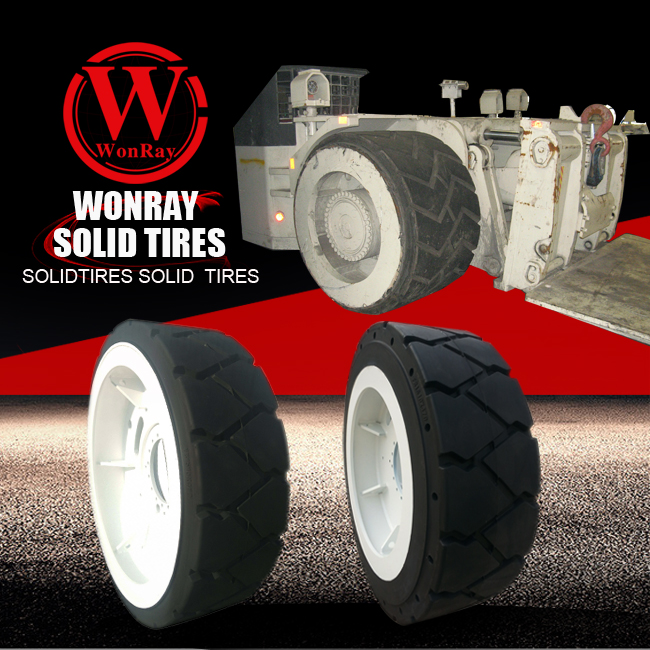
Applications Where Mold On Tires Can Be Used
The application of a Mold On Tire is closely connected with the type of wheel assembly required by the equipment.
Underground Mining Equipment
Underground mining equipment operates in restricted spaces and demanding working environments. Wheel assemblies may encounter rough surfaces, debris, and repeated movement. A solid tire eliminates the need for air pressure and avoids the puncture issue associated with conventional pneumatic tires.
For these machines, the complete wheel dimensions and mounting configuration are particularly important because equipment space can be limited.
Passenger Boarding Bridges
Passenger boarding bridges require wheels that can support controlled movement within airport facilities. The wheel assembly needs to correspond to the equipment’s structure and movement system.
A molded solid wheel can be considered where the equipment requires a specific wheel configuration and does not need the characteristics of an air-filled tire.
Conveyor Systems
Some conveyor systems use specialized wheels for movement or positioning. Depending on the system design, a Mold On Tire can provide a compact solid rubber wheel assembly without the need for inflation.
The appropriate rubber construction and wheel-center configuration should still be determined according to the conveyor’s operating requirements.
Construction and Industrial Equipment
Certain construction and industrial machines also use molded solid tire assemblies. These applications can involve different surfaces, operating speeds, loads, and working cycles, so the same Mold On Tire specification should not automatically be applied across different machines.
Tread Design Should Follow the Actual Application
Although the molded construction determines how the tire and wheel are integrated, the rubber tread still needs to correspond to the working environment.
A wheel used on relatively controlled industrial surfaces may require a different tread configuration from one operating on rough or contaminated ground. Repeated turning, vibration, debris, and surface conditions can all influence how the tread is used.
Therefore, selecting a Mold On Tire should involve two separate questions:How should the tire be constructed? and What rubber and tread configuration does the application require? Keeping these questions separate helps avoid choosing a tire simply because its dimensions appear correct.
When Should You Consider a Mold On Tire?
A Mold On Tire may be worth considering when the equipment requires a solid wheel assembly with a specific wheel-center configuration and does not rely on pneumatic tire inflation.
It can be particularly relevant for specialized industrial equipment where the tire and wheel need to be manufactured as an integrated unit. It can also be useful when the machine operates in conditions where puncture-related maintenance is undesirable.
At the same time, a Mold On Tire should not be selected only because it is a solid tire. The machine’s mounting dimensions, wheel-center design, working environment, speed, and operating requirements should all be reviewed before confirming the specification.
How WonRay Handles Mold On Tire Requirements
WonRay provides solid tire solutions for industrial and specialized equipment, including mold-on products for applications such as underground mining equipment, passenger boarding bridges, conveyor systems, and construction vehicles.
The company provides different mold-on configurations and tread patterns for different applications. When a replacement wheel is required, equipment information, existing tire dimensions, wheel-center measurements, photographs, or technical drawings can help determine the appropriate configuration.
For customers replacing a complete molded wheel assembly, confirming the wheel-center dimensions is especially important because the rubber specification alone may not provide enough information to reproduce the required assembly.
Conclusion
A Mold On Tire is more than a solid rubber tire. Its defining feature is the way the rubber is molded and cured directly around the wheel center, creating an integrated wheel assembly.
This construction makes the relationship between the tire and wheel fundamentally different from designs such as press-on band tires. It also means that replacement selection should focus on the complete assembly rather than only the tire’s diameter or width.
For industrial equipment, the most useful starting point is to identify the machine, understand how the wheel is used, confirm the wheel-center configuration, and then select the appropriate rubber and tread construction. This approach reduces the risk of choosing a tire that appears correct by size but does not match the actual equipment.
FAQ
1. Is a Mold On Tire the same as a press-on band tire?
No. A Mold On Tire is molded and cured directly around its wheel center, while a press-on band tire consists of a rubber tire bonded to a steel band that is subsequently fitted onto a compatible wheel center.
2. Can a Mold On Tire be made for an existing wheel?
The answer depends on the product construction. A mold-on assembly is normally manufactured around its specified wheel center, so the wheel dimensions and configuration need to be confirmed before production.
3. What information is needed to order a Mold On Tire?
Useful information includes the equipment model, tire dimensions, wheel-center measurements, mounting-hole pattern, bore dimensions, and photographs or drawings of the existing wheel assembly.
4. What equipment uses Mold On Tires?
Applications can include underground mining equipment, passenger boarding bridges, conveyor systems, and certain construction or industrial vehicles. The exact tire specification depends on the equipment and working conditions.
Post time: 28-09-2026