
Mold On Tire products combine a rubber running surface with a wheel core to create a compact, integrated wheel-and-tire assembly for industrial equipment. A Mold On Tire is commonly used where the machine requires a small outside diameter, stable rolling dimensions, low maintenance and dependable contact with smooth or prepared surfaces. Because the rubber is formed directly around the wheel core, the finished product functions as one assembled component rather than a separate pneumatic tire and rim.
This product format is widely relevant to material-handling equipment, carts, access platforms, ground-support equipment and specialized industrial vehicles. The practical advantage is simplicity: there is no air pressure to monitor, no tube to replace and no separate tire bead to seat on a conventional rim. Product performance, however, still depends on the rubber compound, wheel-core design, tread shape, hub dimensions and load requirements.
Why the Integrated Structure Is Useful
A Mold On Tire is designed around a close relationship between the rubber and the wheel core. In a conventional pneumatic assembly, the tire and rim remain separate components connected by the bead. In a mold-on construction, the rubber is bonded or molded around the core so the assembly behaves as one unit. This can be useful on compact equipment where installation space is limited and where a stable wheel diameter helps the machine maintain predictable ground clearance and steering geometry.
- · No inflation system, reducing routine pressure checks.
- · Integrated wheel-and-rubber structure for compact equipment layouts.
- · Stable outside diameter for low-speed industrial movement.
- · Rubber contact surface that can be tailored for wear, grip or non-marking needs.
- · Hub and bearing designs that can be matched to specific machine mounting requirements.
Rubber Compound Defines the Running Character
The rubber layer is not only a protective coating. It determines how the Mold On Tire interacts with the floor. A harder compound can reduce deformation and may provide slower wear on smooth surfaces, while a more resilient compound can absorb more small impacts and improve floor contact. Non-marking compounds are useful in finished indoor areas where black tire marks are undesirable. The correct choice depends on machine weight, wheel diameter, route length, turning frequency and floor condition.
Tread design also changes the way the product performs. A smooth face can provide a large and stable contact area on clean concrete. Grooves or molded patterns can add usable edges for traction or help manage small amounts of dust and moisture. On compact industrial wheels, excessively aggressive tread can create unnecessary vibration, so the pattern should match the equipment rather than copy a larger off-road tire.
Typical Equipment That Uses Mold On Tires
Mold On Tire products are often chosen for equipment that operates at relatively low speed and requires a robust wheel with limited maintenance. Access equipment is one important category because scissor lifts and boom lifts need wheels that support the machine while allowing precise positioning on indoor and outdoor work surfaces. Material-handling carts and specialized warehouse equipment also benefit from compact wheel geometry, especially where space is limited.
- Aerial work platforms and selected scissor-lift or boom-lift wheel positions.
- Warehouse carts, industrial trolleys and material-handling equipment.
- Ground-support and specialized service vehicles.
- Industrial machines that require a compact wheel with integrated rubber tread.
- Applications requiring black or non-marking rubber options.
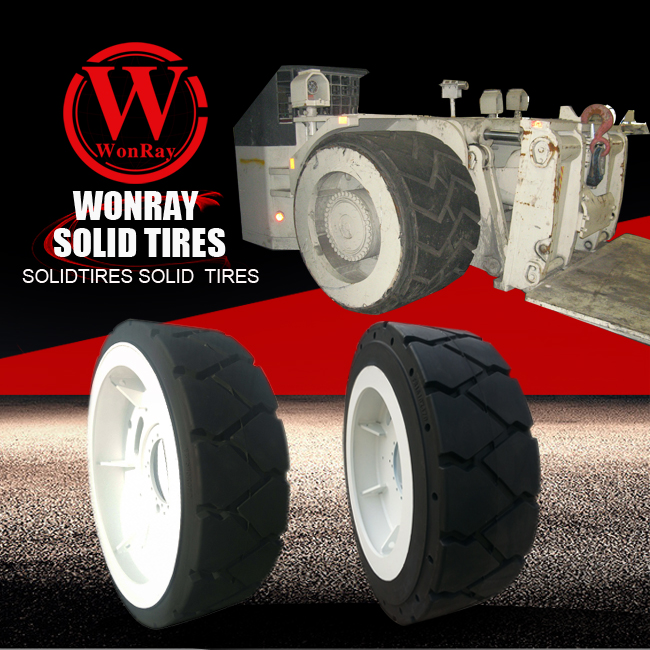
The Hub Is Part of the Tire Specification
One of the most important differences between a Mold On Tire and a conventional tire is that the wheel core is part of the product specification. Outside diameter and tread width are not enough. The hub bore, bearing arrangement, bolt pattern, keyway, offset, mounting face and overall width may all determine whether the assembly fits the machine correctly. For this reason, replacement should be based on the original wheel dimensions or a complete drawing when possible.
Machine model information can also help identify the correct configuration, but dimensions remain the final fitment reference. Equipment manufacturers may use different wheel designs on machines that look similar, and even a small difference in hub geometry can affect alignment or installation. A product-focused specification should therefore treat the rubber and metal core as one complete component.
Mold On Tire Compared With Press-On Tire Designs
Mold-on and press-on products are both solid and low-maintenance, but the construction is different. A press-on band tire normally uses rubber bonded to a steel band that is pressed onto a separate wheel center. A Mold On Tire has the rubber formed directly around the wheel core. Press-on tires can be useful where the band is designed to be replaced on an existing wheel center, while mold-on assemblies are useful where a complete integrated wheel is preferred. The machine design determines which format is correct; the two should not be treated as interchangeable simply because both are solid rubber products.
Service Life Depends on Load, Heat and Floor Contact
Even without punctures, a Mold On Tire can wear prematurely if the load is too high, if the wheel diameter is too small for the duty cycle, or if the equipment makes frequent tight turns on a high-friction floor. Repeated deformation creates heat, while turning scrubs the rubber across the surface. Sharp edges, damaged floor joints and debris can also cut the tread. Regular inspection should therefore focus on wear uniformity, chunking, cracks, bond condition and bearing or hub looseness.
A Complete Product for Compact Industrial Movement
A Mold On Tire is most valuable when the equipment needs a compact, durable and low-maintenance wheel rather than a traditional air-filled tire. The integrated construction simplifies the wheel system, but product selection must still account for rubber characteristics, tread, dimensions and mounting details.
WonRay offers mold-on and industrial wheel products for multiple equipment applications. Matching the complete wheel geometry and the actual operating surface is the most reliable way to obtain stable performance from the product.
Frequently Asked Questions
1. What is a Mold On Tire?
It is a solid rubber tire or wheel assembly in which the rubber is molded directly around a wheel core.
2. Does a Mold On Tire need inflation?
No. It is a solid construction and does not use air pressure.
3. What dimensions are important for replacement?
Outside diameter, tread width, hub bore, bearing or bolt pattern, offset, mounting width and other core dimensions should be confirmed.
4. Where are Mold On Tires commonly used?
They are used on access equipment, carts, warehouse equipment, ground-support vehicles and other compact industrial machines.
Post time: 21-08-2026