
A Milling Machine Tire should be selected around the way the machine actually works, not around a general claim such as “heavy duty.” Road milling equipment moves slowly, carries high machine weight, produces continuous vibration, and travels over a surface that has already been broken by the cutting drum. The tire therefore needs to keep the machine supported and predictable while resisting cuts, tread tearing and sudden service interruption.
For this application, WonRay’s press-on band tire is a particularly relevant product construction. The rubber is vulcanized directly onto a mild-steel band, and the finished tire is pressed onto the wheel with an interference fit. There is no air chamber to puncture, while the compact tire section gives a firm, low-profile wheel assembly. WonRay lists milling machines and other road-paving equipment among the applications for this press-on design.
The Product Structure Solves a Different Problem from a Pneumatic Tire
On a pneumatic tire, load support and cushioning depend heavily on air pressure. A sharp fragment or damaged casing can quickly turn a usable tread into an equipment stoppage. A press-on solid tire removes that failure mode. The steel band provides a rigid mounting base and the bonded rubber layer carries the working contact with the road surface.
That structure is useful on milling equipment because the operating priority is usually controlled low-speed movement rather than high-speed road travel. It also reduces the number of service variables: there is no inflation pressure to monitor and no sudden pressure loss after a puncture. The tire condition can be judged mainly from visible wear, cutting, bond condition and remaining rubber.
What the Tire Is Actually Doing During a Milling Pass
• Supporting machine weight: the compact solid section must remain stable under sustained load so the machine does not feel soft or unstable while the drum follows the pavement profile.
• Resisting sharp debris: broken asphalt, aggregate and construction fragments can cut ordinary tread surfaces. Solid construction prevents those cuts from becoming air-loss failures.
• Keeping steering effort predictable: slow milling involves repeated corrections. A smooth press-on tread can reduce steering resistance on firm surfaces.
• Handling continuous vibration: the rubber layer provides limited cushioning while the steel-band construction keeps the assembly firm enough for heavy equipment.
• Controlling heat through correct sizing: solid rubber still generates heat through repeated deformation, so load, speed, tire size and continuous working time must be matched together.
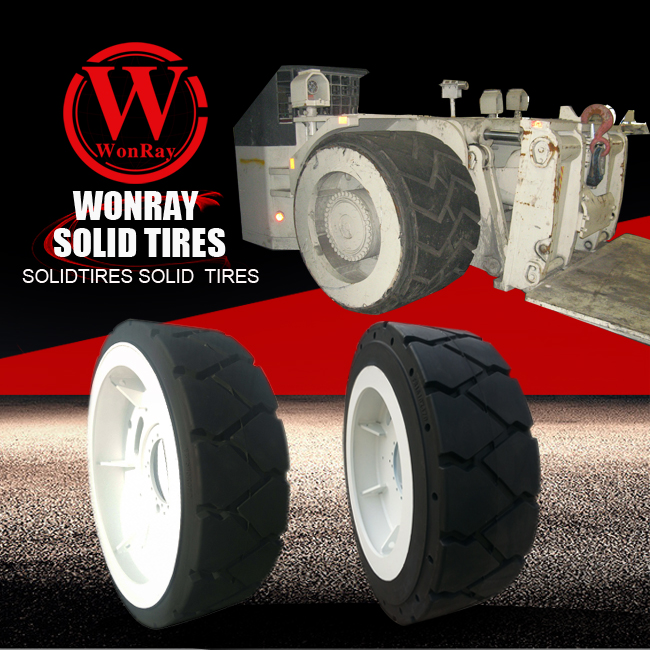
Product Size and Load Must Be Matched as a System
A useful product specification is more than a tire diameter. WonRay’s press-on range includes multiple sizes and load ratings, and the same nominal diameter may be offered in different widths. For example, the company’s size table includes 16x5x10 1/2, 16x6x10 1/2 and 16x7x10 1/2. The correct choice depends on wheel dimensions, drive or steer position, machine load and operating speed.
For a milling-machine replacement, the most useful information is the existing tire marking, steel-band dimensions, wheel width, machine model, wheel position, axle load, typical work speed and a photograph of the current wear. If the old tire shows chunking, side damage or bond separation, that failure pattern should be included because it helps distinguish a sizing problem from a compound, heat or surface problem.
Where This Product Makes the Most Sense
Press-on Milling Machine Tires are strongest in low-speed, high-load equipment where puncture avoidance, compact wheel height and resistance to abrasive road debris matter more than pneumatic cushioning. Typical use includes milling and road-paving equipment working on firm asphalt or concrete rehabilitation sites. The same press-on product family is also used on electric forklifts, trailers and conveying equipment, but the pattern and size should still be selected for the exact machine rather than transferred from one application to another.
The practical value of the product is therefore clear: it removes air-related failure, provides a rigid load-supporting wheel, resists cuts through a simple solid tread, and can be matched by exact steel-band size and load requirement. For milling work, that is more useful than simply describing a tire as wear resistant.
FAQ
1. What type of WonRay tire is used on some milling machines?
WonRay documents smooth R700 press-on band tires for milling applications and specifically lists 16x6x10 1/2 as a size used on WIRTGEN milling machines.
2. Why use a press-on tire instead of a pneumatic tire?
The press-on solid structure has no air chamber, so punctures do not cause pressure loss. It also provides compact, firm load support for low-speed industrial equipment.
3. Is a smooth tread suitable for wet milling sites?
Not always. Smooth tread offers low rolling and steering resistance, but wet traction is weaker than patterned tread. The surface condition should be confirmed before matching.
4. What information is needed to match a replacement tire?
Provide the tire and steel-band size, machine model, wheel position, load, work speed, surface condition and photographs of the existing tire and wear pattern.
Post time: 11-08-2026