
Loader Tires are a critical product category for machines that lift, push, carry and transfer heavy materials across yards, construction zones, recycling sites, ports and industrial facilities. A loader places concentrated weight on its tires while also exposing them to impact, turning force, sharp debris and uneven surfaces. For this reason, Loader Tires must provide more than basic rolling. They need stable load support, useful traction, resistance to cuts and abrasion, and a structure that can withstand repeated compression during demanding work.
Loader applications vary widely. Some machines spend most of the day on smooth concrete, while others work on gravel, scrap, broken pavement or mixed surfaces. The correct Loader Tires therefore depend on the machine size, load, travel distance, ground condition and puncture risk. Solid loader tires are especially valuable in industrial environments where repeated flats create costly interruptions, while pneumatic or other tire types may still be appropriate when maximum cushioning and flotation are the main priorities.
The Product Must Carry Load and Survive Impact
Loader work combines static load and dynamic force. When the bucket is filled, front axle load increases. When the machine travels over joints, stones or uneven ground, impact travels through the tire. During steering, the tread is also pushed sideways across the surface. A Loader Tire therefore needs enough structural strength to resist excessive deformation while retaining enough resilience to protect the wheel and machine from constant shock.
- High load support during lifting and material transport.
- Resistance to tread cuts, chunking and abrasion on harsh surfaces.
- Traction suitable for concrete, compacted gravel, yards or mixed ground.
- Sidewall and shoulder stability during loaded turns.
- Heat control for repeated travel and long working periods.
Solid Loader Tires and Pneumatic Loader Tires Serve Different Priorities
Solid Loader Tires remove the risk of sudden air loss and are useful where sharp debris, scrap metal, broken pallets or damaged surfaces are common. They also remove routine pressure checks and can provide very stable dimensions under load. These characteristics make them practical for scrap yards, recycling facilities, industrial warehouses, ports and other low-speed environments where equipment availability is more important than maximum ride softness.
Pneumatic Loader Tires, by contrast, use air volume to absorb impact and can provide more cushioning and flotation on soft or uneven ground. They may be better suited to applications where the loader travels faster, covers longer distances or works on loose soil that requires a larger flexible footprint. The product decision should therefore begin with the jobsite. A solid tire solves puncture and maintenance problems, but it is not automatically the best answer for every terrain.
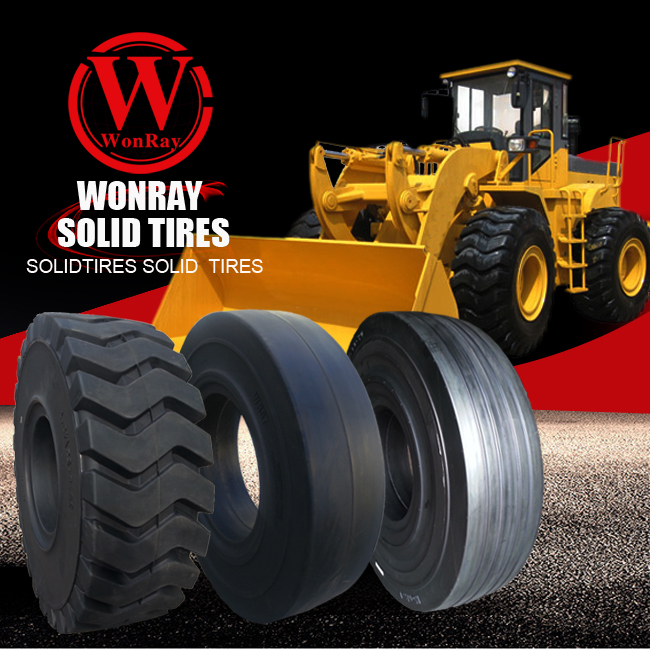
Tread Pattern Should Match the Surface
The tread is the part of the Loader Tire that directly controls contact with the ground. A deep block pattern can create more edges for traction on compacted soil, gravel and mixed yards. On hard concrete, however, very aggressive tread can experience faster block movement and shoulder wear during steering. A broader contact pattern may provide more even wear on prepared industrial surfaces.
The condition of the route also matters. Wet concrete needs reliable contact and water escape. Loose stone requires tread that can engage the surface without trapping excessive debris. Scrap yards add cut risk, so rubber strength and tread thickness become especially important. Loader Tires should therefore be matched to the most demanding normal part of the route, not to a single clean area where the machine occasionally travels.
Common Industrial Applications for Loader Tires
Loaders are used in industries where materials must be moved quickly between storage, processing and transport areas. The tire must support this workflow rather than become a maintenance bottleneck. In recycling plants, loaders move metal, glass, plastic, wood and mixed waste. In ports and logistics yards, they handle bulk material and site maintenance. In construction-material operations, they transport aggregate, sand, stone or packaged products. In manufacturing plants, compact loaders may move raw material or production waste between indoor and outdoor zones.
- Recycling and scrap handling facilities.
- Ports, terminals and industrial storage yards.
- Construction-material, aggregate and building-product sites.
- Factories and heavy workshops with rough internal routes.
- Waste handling, demolition and outdoor maintenance operations.
What Good Loader Tire Wear Should Look Like
A well-matched Loader Tire normally develops gradual and reasonably even wear. Fast wear on one shoulder may point to repeated turning or alignment issues. Missing chunks can result from sharp debris, impact or heat acting on existing cuts. Deep cracks, separation around the base, severe flat spots or large differences between paired tires require closer attention. Inspection should also include the wheel, because rim damage or looseness can create symptoms that appear to be a tire problem.
Choose Loader Tires Around the Work the Machine Actually Does
Loader Tires perform best when product selection reflects the machine’s real work: load, route, surface, travel distance, turning pattern and puncture exposure. Solid loader tires can offer strong value in low-speed industrial conditions where flat prevention and predictable operation matter, while other tire structures may be better where flotation and ride quality dominate.
WonRay’s product range includes loader and OTR solid tire solutions for industrial applications. Matching the product to the actual machine and site remains the most important step for reliable service.
Frequently Asked Questions
1. What are Loader Tires designed to handle?
They are designed for heavy load, impact, abrasion, turning force and traction on industrial or rough working surfaces.
2. When are solid Loader Tires useful?
They are useful in puncture-prone, low-speed industrial sites such as scrap yards, recycling facilities, ports and rough paved yards.
3. How should tread be selected for Loader Tires?
Match tread depth and pattern to the main surface, including concrete, gravel, mixed yards, wet areas or debris-heavy ground.
4. What information is needed before replacing Loader Tires?
Confirm tire size, rim or wheel, axle load, machine model, surface, speed, travel distance, turning frequency and daily working hours.
Post time: 20-08-2026