
Industrial Rubber Tires cover a broad family of tires and wheels used on forklifts, loaders, trailers, access platforms, tow vehicles and other material-handling equipment. They are designed around low-speed industrial duty, repeated loads, frequent turning and hard working surfaces rather than the highway conditions associated with road tires.
Because Industrial Rubber Tires are used on very different machines, the term does not describe one construction. A forklift may use a solid pneumatic tire or cushion tire, an access platform may use a mold-on wheel, and a heavy industrial trailer may use a solid rubber tire on a dedicated rim. The correct form begins with the machine and wheel system.
Industrial Rubber Tires Are a Family of Different Constructions
| Construction | Typical equipment | Main characteristics |
| Solid pneumatic-profile | Forklifts, loaders, industrial vehicles | Solid rubber body, puncture-free operation, compatible rim required |
| Cushion / press-on | Compact forklifts, indoor handling equipment | Low-profile rubber on steel band, pressed onto wheel center |
| Mold-on wheel | AWP equipment, carts, specialized machines | Rubber bonded directly to wheel center |
| Industrial trailer solid tire | Trailers, tow systems, support equipment | Stable load support and no inflation requirement |
These forms differ in overall height, stiffness, wheel interface and cushioning. Selecting Industrial Rubber Tires by outside diameter alone can therefore lead to a mismatch even when the tire appears close in size.
Rubber Compound Determines More Than Wear Rate
Industrial rubber must balance several competing demands. A tread needs enough abrasion resistance for concrete or asphalt, enough toughness to resist tearing, enough friction for the floor and enough resilience to control repeated deformation. Hardness is only one part of that balance.
Some industrial solid tires also use multiple rubber zones. A harder tread region can resist surface wear, a more resilient internal region can absorb part of the deformation, and a stronger base can support the tire on the rim. The exact construction depends on tire type and application.
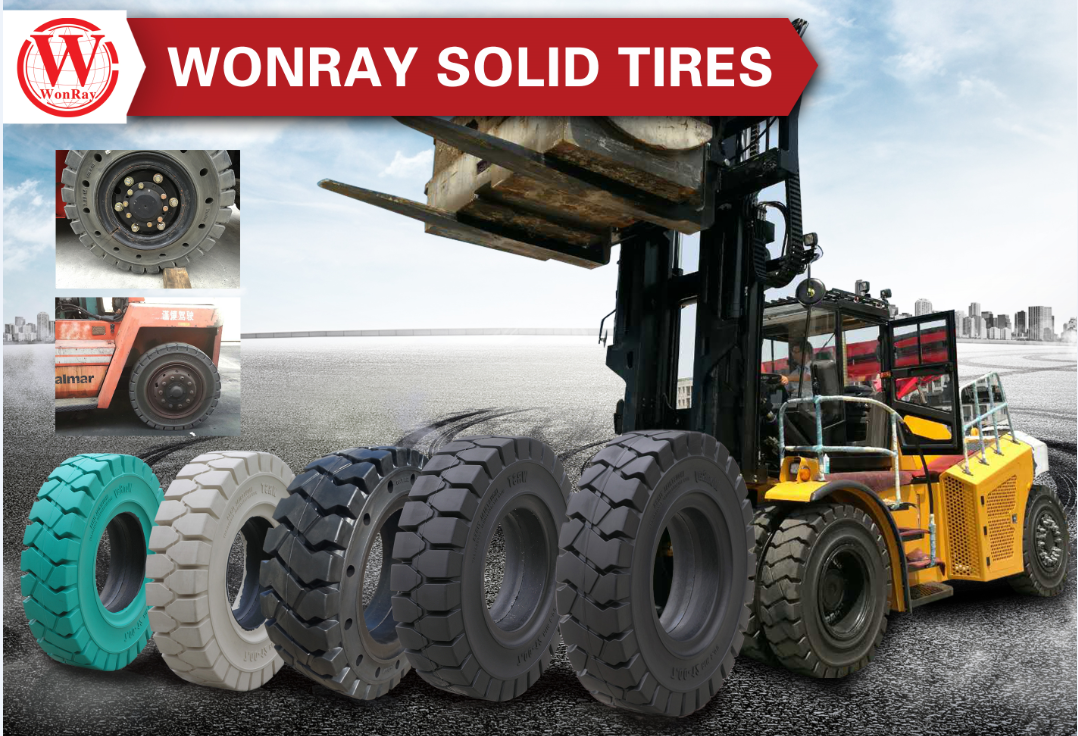
Equipment Type Changes the Main Tire Requirement
• Forklifts need load support, controlled traction and resistance to shoulder scrub during tight turns.
• Skid-steer and compact loaders need strong tread and shoulder resistance because steering creates lateral drag.
• Industrial trailers need stable rolling, load support and resistance to flat spotting during long loaded stops.
• Access platforms need accurate wheel dimensions, floor-friendly compounds and secure hub or bearing fit.
• Tow vehicles need a balance between rolling resistance, traction, heat and repeated cornering.
This is why one Industrial Rubber Tires specification cannot be copied across an entire facility unless the machines use the same wheel system and duty. The operating movement is as important as the tire size.
Tread Pattern Should Follow the Working Surface
Smooth or lightly patterned tread can provide a broad contact area on clean hard floors. More open tread creates additional edges and space for loose material on mixed or outdoor surfaces. Deep aggressive blocks can help on some loose ground but may flex and scrub more during tight turning on concrete.
A useful pattern therefore reflects the dominant surface and movement. Forklifts that spend most of the shift on smooth concrete should not be specified from the same tread priorities as loaders working on crushed stone or debris.
Wheel Fit Is Part of Every Industrial Tire Specification
Industrial Rubber Tires transfer load through a rim, wheel center, hub, bearing or press fit, depending on the construction. Wheel dimensions are therefore as important as the rubber dimensions. Incorrect band fit, wrong rim width, mismatched hub bore or insufficient clearance can create installation and running problems before tread performance is even considered.
• Confirm complete tire size and actual outside diameter.
• Confirm rim, band, hub, bearing or bore dimensions according to construction.
• Check wheel position and available machine clearance.
• Confirm axle load, attachments and the normal carried load.
• Describe the surface and daily movement pattern.
Inspection Should Match the Construction
A solid pneumatic tire should be checked for cuts, chunking, heat cracking and abnormal diameter loss. A press-on tire also requires attention to band seating and wheel-center condition. Mold-on wheels should be inspected around the rubber-to-core bond and bearing or hub area. Different constructions show problems in different places.
Wear should be interpreted before replacement. Repeated shoulder loss points toward turning stress; one-sided wear can indicate alignment or wheel issues; local flat areas can follow braking or long stationary loading. Changing rubber without correcting the underlying condition may reproduce the same pattern.
Industrial Rubber Tires Work Best When Structure and Duty Match
Industrial Rubber Tires should be specified from the complete combination of machine, wheel structure, load, speed, route and surface. The name identifies a broad industrial tire family, while the actual construction decides how the tire mounts, carries load, absorbs shock and wears.
WonRay supplies solid tires, cushion tires, mold-on wheels and related industrial wheel assemblies for different equipment categories. Correct matching begins with the existing wheel system and then adjusts tread, compound and construction to the real duty cycle.
Frequently Asked Questions
1. Are all Industrial Rubber Tires solid?
No. Industrial rubber tire categories include solid, cushion, mold-on and pneumatic forms depending on the machine and wheel system.
2. Why is wheel information necessary?
The tire transfers load through a rim, band, hub or bearing interface. Correct dimensions are essential for installation and running stability.
3. How should tread be selected?
Use the dominant surface and turning pattern. Smooth hard floors and loose outdoor surfaces normally need different tread priorities.
4. What causes uneven wear on industrial tires?
Turning scrub, alignment, load distribution, braking, wheel condition, heat and surface differences can all create uneven wear.
Post time: 28-08-2026