
Wheel Loader Tires directly affect how efficiently a wheel loader handles loading, carrying, reversing, turning, and repeated movement around a jobsite. Unlike tires used on smaller industrial vehicles, wheel loader tires must support heavy equipment while dealing with changing loads, traction demands, and different ground conditions. Choosing a tire only according to its size can therefore result in an unsuitable solution.
A better selection process considers the working surface, material being handled, machine weight, travel distance, loading cycle, turning frequency, and expected service requirements. A wheel loader operating in a quarry may have very different tire requirements from one working in a recycling yard, construction site, or industrial facility.
Why Wheel Loader Tire Selection Matters
Wheel loaders normally operate through repeated working cycles. The machine approaches a material pile, loads the bucket, reverses, turns, transports the material, unloads, and returns for another cycle. During this process, the tires experience repeated acceleration, braking, steering, and changes in load.
When the bucket enters a pile, the tires must maintain sufficient contact with the ground while the machine applies force to the material. During loaded turns, the tires also experience additional lateral forces. If the tire is not suitable for the application, excessive wheel spin, irregular wear, or premature damage may occur.
For this reason, Wheel Loader Tires should be selected according to the complete working environment rather than simply matching the tire size to the machine.
Start With the Working Surface
The ground condition is one of the most important factors in tire selection. A loader working mainly on concrete or paved surfaces faces different requirements from a machine operating on gravel, compacted soil, broken rock, or construction debris.
Quarries and aggregate sites can expose tires to sharp stones, repeated impacts, and abrasive materials. Construction sites may combine several different surfaces during the same working day. Industrial yards may provide relatively firm ground but involve frequent turning and short-distance movement.
The key question is therefore not only whether a tire fits the wheel loader, but whether its construction and tread are suitable for the surface where the machine actually operates.
Consider the Loading Cycle
The way a loader works can influence tire wear as much as the ground itself. Machines that repeatedly enter material piles may experience more wheel spin and high traction demand. Machines working in confined areas may also make frequent short-radius turns, creating additional forces on the tires.
Before selecting replacement Wheel Loader Tires, consider how often the machine enters piles, how far it travels during each cycle, how frequently it turns under load, whether wheel spin occurs, and how many hours it operates each day.
These factors help determine whether the existing tire configuration is appropriate or whether a different construction or tread pattern should be considered.
Choose the Tread for the Application
Tread design affects traction, stability, rolling behavior, and interaction with the ground. A tire used on loose or uneven surfaces may require a tread pattern that provides sufficient traction, while a machine working mainly on firm surfaces may require a different balance between traction and rolling performance.
An aggressive tread is not automatically the best option. If a loader spends most of its time on hard surfaces, an unsuitable tread can influence wear and operating characteristics. Conversely, a tire designed primarily for smooth surfaces may not provide the required performance on loose aggregate or rough terrain.
The correct tread should therefore be determined by the actual operating surface and working cycle.
Tire Construction and Operating Conditions
Rubber construction and tire structure also influence performance. Load, operating speed, temperature, surface condition, and working time can all affect how a tire behaves.
A loader working continuously for long cycles may experience different operating conditions from a machine performing short movements with frequent stops. Similarly, abrasive material can create a different wear pattern from clean concrete or asphalt.
This is why tire selection should not depend on one specification alone. Tire dimensions, construction, tread design, wheel compatibility, load requirements, and application conditions should be considered together.
When Should Solid Wheel Loader Tires Be Considered?
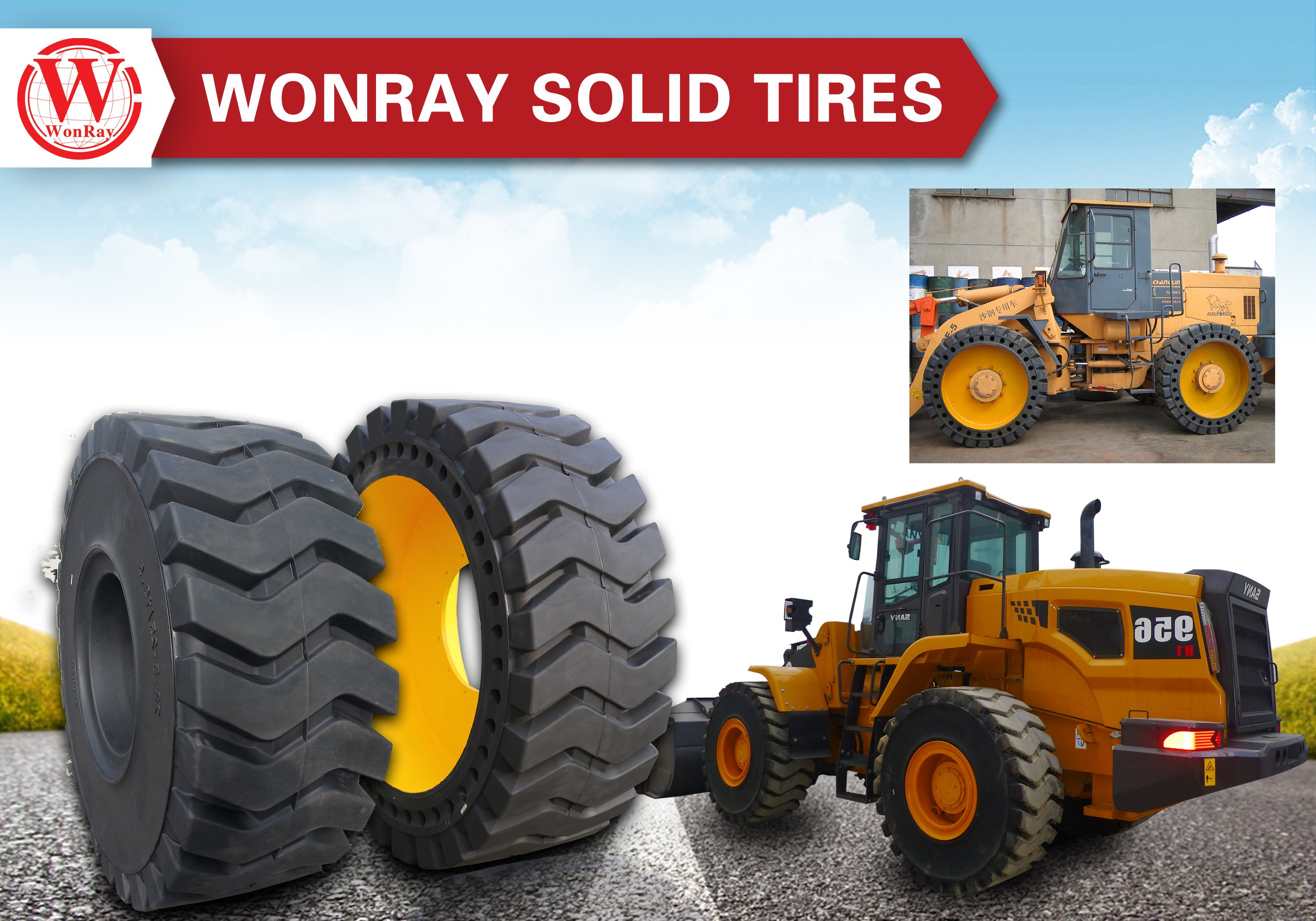
Solid tires can be considered for certain industrial and demanding applications where avoiding air-pressure-related problems is important. Because solid tires do not depend on maintaining pneumatic pressure during operation, they can provide an alternative where puncture-related interruptions are a concern.
However, solid tires are not automatically suitable for every wheel loader. Machine configuration, wheel system, operating speed, load, surface condition, and expected ride characteristics should all be evaluated before making a change from pneumatic to solid construction.
The objective should be to match the tire construction to the actual application rather than assuming that one tire type works for every operating environment.
Common Wheel Loader Applications
Different wheel loader applications create different tire requirements.
Quarries and aggregate operations may involve sharp materials, rough surfaces, repeated impacts, and demanding loading cycles.
Construction sites often require a balanced solution because ground conditions can change throughout the day. Traction and durability may both be important.
Recycling and waste-handling facilities can expose tires to irregular debris and materials that may cause additional damage.
Industrial yards may have relatively controlled surfaces but involve frequent loading, unloading, reversing, and turning. In these environments, wear caused by repeated maneuvering can become an important consideration.
Understanding the actual application makes it easier to select a tire that fits both the machine and its working environment.
A Practical Wheel Loader Tire Selection Checklist
Before ordering replacement Wheel Loader Tires, check:
- Tire size and wheel configuration
- Machine model and operating conditions
- Primary working surface
- Typical load and loading cycle
- Travel distance and operating speed
- Frequency of turning and reversing
- Wheel spin during loading
- Existing tire wear and damage pattern
- Required tread characteristics
- Compatibility between tire and wheel assembly
Inspecting the existing tire can also provide useful information. Uneven wear, localized damage, or excessive tread loss may indicate that the current tire configuration does not fully match the application.
Wheel Loader Tire Solutions From WonRay
WonRay provides solid tire products for industrial and off-road applications, including wheel loader-related solutions. When evaluating a Wheel Loader Tires requirement, tire dimensions are only one part of the matching process.
Providing the machine model, current tire size, wheel configuration, working surface, operating conditions, and expected load can help determine a suitable product configuration. Photos of the existing tire and wheel can also be useful when confirming replacement requirements.
Conclusion
Choosing Wheel Loader Tires should begin with the working environment rather than the catalog. Surface condition, loading cycle, machine weight, travel pattern, turning frequency, tread requirements, and tire construction can all affect tire performance.
A tire suitable for a quarry may not be the best match for an industrial yard, while a configuration designed for firm surfaces may not be appropriate for rough aggregate. Matching the tire to the real application can help reduce unnecessary wear and improve the reliability of the machine’s daily operation.
FAQ
1. How do I choose the right Wheel Loader Tires?
Start by confirming the tire size and wheel configuration, then evaluate the machine’s load, working surface, operating speed, loading cycle, and turning frequency. The tire should be selected according to the complete application rather than size alone.
2. Are solid tires suitable for wheel loaders?
Solid tires can be considered for certain demanding industrial applications where puncture-related interruptions are a concern. However, suitability depends on the wheel loader, wheel system, load, speed, ground conditions, and operating requirements.
3. Do different working surfaces require different Wheel Loader Tires?
Yes. Quarry, construction, recycling, aggregate, and industrial-yard applications can create different demands on the tire. Tread design and tire construction should be matched to the actual working surface and operating cycle.
4. What information should I provide when looking for replacement Wheel Loader Tires?
Useful information includes the machine model, existing tire size, wheel configuration, operating surface, typical load, working conditions, and photos of the current tire and wheel. These details can make replacement matching more accurate.
Post time: 28-09-2026